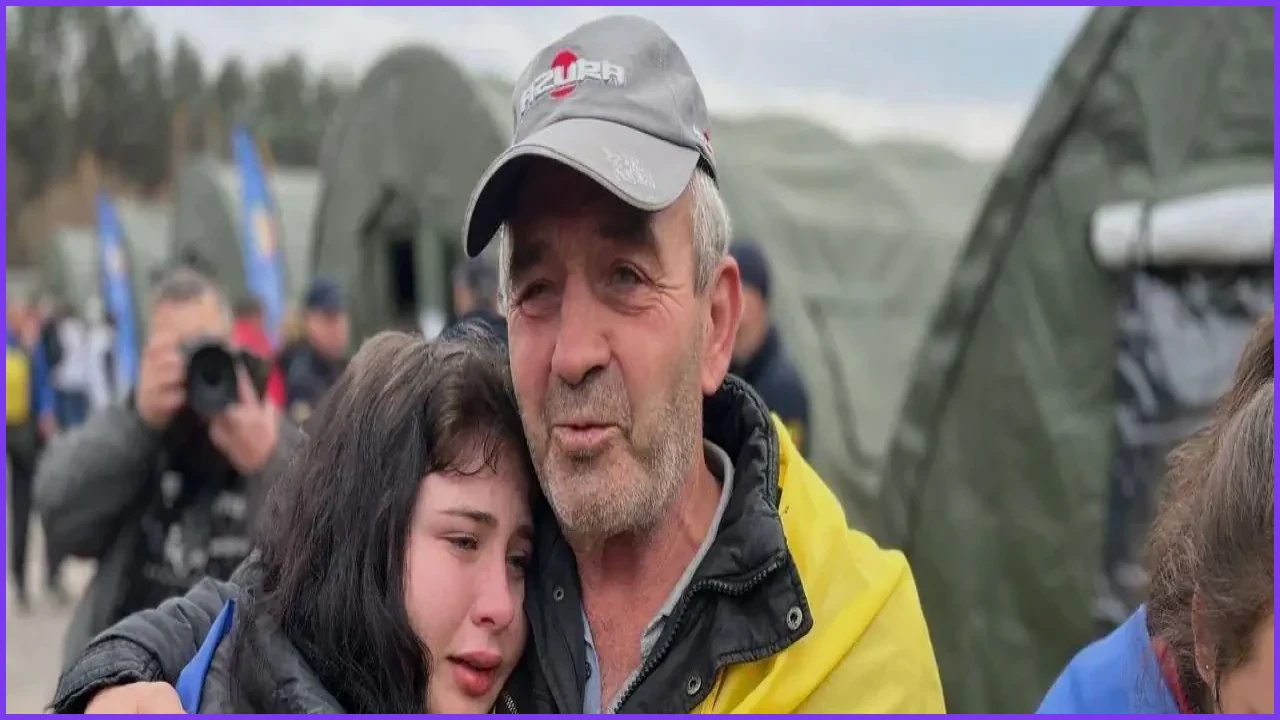
For residents of the front-line city of Oleshky, the past few years of Russian occupation have been defined by a single word: "Horror." On Saturday, hundreds of these residents arrived at a military facility in the Ukrainian region of Chernihiv, marking the end of a perilous journey that took them through Russian-occupied territory, southern Russia, and finally Belarus.
Among the arrivals were Olha and her husband Viacheslav, who disembarked from a coach with their adult children and their dog. Describing the relief of reaching safety, Viacheslav told reporters, "We came back from hell."
Oleshky has been under Russian control since the initial days of the full-scale invasion in February 2022, trapped between the Dnipro River and Russian forces. The conditions inside the city were dire, with residents living under constant threat of drone attacks and missile strikes.
Olha and Viacheslav, who lived in the city with their son and daughter, explained that they had long feared that attempting to flee would be even more dangerous than staying, due to the prevalence of mined routes and the risk of being targeted by drones.
As food supplies dwindled, some residents were forced to forage for survival. Olha recounted the extreme measures taken by those desperate for food, noting, "People were stepping on mines, dying and being maimed, all just to survive." Those who remained too fearful to venture out were often forced to cook garden weeds to stay alive.
The opportunity to escape finally arrived this week when a humanitarian ceasefire, brokered by US First Lady Melania Trump, took effect in the Kherson region. This truce provided the first period of peace in the area in four years, allowing for a four-hour window on Friday for residents to depart.
A convoy of 25 buses was deployed to transport up to 750 evacuees, accompanied by ambulances for those with limited mobility. It is estimated that up to 6,000 people, including 200 children, had been living in Oleshky and its surrounding areas, with 1,700 remaining inside the city itself.
Upon their arrival in Chernihiv, the scene was one of emotional reunions. Some elderly residents were so weak from their ordeal that they had to be carried off the buses on stretchers. Mykhailo Palii, another evacuee, was met on the tarmac by his daughters, Dasha and Anya, who had feared they would never see him again.
Palii shared that he had kept the true extent of the danger from his family to spare them worry, even as his own home suffered damage. "A hole was blown into the bathroom," he said. "There were drone attacks and missile strikes. It happened, but I didn't tell them about it because I knew they would worry."
Other survivors, such as Tetiana and Volodymyr, arrived carrying their cat. They had been living in an abandoned neighbor's house for three years after their own home was burned down. For them, the decision to leave was straightforward, as they had no remaining family in the city.
While the evacuees are now safe, they remain deeply concerned for those left behind. "There are still a lot of people left there, living under those conditions," Olha said.
As they look toward the future, the evacuees face the challenge of rebuilding their lives. Palii expressed a readiness to work in any capacity, from construction to demolition, to support his family.
Olha, who has no relatives elsewhere in Ukraine, plans to stay with acquaintances while she and her family find their footing. "If we managed to survive in hell, we'll survive here too," she said.
Warning: This story contains graphic content.
Palii said he would look for a job so he can provide for his family: "There's no job I can't handle. Digging, hoeing, planting, building. I can even do demolition work."
Related Articles

Mr. Udoy is a professional Web Developer and Blogger with 7+ years of experience in the tech world. He specializes in web architecture and digital storytelling. As the driving force behind worldincidents.com, he focuses on delivering high-quality, well-researched content to a global audience.