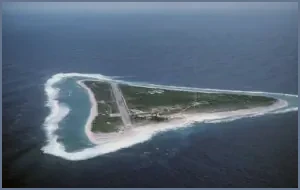
In February 2026, Japan achieved a global first by continuously extracting rare-earth mud from a depth of 6,000 meters in the waters off Minamitorishima, bringing sediment rich in critical minerals aboard a surface vessel. Located roughly 1,200 miles southeast of Tokyo, the remote, uninhabited easternmost island has quickly become the focal point of nationwide excitement. For a country that relies on China for approximately 90 percent of its rare-earth supply and previously suffered from a Chinese export halt in 2010, the milestone was hailed as a decisive turn toward resource self-sufficiency.
Yet behind the technical achievement lies a complex mix of geopolitical positioning, legal strategy, and territorial oversight. As a member of the International Seabed Authority (ISA) operating in the increasingly competitive Asia-Pacific region, Japan is attempting to shape the future rules of deep-sea commercial development. Experts point out that the competition over maritime minerals shares a structure similar to the space race, where nations rush to secure security advantages, establish physical footprints, and plant their symbolic flags before international regulatory frameworks are finalized.
Analysts argue that the driving force behind the urgency around Minamitorishima extends well beyond the raw mineral deposits themselves. Shigeru Tanaka, director of the Asia-Pacific Resource Center (PARC), noted that Japan has resisted pressure from international stakeholders calling for a pause on commercial deep-sea mining until at least 2030. Tanaka suggested the government's primary motivation is to demonstrate active economic use to reinforce legal control over the vast Exclusive Economic Zone (EEZ) surrounding the island under the United Nations Convention on the Law of the Sea.
This strategy mirrors past diplomatic friction over Okinotorishima, a remote reef-islet where China contested Japan's EEZ rights by arguing the location was merely a rock incapable of supporting economic life. Under international maritime law, islands generate broad exclusive economic zones, whereas rocks generate none. Tanaka contended that demonstrating economic activity at Minamitorishima serves to solidify its legal classification and elevate Japan's sovereign claims, even though current deep-sea mining technology remains economically unfeasible.
Minamitorishima is simultaneously becoming the focal point for two other separate national initiatives. The Japanese Ministry of Defense informed Ogasawara Village, which holds local administrative jurisdiction over the island, of plans to initiate missile launch exercises starting next year. Moving operations previously conducted in the United States to domestic jurisdiction, the drills will feature truck-mounted mobile launchers firing missiles with effective ranges between 200 and 300 kilometers.
In March 2026, just one month after the initial rare-earth extraction success, the Ministry of Economy, Trade, and Industry (METI) approached Ogasawara Village to request permission to begin preliminary selection procedures for locating a final high-level radioactive waste disposal facility on the island. The local mayor, Masaaki Shibuya, granted official consent for the initial literature survey in April.
The convergence of rare-earth mining, missile testing drills, and potential nuclear waste storage on a single remote landmass has raised administrative and security concerns. Critics point out that housing defense installations alongside high-level nuclear waste on an isolated island could elevate its profile as a high-value strategic target during conflict. When Ogasawara Village council member Masashi Miyagi questioned METI and the Nuclear Waste Management Organization of Japan (NUMO) regarding security oversight, officials stated that national defense fell outside their legal jurisdiction, exposing a lack of centralized coordination across the three national projects.
Addressing the broader regional implications, Senator William Parkinson of the Guam Legislature expressed concern over the administrative treatment of remote Pacific territories. Parkinson warned that while Minamitorishima is uninhabited and administratively convenient for Tokyo, it remains ecologically connected to the broader Pacific ocean environment and surrounding island communities.
Geopolitical maneuvering around the island expanded further in March 2026, when a bilateral summit between Japan and the United States yielded an agreement on joint rare-earth development off Minamitorishima. The agreement emerged alongside reports of increased exploration by Chinese state-owned enterprises in international waters directly bordering Japan's EEZ. However, key domestic scientific figures were caught off guard. Hiroyuki Yamamoto of the Japan Agency for Marine-Earth Science and Technology (JAMSTEC) revealed during an April interview that he first learned of the joint project through news reports and characterized the sudden announcement as primarily a political stunt.
Tanaka emphasized that if Tokyo were solely focused on resource acquisition, alternative options exist, such as securing formal ISA exploration licenses or lodging diplomatic objections to Chinese activity through the ISA Council. He emphasized that Chinese exploration vessels operate legally in high seas international waters without possessing a monopoly.
Tom Hale, a researcher specializing in critical mineral supply chains at the University of Delaware, placed Japan's push in the historical context of tensions dating back to the 2010 Senkaku Islands dispute. While METI's 2024 Marine Energy and Mineral Resources Development Plan emphasizes domestic ocean mining to insulate the country from geopolitical risk, Hale observed a paradox. Securitizing supply chains creates an intense political urgency that accelerates timelines beyond scientific consensus, reducing the opportunity to pursue diplomatic resolution, international cooperation, and risk de-escalation.
“The rare earth and nuclear waste issues have been presented to us as completely separate matters. Based on the explanations we’ve heard for each, I believe they are entirely distinct,” said Shibuya.
Washington and Tokyo Aim to Curb China. Will It work?
Related Articles

Md. Kazi Bijoy is a dedicated tech enthusiast and content creator with a passion for digital innovation. With years of experience in the tech industry, he specializes in breaking down complex topics into easy-to-understand guides. When he isn’t writing, he explores the latest gadgets and researches emerging trends in the digital world.