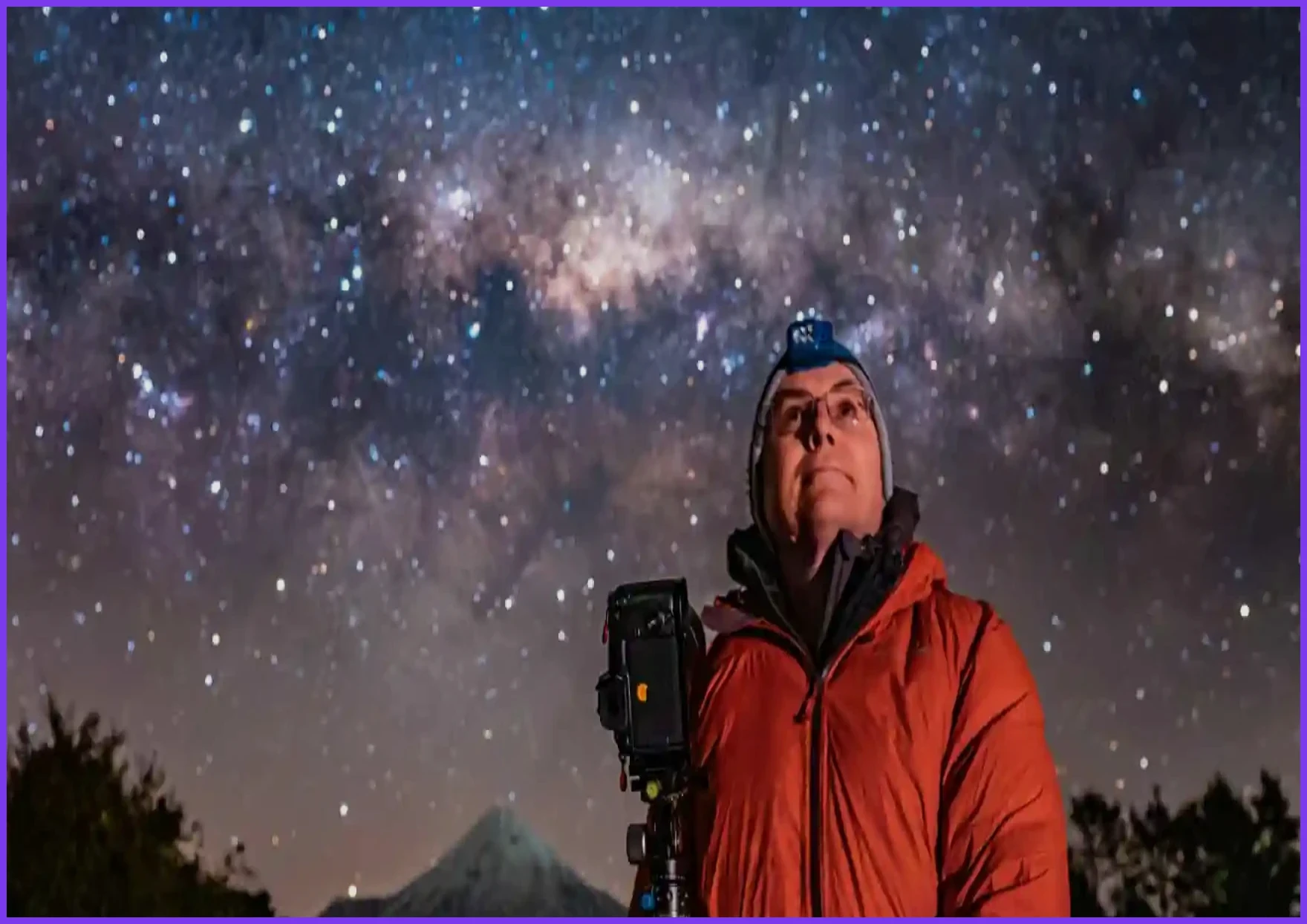
A spectacular photograph capturing thousands of satellite trails forming a dense grid across the night sky above Mount Taranaki in New Zealand's North Island has accumulated tens of millions of views online, leaving its creator defending the image against claims that it was generated by artificial intelligence.
The photo was captured by 51-year-old astrophotographer Brendan Larsen, who spent two hours one night in September photographing the night sky above the mountain. Larsen configured his camera to shoot an unlimited sequence of eight-second exposures with two-second intervals between frames. "I left her running for two hours and captured 578 photos … That was the easy part," Larsen explained.
The primary challenge came during post-production, where Larsen spent approximately 40 hours layering the individual shots using Adobe Photoshop. Each frame contained about 25 satellites, requiring him to painstakingly erase background stars to reveal the continuous orbital tracks. "I could start to see the pattern emerging and realised: ‘Wow, this looks really awesome.’ I knew if I carried on it would look even better and more impressive in terms of satellite numbers," he said. The completed composite shows the sky inundated with roughly 1,400 satellites and 14,000 light trails crisscrossing above Mount Taranaki.
When Larsen published the final image to his social media accounts in mid-October, it rapidly went viral, bringing him 15,000 new followers, tens of millions of views, and thousands of comments. However, a portion of viewers dismissed the artwork as synthetic AI. Larsen noted that he understands why people are skeptical: "AI generating software is becoming so good it is becoming difficult to tell AI images from real images … especially if you’re not familiar with the location or with astrophotography." Nevertheless, he described the accusations as frustrating, adding that it is equally exasperating to see his work stolen, downloaded, and recreated by AI tools with obvious visual flaws.
Anticipating backlash and AI claims, Larsen recorded video of his step-by-step editing process, hoping it would establish authenticity while allowing viewers to build an emotional connection with the landscape. Growing up in rural New Zealand, Larsen recalled being "absolutely blown away" by the star-filled skies of his childhood. But over his six years of photographing the night sky, he has documented a clear rise in light pollution and orbital objects. "It’s interesting and fascinating seeing satellites, but it’s also disturbing," he stated.
Public feedback on his work has reflected broad concern over orbital overcrowding. "I’ve got about 10,000 comments on my Facebook page … nine out of 10 of the comments are like: ‘Wow, beautiful photo, but horrifying, terrifying and really concerning about what’s happening to the night sky,’" Larsen shared. Currently, around 16,000 operational satellites circle Earth, along with tens of thousands of retired spacecraft, spent rocket stages, and payload breakup debris. Recent scientific studies have cautioned that metal particles from rocket launches and satellite reentries could alter atmospheric chemistry and harm the ozone layer, while the United Nations has warned that escalating space activity threatens astronomy, darkness, and ground safety.
While satellites do not yet visually dominate the sky to the naked eye, Larsen remains concerned about the future of night-sky visibility. He hopes his image sparks meaningful public debate over the responsible use of satellites, saying, "We can raise awareness, and through that get a groundswell of support for protecting the night sky."
Related Articles

Md. Kazi Bijoy is a dedicated tech enthusiast and content creator with a passion for digital innovation. With years of experience in the tech industry, he specializes in breaking down complex topics into easy-to-understand guides. When he isn’t writing, he explores the latest gadgets and researches emerging trends in the digital world.