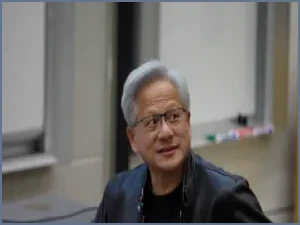
The resignation of Nvidia co-founder and former chief executive officer Jensen Huang has ignited intense debate across Chinese-language media and digital platforms, where commentators increasingly view his exit as a casualty of ethnic prejudice and rising geopolitical rivalry between the United States and China over artificial intelligence and advanced semiconductors. Huang, who was born in Taiwan and raised in the United States before building Nvidia into one of the world's most dominant AI chipmakers—notably appearing at a Stanford University fireside chat on April 30, 2026—is being portrayed by Chinese analysts not merely as an executive facing corporate scrutiny, but as a symbolic casualty for the broader Chinese American community.
The controversy follows allegations surrounding Huang's extramarital affairs, including claims that one of the women involved had ties to Chinese intelligence operations. As details emerged, American news coverage and social media reactions drew sharp criticism for invoking racial and gender stereotypes. The New York Post published the headline "HUANG HUANG BANG BANG," while The Economist published a pun reading "Two Huangs Don't Make a Right." These headlines prompted formal criticism from the Asian American Journalists Association (AAJA). Online, explicit mockery intensified, including a circulated photograph of an Asian woman captioned "How your Chinese gf looks at you before asking for state secrets," alongside posts compiling photographs of Chinese partners of prominent American technology executives to suggest inherent suspicion. In response, Chinese media outlets published articles with headlines such as "Why Has the Siege of Nvidia Turned into a Racial Witch Hunt?"
Within Chinese-language digital outlets, CollegeDaily—a commercial media platform popular among overseas Chinese students—characterized Huang’s departure as "a tragedy for millions of Chinese Americans." Prominent media voices and commentators largely set aside issues of personal misconduct, corporate oversight, and national security in favor of claims that the American political establishment engineered Huang's removal. Hu Xijin, former editor-in-chief of the Global Times, publicly speculated on X that U.S. intelligence agencies leaked damaging material to The New York Times to trigger media exposure and market pressure that forced Nvidia’s board to act. Hu characterized the event as "almost a 'coup' aimed at driving a Chinese founder out of America's most important high-tech company" and warned that it would "have a profound impact on the situation of Chinese people in the United States." He further asserted, "If even Jensen Huang can be driven out so casually, then removing a Chinese person from some other, less prominent position would require even less hesitation."
Academic and public commentary in China reinforced the narrative of systemic exclusion. Rao Yi, a prominent scientist at Peking University, published an essay on his WeChat public account titled "The Jensen Huang Affair Proves That Every Overseas Chinese Experiences Racial Discrimination." Rao's piece focused on perceived discrimination against Huang as well as assumptions surrounding Alice Huang, a Chinese business executive with whom Jensen Huang is believed to have had a romantic relationship. Meanwhile, participants in Canadian Chinese-language WeChat forums questioned why other American corporate leaders involved in personal scandals did not experience similar outcomes, while expressing concern over whether Huang's children, who work at Nvidia, might face pressure to leave the company.
These reactions reflect growing skepticism over whether high-level corporate achievement can shield individuals of Chinese heritage from racial exclusion in the U.S. Despite amassing immense wealth, directing a crucial global technology firm, and maintaining direct communication with U.S. political figures, including President Donald Trump, Huang was framed by commentators as fundamentally vulnerable. TechFlow, a Chinese technology and investment publication, summarized his predicament by stating, "He has the chips, but not the microphone," contrasting Huang’s influence with media-owning magnates such as Elon Musk, Jeff Bezos, and Rupert Murdoch.
On social media forums, commentators used harsher comparisons, circulating the phrase, "The law doesn't reach Epstein's island, but respect doesn't extend to bananas." The statement juxtaposed the perceived legal impunity of figures linked to the Jeffrey Epstein child sex abuse scandal against the perceived precariousness of assimilated Chinese Americans, who are sometimes derogatorily called "bananas."
Other Chinese-language publications argued that broader institutional forces orchestrated Huang's fall. Jinse Finance, a blockchain and cryptocurrency news site, published an analysis mapping ten entities allegedly involved in forcing Huang out, including mainstream news organizations, the U.S. Congress, Wall Street, intelligence services, competing tech firms, and Nvidia insiders. Jinse Finance alleged that artificial intelligence firm Anthropic served as the main instigator, claiming it exploited anti-Chinese sentiment in Washington out of corporate rivalry.
Cultural commentary in the U.S. also stirred backlash online. Indian American author Anand Giridharadas penned a satirical essay in The New York Times referencing Huang's signature fashion titled "Jensen Huang Betrayed the Leather Jacket Community." Although framed around apparel, the piece was interpreted by some readers as mocking the racial undertones of the fallout. After The New York Times published a Chinese translation of the article, a user on an anonymous Peking University forum accused the translation's editors of displaying "the zeal of converts," implying that publishing critical coverage of a prominent Chinese American executive betrayed the ethnic Chinese community.
The framing of Huang as an ethnic victim coincided with the spread of online conspiracy theories. Analysts noted that some commentators highlighting racial bias against Huang simultaneously shared translated screenshots of English-language social media posts containing antisemitic claims. These posts highlighted the Jewish heritage of several American AI leaders to allege secret industry control, or pointed to the Israeli background of potential Nvidia leadership candidates to claim a Zionist takeover of artificial intelligence, with such content widely reshared across Chinese-language WeChat groups in Canada.
You have reached the limit of 3 free articles this month.
Related Articles

Md. Kazi Bijoy is a dedicated tech enthusiast and content creator with a passion for digital innovation. With years of experience in the tech industry, he specializes in breaking down complex topics into easy-to-understand guides. When he isn’t writing, he explores the latest gadgets and researches emerging trends in the digital world.