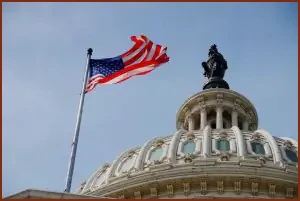
When the newly elected Democratic majorities in the Senate and House of Representatives are sworn in on January 3, 2027, the shift in legislative power is expected to significantly alter U.S. foreign policy across the Asia-Pacific. While President Donald Trump retains executive authority over foreign and military affairs under the U.S. Constitution, Congress holds substantial constitutional powers that the incoming Democratic majorities plan to exercise to constrain White House strategy.
The Trump administration's broader approach toward the Asia-Pacific has largely functioned as a secondary focus behind its bilateral confrontation with China, an ideological commitment to tariffs, and criticism of partner nations for allegedly free-riding on American security guarantees, military expenditures, and open market access. Critics argue this policy has alienated leadership and populations among key allies while degrading American hard and soft power without successfully checking Chinese influence.
Following widespread midterm election losses and low approval ratings for the administration, Trump is expected to struggle to maintain strict party-line Republican support. The eroded cohesion among GOP members limits the president's ability to count on veto power to block legislative overrides. Consequently, Congress is positioned to consider statutory limits on executive military action through the War Powers Act and seek to reclaim authority over trade tariffs delegated to the presidency under the Constitution.
Budgetary power represents an immediate channel of congressional leverage. Because both chambers must authorize federal spending, lawmakers can attach binding conditions to funding bills to block specific executive initiatives or reverse policy decisions. Historically, when President Barack Obama indicated plans to close the Guantanamo Bay detention facility, Congressional Republicans inserted a measure into a major defense bill prohibiting the use of funds for that purpose despite executive opposition. The incoming majority is anticipated to scale up the use of spending restrictions to reshape executive policy.
Leverage will also be asserted through the Senate's authority over treaties, judicial choices, and foreign diplomatic appointments. Over 150 presidential nominees remained awaiting Senate confirmation or action as of the November election. The inability to fill these positions threatens White House diplomatic goals and alters the posture of American diplomacy. Simultaneously, Democratic control of congressional committees provides full authority to launch formal oversight investigations into financial management, administrative conduct, and foreign policy execution.
Key areas targeted for legislative oversight in the Asia-Pacific include military readiness, trade strategies, security breaches, corruption, Taiwan relations, and the dismantlement of USAID along with the defunct Department of Government Efficiency (DOGE). Furthermore, the House and Senate can pass simple or concurrent non-binding resolutions to formally express congressional sentiment on regional security and trade, creating normative pressure on the White House without requiring presidential approval.
Democratic lawmakers, joined by Republican members less constrained by Trump's political standing, intend to reassert backing for Taiwan and regional allies against a transactional White House posture. In May 2026, ahead of a summit between Trump and Chinese President Xi Jinping, incoming Senate Majority Leader Chuck Schumer warned the administration against selling out Taiwan in exchange for trade or investment commitments. Representative Hakeem Jeffries, the leading contender for Speaker of the House, similarly highlighted the strategic importance of the alliance between the U.S. and South Korea.
Resistance to the administration's policy has also surfaced among Senate Republicans. In February, Senator Mitch McConnell publicly urged an end to the practice of picking trade fights with close allies. With declining executive approval ratings, additional GOP members may break ranks to support traditional party positions upholding regional security partnerships through legislative authorizations and targeted economic support.
Lawmakers from both parties have expressed skepticism toward executive efforts to court leadership in China, North Korea, and Russia at the expense of traditional alliances. Republican senators questioned Trump's invitation to Russian President Vladimir Putin to attend the Group of 20 (G20) summit in Miami in December. During a recent summit in Washington between Trump and Xi, GOP lawmakers pressed the president to confront China over reports of military assistance to Iran and demand concessions on U.S. agricultural exports, while Senator Lisa Murkowski publicly described the 21-gun salute and B-1 bomber flyover arranged for Xi's arrival as over the top and inappropriate.
Regarding economic policy, Congress is preparing to apply political and budgetary pressure to lower or eliminate sweeping tariffs. According to data from the Tax Foundation, existing duties cover roughly 54 percent of goods imported into the United States, including broad tariffs imposed on dozens of nations over alleged forced labor practices without prior individual investigation. Citing consumer hardship and losses across manufacturing and agricultural sectors, Senator Ron Wyden, expected to chair the Senate Finance Committee, confirmed that discussions regarding tariff-mitigation legislation are already underway.
In addition, legislative leaders plan to use spending authority to counter perceptions that the United States is an unreliable international partner. The congressional agenda includes restoring soft power instruments such as USAID and the Voice of America, expanding international cooperation on critical minerals, and recommitting federal funding toward global climate change initiatives to demonstrate that "America First" policies lack majority public backing.
While analysts acknowledge that Trump's past actions suggest he may double down rather than moderate his agenda—with Charles Kupchan of the Council on Foreign Relations observing that U.S. strategy may remain driven by unilateralist, protectionist, neo-imperial, and anti-immigrant impulses—Congress retains the constitutional tools to resume its role as an independent policymaker. Control over federal appropriations, executive nominations, and committee oversight gives the incoming Democratic majority a robust counterweight to redirect U.S. policy in the Asia-Pacific.
Related Articles

Md. Kazi Bijoy is a dedicated tech enthusiast and content creator with a passion for digital innovation. With years of experience in the tech industry, he specializes in breaking down complex topics into easy-to-understand guides. When he isn’t writing, he explores the latest gadgets and researches emerging trends in the digital world.