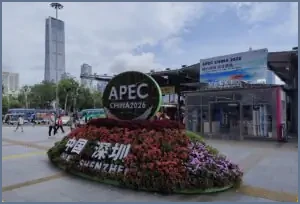
As thousands of international delegates gather in Shenzhen for the APEC Economic Leaders' Meeting on November 18 and 19, 2026, Beijing is utilizing the diplomatic stage to highlight its ambitious regional development blueprint. The host city's streets are adorned with pink bougainvillea—its official flower in full autumn bloom—alongside hundreds of welcoming floral displays and green sculptures. Against this backdrop, Chinese President Xi Jinping, U.S. President Donald Trump, and Russian President Vladimir Putin are set to hold a high-profile trilateral meeting on November 19.
Beyond the summit festivities, Beijing is using Shenzhen as a stage to showcase the Greater Bay Area (GBA), a long-term project aimed at linking nine mainland cities in the Pearl River Delta with Hong Kong and Macao into an interconnected high-tech megapolis. The regional strategy seeks to present China's past industrial growth alongside its ambitions for the nation's next economic phase.
Historically recognized as "the world's factory," the Pearl River Delta rose to economic prominence following China's reform and opening-up policies. Shenzhen was established as one of the country's inaugural Special Economic Zones in 1980, drawing substantial foreign investment and manufacturing operations attracted by lower land and labor costs. Over the decades, early garment and toy workshops gradually gave way to advanced electronics plants, establishing Shenzhen and neighboring Dongguan as global hubs for consumer technology.
Much of this early industrial expansion operated under a "front shop, back factory" arrangement. Hong Kong-based firms provided financing and facilitated access to international markets, while manufacturing operations across the border in Guangdong took on production. Through this setup, Shenzhen transformed from a modest border town into one of China's primary tech and manufacturing centers.
Beijing formalized plans to unify the region's economy with the announcement of the Greater Bay Area development plan in 2019. Rather than building a single mega-city, the strategy establishes a sprawling network of 11 jurisdictions with distinct local governments and specialized economic roles, with the goal of creating an internationally competitive city cluster.
Under this division of responsibilities, Hong Kong serves as the financial and international trade center, while Macao is designated as a tourism hub. Guangzhou, the provincial capital, contributes strengths in commerce and scientific research, while Shenzhen is expected to lead in technological innovation and venture capital. Smaller industrial cities like Dongguan and Foshan maintain crucial roles as manufacturing bases, supported by dense supplier networks.
To tie the regional network together, China has built major "hard connectivity" physical infrastructure projects. High-speed transport lines, including the Guangzhou–Shenzhen–Hong Kong Express Rail Link, have cut travel time between Hong Kong's West Kowloon station and Shenzhen's Futian station to 14 minutes, supporting a broader ambition to establish a one-hour travel circle among the region's core cities.
However, researchers note that "soft connectivity," or legal and regulatory integration, continues to face hurdles. The region spans three separate legal regimes—mainland Chinese law alongside the independent legal systems of the Hong Kong and Macao special administrative regions. Routine business operations, such as transferring personal data between companies in Shenzhen and Hong Kong, require navigating two distinct legal privacy codes, while local municipalities continue to compete with one another for capital and talent.
The integration push has also stirred political concerns in Hong Kong regarding the preservation of the city's autonomy. When the GBA blueprint was introduced in 2019, former Hong Kong legislator Alvin Yeung expressed concern that centralized planning could erode the territory's distinctive status. Public sentiment remains mixed; a 2025 survey by the Chinese University of Hong Kong found that 39.4 percent of respondents viewed the GBA as an opportunity for Hong Kong, while 21.5 percent disagreed and 32.2 percent were undecided, even as Hong Kong's First Five-Year Plan commits the city to deeper integration with the mainland.
Ultimately, Beijing envisions the regional cluster driving China's transition away from low-cost manufacturing toward leadership in advanced technology. Under the nation's 15th Five-Year Plan, strong emphasis is placed on achieving technological self-sufficiency in areas such as semiconductors, artificial intelligence, robotics, and biotechnology, with the goal of creating a global innovation hub that can rival the San Francisco Bay Area.
Selecting Shenzhen as the host city for APEC plays a key role in Beijing's narrative surrounding "the Chinese miracle." When President Xi Jinping announced Shenzhen as the host at the APEC handover ceremony in November 2025, he highlighted its transformation "from a backward fishing village into a modern metropolis," describing it as "a miracle created by the Chinese people in world-development history."
Related Articles

Meet Md. Rubel Rana
As a core contributor to Worlddincidents.com, Rubel Rana brings a unique perspective to the world of journalism. Whether it’s deep-diving into historical trivia or covering the latest global headlines, Rubel Rana is committed to delivering high-quality, high-impact articles. Their writing blends meticulous research with a compelling voice, helping readers stay informed and curious about the world around them.