Polish Prime Minister Donald Tusk declared on Friday that Russian weapons landing inside his country overnight were an intentional provocation directed at NATO. The incident occurred as Russian forces launched one of their heaviest combined air assaults against Ukraine since the full-scale invasion began on February 24, 2022.
Addressing the airspace breach, Tusk confirmed that the weapons landing on Polish soil originated from Russia. He stated that both Polish authorities and foreign partners, including allies within NATO, assess that the landing does not appear to be an accident but rather a deliberate act of provocation.
According to Polish defense officials, three Russian weapons—believed to be two Kh-101 cruise missiles and one jet-powered drone—crossed into southeastern Polish airspace on Friday. The objects landed between 30 and 60 miles inside Polish territory from the Ukrainian border. In response, Poland scrambled fighter jets and activated Patriot anti-missile batteries in the region. No casualties or injuries were reported within Poland.
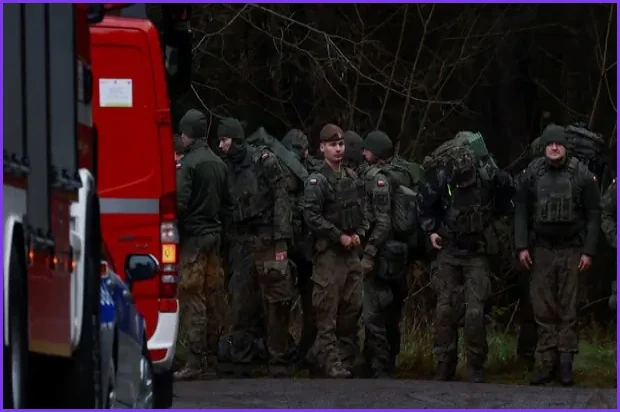
Deputy Prime Minister and Defense Minister Władysław Kosiniak-Kamysz pointed out the timing of the intrusion, noting that thousands of troops from 11 European nations belonging to the Coalition of the Willing were actively conducting major military exercises in Poland to prepare for a potential post-war mission in Ukraine. Kosiniak-Kamysz expressed on social media that it was difficult to view the location and timing of the airspace violation as a coincidence.
The incident triggered an immediate operational response from NATO air defenses. Polish F-16 fighters, Swedish JAS 39 Gripens, and a Dutch A330 Multi Role Tanker Transport aerial refueling aircraft were deployed alongside alerted Allied ground-based air defense units. Under Article 5 of NATO's founding treaty, an armed attack against any single member is considered an attack against all 32 member states.
NATO Secretary General Mark Rutte reported holding consultations with Tusk regarding the severe airspace violations. Rutte emphasized the alliance's unified stance, offering full solidarity with Poland while committing to reinforce collective deterrence and defense capabilities. He condemned Moscow's ongoing war against Kyiv and characterized the airspace intrusion as a dangerous consequence of Russian aggression.
In military channels, NATO's Supreme Allied Commander Europe, U.S. Air Force Gen. Alexus Grynkewich, remained in contact with Polish defense leaders while investigation efforts continued, according to spokesperson Martin O'Donnell.
Across the border, Ukrainian President Volodymyr Zelenskyy reported that Russia fired over 400 drones and 110 missiles, including cluster munitions, in an overnight and early Friday barrage. Ukrainian Prime Minister Serhii Koretskyi confirmed that at least eight people were killed and more than two dozen others were wounded as strikes hit Kyiv and nine other regions.
Ukrainian air defense forces managed to shoot down 79 of the 110 incoming missiles, but failed to intercept any of the 27 ballistic missiles. Zelenskyy attributed the failure to a critical shortage of interceptor munitions, noting that Kyiv has appealed to the Trump administration for months to deliver necessary resupplies, as delays cost civilian lives.
The aerial assault inflicted widespread damage across Ukraine. In the capital, Kyiv, missiles damaged key infrastructure, including bridges, commercial space, office buildings, and a water supply facility. The strike wave hit near the Dutch embassy and caused direct damage to the Austrian embassy, prompting French Foreign Minister Jean-Noel Barrot to request an emergency meeting of the United Nations Security Council and insist that Russia be held accountable.
Additional damage was sustained by a hospital in Kharkiv, commercial properties in the Mykolaiv, Odesa, and Chernihiv regions, and residential areas in Dnipropetrovsk, Vinnytsia, Sumy, Chernihiv, and Lviv in western Ukraine. An official from Ukraine's energy ministry noted that several nuclear power facilities were forced to curtail power generation after energy infrastructure took direct hits.
Zelenskyy described the attack strategy as particularly vile, explaining that Russian forces dispatched missile groups in waves separated by 20 to 30 minutes. The delayed pattern was designed to target emergency responders and complicate rescue operations, fire suppression, and rubble removal. He reiterated demands for concrete international air defense deliveries, urging the U.S. Department of Defense to release stalled shipments.
The military escalation follows a rare 90-minute trilateral meeting in Shenzhen, China, between President Donald Trump, Chinese President Xi Jinping, and Russian President Vladimir Putin. During the Thursday summit, Trump greeted Putin as a friend, but the discussions yielded no major diplomatic breakthroughs. Following the session, Putin explicitly ruled out direct talks with Ukraine, pointing to a recent Ukrainian attack that damaged a strategic bridge connecting Russia to occupied Crimea. Putin had warned on Thursday that Russia would deliver a far more painful response, a threat realized in Friday's heavy bombardments.
"The tactics of the strike this time were particularly vile," Zelenskyy said in his post on social media, noting that there had been "several groups of missiles with pauses of 20-30 minutes to complicate extinguishing the fires, clearing the rubble and recovery."
"A clear response from the world to all this is also needed," he said. "It is important that there are not only statements from partners about supporting Ukraine and Ukrainians, but also the implementation of specific agreements on air defense … We very much hope that the Pentagon will release the supply that we expect."
Related Articles

Md. Kazi Bijoy is a dedicated tech enthusiast and content creator with a passion for digital innovation. With years of experience in the tech industry, he specializes in breaking down complex topics into easy-to-understand guides. When he isn’t writing, he explores the latest gadgets and researches emerging trends in the digital world.