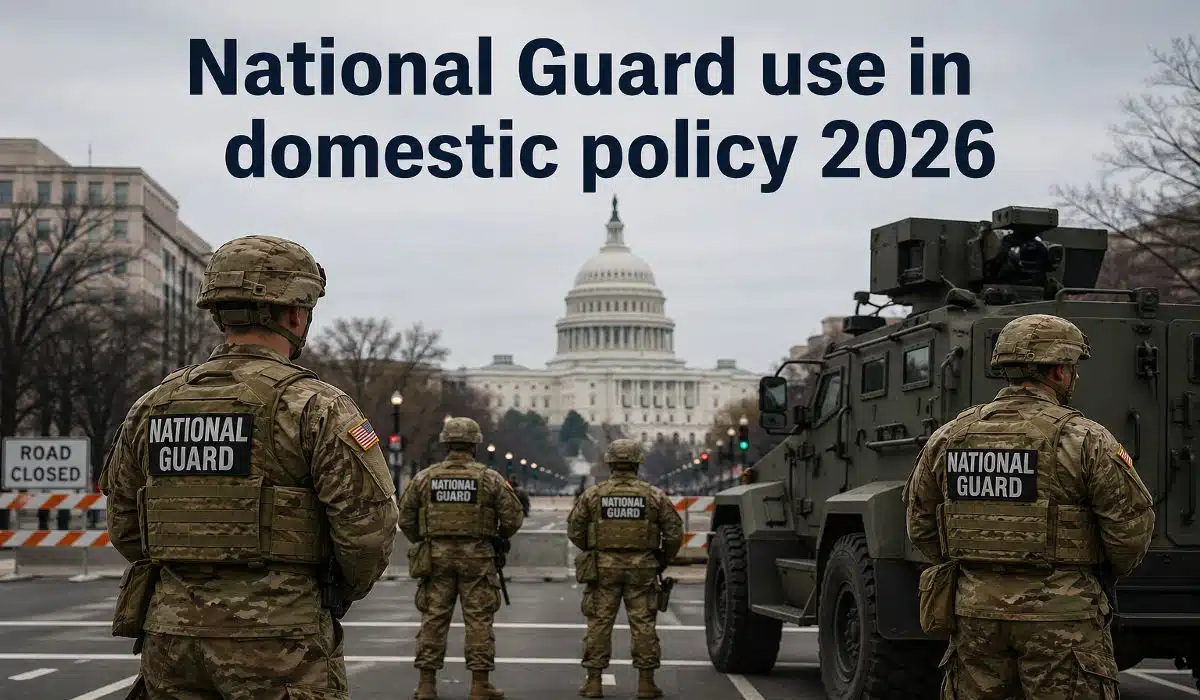
In 2026, the distinction between foreign defense and domestic policy is increasingly blurred. The National Guard use in domestic policy 2026 reflects a strategic “America First” pivot, where the Guard is no longer just a “weekend warrior” force but a primary instrument for maintaining internal sovereignty and public safety.
Homeland Defense as a Foremost Priority
The 2026 National Defense Strategy (NDS) officially designates homeland defense as the Department of War’s (DoW) top priority. This shift has cemented the National Guard use in domestic policy 2026 as a permanent fixture. By invoking the Monroe Doctrine and the “Trump Corollary,” the administration has tasked the National Guard with reasserting dominance in the Western Hemisphere, starting with the physical defense of U.S. soil.
Establishing 100% Operational Control of the Southern Border
Perhaps the most visible aspect of National Guard use in domestic policy 2026 is at the U.S.-Mexico border. Since early 2025, over 18,000 National Guardsmen have been deployed to secure the border. Secretary of War Pete Hegseth recently noted that this deployment has led to the lowest level of border crossings in over 50 years. The Guard’s role here includes:
Perimeter Enforcement: Repelling unlawful mass migration.
Counter-Narcotics: Disrupting the flow of illegal drugs and human trafficking.
Technological Integration: Utilizing advanced counter-drone and surveillance systems.
Urban Deployments and Crime Reduction
A controversial but impactful component of National Guard use in domestic policy 2026 involves deployments to major U.S. cities. Throughout late 2025 and into 2026, units have been mobilized in cities like Washington, D.C., Memphis, and New Orleans. In Washington alone, the deployment has been extended through the end of 2026 to work alongside law enforcement. Data suggests these uniformed presences have contributed to sharp reductions in violent crime in these specific urban hubs.
The “Golden Dome” and Aerospace Defense
For the first time, National Guard use in domestic policy 2026 includes specialized roles in missile defense. Guard units are being integrated into the “Golden Dome” project, a cost-effective missile defense system designed to protect American cities from aerial attacks. This represents a technical leap for the Guard, requiring a higher degree of synchronization with active-duty forces than ever before.
Disaster Response and Resilience
Despite the shift toward security, the traditional National Guard use in domestic policy 2026 for disaster response remains critical. The 2026 National Guard Domestic Operations Conference highlighted that the Guard is now the nation’s “primary domestic response force.” Innovations in 2026 include:
Integrated Rapid Response: Synchronizing plans across all 54 states and territories.
EMAC Agreements: Pre-identifying resources for faster interstate support during wildfires or chemical leaks.
Legal and Constitutional Debates
The expansion of National Guard use in domestic policy 2026 has sparked significant legal discourse. Cases like DC v. Trump have reached the appellate courts, questioning the President’s authority to deploy out-of-area National Guard units without a governor’s consent. These debates center on whether the Guard is being used as a “training ground” for the military or a tool for domestic law enforcement, raising fundamental questions about the Posse Comitatus Act.
The Cost of Domestic Deployment
Maintaining the National Guard use in domestic policy 2026 comes with a significant price tag. The Congressional Budget Office (CBO) estimated that deploying 1,000 personnel to a U.S. city costs between $18 million and $21 million per month. As deployments continue in the District of Columbia and at the border, the debate over the 2026 budget continues to be a hot-button issue in Congress.
Read More: Epic Games Celebration This Weekend Rock 2026
Quelling Civil Disturbances
In late 2025, a landmark executive order directed the creation of specialized National Guard units specifically trained to quell civil disturbances. This aspect of National Guard use in domestic policy 2026 allows the President to deploy these units to states at his discretion. While legal experts at the Brennan Center and NILC have raised concerns about the “authoritarian” potential of these deployments, the administration argues that these units are a necessary tool to restore order when state and local law enforcement are overwhelmed.
Defending Domestic Infrastructure
The National Guard use in domestic policy 2026 extends into the digital realm through the Cyber Shield 2026 exercise. With over 800 Soldiers and Airmen from 42 states participating, this unclassified mission focuses on defending computer networks and responding to cyber incidents within the U.S. This “cyber militia” model ensures that domestic utilities, hospitals, and government systems have a ready-response force to mitigate foreign or domestic hacking threats.
The Federalization of State Missions
A major shift in National Guard use in domestic policy 2026 is the increasing use of federalization. Throughout 2025 and into 2026, the administration federalized Guard units in states like California and Washington D.C. to bypass gubernatorial opposition. This has sparked a “boundaries of authority” debate in the New York Times and other outlets, questioning whether the Guard should serve the President’s national security goals or the specific needs of their home states.
High-Cost Urban Operations
The financial scale of National Guard use in domestic policy 2026 is unprecedented. The Congressional Budget Office (CBO) reported in early 2026 that deployments to cities like Chicago, Portland, and Los Angeles cost nearly $500 million in just six months. While troops were withdrawn from some cities in January 2026, the ongoing deployment to the District of Columbia is estimated to cost over $600 million annually, leading to intense debates in the Senate Homeland Security Committee regarding sustainable funding.
Operation Midnight Hammer and Warfighting Ethos
Secretary of War Pete Hegseth has emphasized that National Guard use in domestic policy 2026 must align with a “warrior ethos.” Missions like Operation Midnight Hammer showcased the Guard’s combat readiness during domestic operations. The administration’s goal is to eliminate “unnecessary mandatory trainings” and empower noncommissioned officers to focus on lethality, even when the Guard is performing domestic security functions.
Wildfire Suppression and “Whole-of-Government” Response
Even as security roles expand, the National Guard use in domestic policy 2026 for environmental crises remains vital. In April 2026, the Georgia National Guard mobilized up to 150 personnel for wildfire suppression efforts following a state of emergency. Utilizing CH-47 Chinook helicopters and Bambi Buckets, the Guard acts as a force multiplier for agencies like GEMA, proving that their dual-mission capability is still essential for domestic disaster resilience.
FAQ
Q1: Can the President deploy the National Guard without a Governor’s permission?
Ans: Under Title 32, Governors typically command the Guard. However, the 2026 legal battle in DC v. Trump explores the President’s ability to “federalize” or use a patchwork of broad laws to deploy units for specific domestic missions.
Q2: How has violent crime changed due to the 2026 deployments?
Ans: According to the Department of War, cities with a uniformed Guard presence, like Memphis and New Orleans, have seen statistically significant drops in violent crime rates compared to early 2025.
Q3: What is the “Trump Corollary” mentioned in the 2026 strategy?
Ans: It is a policy framework that reasserts U.S. military dominance in the Western Hemisphere to prevent external threats from reaching the homeland, heavily involving the National Guard.

Mr. Udoy is a professional Web Developer and Blogger with 7+ years of experience in the tech world. He specializes in web architecture and digital storytelling. As the driving force behind worldincidents.com, he focuses on delivering high-quality, well-researched content to a global audience.