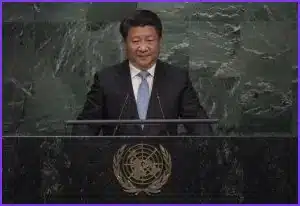
China's dual diplomatic actions in mid-2026 highlight Beijing's evolving strategy for global governance. On June 17, the State Council Information Office published a major white paper titled "More Just and Equitable Global Governance: China’s Principles, Proposals and Actions." Just a month later, on July 16, 29 governments signed the founding agreement of the World Artificial Intelligence Cooperation Organization (WAICO) in Shanghai. Together, these events illustrate a sophisticated strategy: instead of attempting to overthrow the post-World War II international order, Beijing is working to reshape it from within. By emphasizing the centrality of the United Nations while creating new, Beijing-led institutions, China is reinterpreting existing international norms to prioritize state sovereignty, noninterference, and state-led development over independent external scrutiny and individual rights claims.
The June white paper explicitly states that countries should uphold the UN-centered international system and order based on international law rather than "reinventing the wheel." This approach reflects what scholars describe as reform without rupture. Rather than viewing China through a simple binary of status quo or revisionist, analysts like Alastair Iain Johnston suggest that China adopts varied stances toward different issue-specific orders. Beijing's current doctrine has been built incrementally. On September 1, 2025, President Xi Jinping launched the Global Governance Initiative (GGI) during the Shanghai Cooperation Organization Plus meeting in Tianjin. The GGI concept paper identified three critical deficits: the underrepresentation of the Global South, weakened international rules, and institutional ineffectiveness in development and emerging technologies like artificial intelligence.
To address these deficits, the GGI proposed five core principles: sovereign equality, the international rule of law, multilateralism, a people-centered approach, and "real results." This framework integrates older Chinese foreign policy concepts, including the Five Principles of Peaceful Coexistence, the "democratization of international relations," and Xi's signature "community with a shared future for humanity." The June 2026 white paper organized these ideas into a "complete action framework" covering development, security, civilization, and governance. This doctrine is being institutionalized through a cumulative, experimental process, establishing routines, coalitions, and organizations where China positions itself as an inevitable guide for global evolution.
A central element of this strategy is the reinterpretation of sovereign equality, a principle deeply rooted in the UN Charter. While Article 2 of the Charter protects sovereign equality and limits intervention in domestic matters, other sections invoke human rights and fundamental freedoms. For many developing nations and former colonies, sovereign equality serves as a vital shield against external coercion and great power privilege. China's concept of "democracy in international relations" utilizes this sentiment to advocate for narrowing the gap between legal equality and actual geopolitical influence, allowing Beijing to position itself as a champion for the Global South. However, China increasingly treats sovereign equality as the primary lens through which all other international norms must be interpreted. The GGI defines it as the "foremost premise" of governance, linking equal international participation to noninterference and the right of each government to choose its own political and development paths, effectively insulating state authority from internal accountability.
This selective interpretation also shapes China's approach to the "international rule of law." While Beijing frequently objects to unilateral sanctions, extraterritorial jurisdiction, and the selective application of rules by Western powers—criticisms that resonate widely—its own compliance with adverse legal rulings remains a key point of contention. A prime example is the 2016 South China Sea arbitration. The tribunal, operating under the UN Convention on the Law of the Sea (UNCLOS), ruled on maritime entitlements and conduct rather than land sovereignty. China rejected the proceedings, and on the ruling's tenth anniversary in 2026, Beijing reiterated that the award was illegal, null, void, and non-binding. However, UNCLOS Annex VII explicitly states that a party's refusal to participate does not halt proceedings and that decisions are final and binding. This highlights a fundamental question: whether international law can truly constrain a major power when a ruling conflicts with its self-defined core interests.
The concept of a "people-centered" approach is also interpreted through a state-centric lens. While the GGI emphasizes peace, development, health, security, and technological inclusion, it treats these primarily as substantive goods delivered by competent governments. This contrasts with the UN Declaration on the Right to Development, which positions the individual as the active participant and central subject of all indivisible human rights. In practice, China seeks to recalibrate human rights governance by prioritizing state sovereignty. During a May 2026 meeting of the Group of Friends, which saw its membership grow from 43 in December 2025 to over 60, Foreign Minister Wang Yi presented nine priorities, including a rejection of "human rights above sovereignty." Research by scholars like Katrin Kinzelbach indicates that Chinese diplomacy focuses on contesting the implementation and monitoring of human rights norms rather than their formal validity. Furthermore, an analysis of over 93,000 Universal Periodic Review recommendations by Xinyuan Dai and Lucie Lu reveals that China has increasingly championed economic and social rights, a preference shared by many developing nations.
Beijing's governance proposals find a receptive audience among many governments due to genuine failures in the existing international system. For instance, Africa represents 28 percent of UN membership but lacks a permanent seat on the Security Council. Additionally, the International Monetary Fund's 16th quota review increased quotas by 50 percent but left relative voting shares unchanged. On climate finance, developed nations missed their annual $100 billion target for two years, only exceeding it in 2022. Although OECD data showed climate finance reached $136.7 billion in 2024, only a quarter supported climate adaptation, and the funds remained concentrated in middle-income countries. While China utilizes these structural gaps to build support, the Global South is not a monolithic bloc; many developing nations welcome Chinese finance and support Security Council reform while simultaneously resisting Chinese maritime claims and maintaining strategic autonomy.
To translate these interpretations into concrete global practices, China employs a strategy of "institutional layering," a term used by scholars Jack Taggart, Han Cheng, and Sebastian Haug to describe embedding new alliances and practices within established frameworks. Beijing utilizes venues such as the Shanghai Cooperation Organization, BRICS, the Group of 77 plus China, and the Group of Friends to build coalitions and prepare agendas. The newly established WAICO, headquartered in China, is a key example of this approach. At its launch in Shanghai, Xi Jinping pledged tangible benefits, including 5,000 AI training opportunities for developing countries, regional cooperation centers, and access for 30 nations to an AI-powered meteorological warning system. By focusing on concrete, localized deliverables, China seeks to expand its influence and set international agendas without bearing the full financial costs of global leadership.
Ultimately, China's vision of global governance will be tested by its willingness to accept reciprocal constraints when compliance is costly. While Beijing advocates for African representation on the Security Council, it has not specified how permanent membership should expand or how its own veto power might be limited. Similarly, its rejection of the South China Sea arbitration challenges its rhetoric on the uniform application of international law. For its "people-centered" model to be credible, individuals and civic groups must have the agency to challenge government actions; otherwise, participation is reduced to intergovernmental consultations and development is equated solely with state performance. To counter China's growing influence, Western powers must also address their own selective legalism, support genuine reforms in international financial institutions, and deliver reliable development and climate finance. The future of global governance will depend not on the survival of the UN Charter, but on who is permitted to interpret its principles and whether major powers will abide by those interpretations when they run contrary to their own interests.
Related Articles

Mr. Udoy is a professional Web Developer and Blogger with 7+ years of experience in the tech world. He specializes in web architecture and digital storytelling. As the driving force behind worldincidents.com, he focuses on delivering high-quality, well-researched content to a global audience.
2 thoughts on “China’s Strategy to Reform Global Governance From Within”