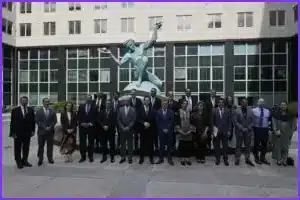
The United States and Pakistan have concluded their fourth annual Counterterrorism Dialogue in Washington, D.C., highlighting a security partnership that has increasingly evolved to address Pakistan's core domestic security concerns alongside American counterterrorism priorities. Held on August 4, 2026, the latest round of talks showcased a more balanced bilateral dynamic compared to earlier sessions that focused primarily on direct threats to U.S. security.
The Pakistani delegation at the talks was headed by Ambassador Nabeel Munir, who serves as the special secretary at the Ministry of Foreign Affairs. Leading the American side was Ambassador Gregory LoGerfo, the U.S. coordinator for counterterrorism. A joint statement issued at the conclusion of the meeting emphasized the shared strategic interests of both nations and their mutual determination to address regional security challenges.
According to the joint statement, "The United States and Pakistan affirmed their joint resolve to confront terrorist organizations that endanger the safety of their citizens and the stability of the region, including ISIS-Khorasan (ISIS-K), al-Qa’ida (AQ), the Tehreek-e-Taliban Pakistan (TTP), and the Balochistan Liberation Army (BLA) and its affiliates." The two countries emphasized that their counterterrorism collaboration is intended "to keep both of their nations safe and secure, and as part of an enduring vision of regional peace, prosperity, and stability."
The institutionalization of this annual bilateral mechanism indicates that counterterrorism remains a crucial pillar of the U.S.-Pakistan relationship, surviving broader geopolitical shifts over the years. Before the dialogue was inaugurated in 2023, security and counterterrorism exchanges between the two nations were routinely subsumed under broader frameworks, such as the U.S.-Pakistan Strategic Dialogue or various Defense Consultative Group sessions. In those larger forums, counterterrorism initiatives often had to compete with broader and sometimes conflicting agendas.
The inaugural session in 2023 was primarily designed to re-establish a structured and formal engagement following the post-2021 regional posture shift caused by the withdrawal of U.S. military forces from Afghanistan. This withdrawal had temporarily slowed the momentum of bilateral security cooperation. Consequently, the 2023 dialogue served to establish a baseline for security contact by focusing broadly on general regional stability, countering violent extremism, and combating terrorism financing.
By the second session in 2024, both delegations began refining the framework's focus, prioritizing the TTP and ISIS-K, also known as the Islamic State Khorasan Province (ISKP), as key regional threats. The joint statement from that year noted that "The United States and Pakistan recognize that a partnership to counter ISIS-Khorasan, TTP, and other terrorist organizations will advance security in the region."
A major turning point occurred during the third round in 2025, when the joint statement formally integrated the Balochistan Liberation Army (BLA) alongside the TTP and ISKP. For Islamabad, securing explicit U.S. recognition of the BLA as a threat within a formal security dialogue was a major diplomatic victory. Following a wave of high-profile, BLA-led militant attacks in Pakistan, Islamabad had consistently pressured Washington to recognize the group's violence as a primary threat requiring bilateral focus.
The fourth round in 2026 further expanded this operational scope by reintroducing al-Qaida into the explicit joint threat environment alongside ISKP, the TTP, the BLA, and its affiliates. From the American perspective, including al-Qaida underscores persistent concerns in Washington regarding core militant networks that continue to operate in the region, particularly out of Afghanistan.
The trajectory of the dialogue over the last four years shows a shift toward a more balanced trade-off. The 2025 and 2026 sessions were not solely focused on threats of concern to the United States; they also featured formal U.S. acknowledgement of Pakistan's internal security challenges, specifically the BLA and the TTP. Moving forward, Pakistan's strategic objective will likely focus on turning these joint statements into concrete, operational support. Islamabad has consistently sought expanded cooperation from the U.S. to dismantle cross-border sanctuaries in Afghanistan and secure official United Nations sanctions against top BLA and TTP leaders. Obtaining tangible U.S. pressure on regional facilitators of BLA and TTP attacks—by disrupting their international funding streams and operational networks—would represent the next key breakthrough for this evolving bilateral partnership.
The institutionalization of this annual bilateral mechanism demonstrates that counterterrorism continues to serve as a crucial pillar of Pakistan-U.S. relations, which has long survived broader geopolitical shifts. Since the dialogue’s inauguration in 2023, the platform has steadily evolved into a structured security partnership.
You have reached the limit of 2 free articles this month.
Related Articles

Mr. Udoy is a professional Web Developer and Blogger with 7+ years of experience in the tech world. He specializes in web architecture and digital storytelling. As the driving force behind worldincidents.com, he focuses on delivering high-quality, well-researched content to a global audience.