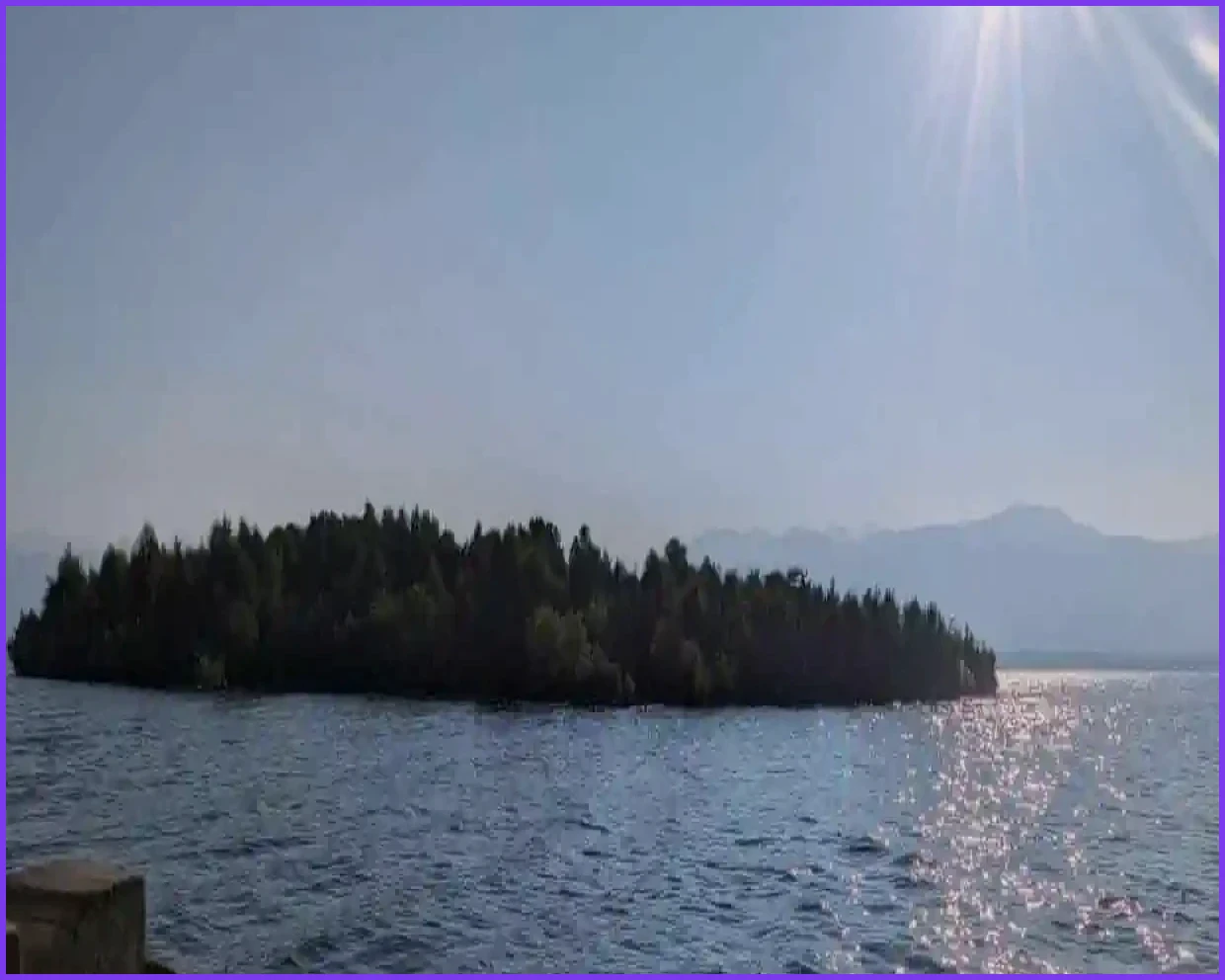
A massive, thickly forested floating island has mystified residents and experts in British Columbia, Canada, after appearing on Williston Lake, vanishing, and then reappearing nearly 20 miles away.
The landmass, which measures approximately 150 meters (500 feet) long and 75 meters (250 feet) wide, was first spotted in August. A local boater captured footage of the unusual sight, showing nearly 100 trees swaying in the lake's choppy waters. Within days of the initial sighting, the island vanished, only to make a sudden second appearance on Monday about 20 miles from its original location.
The phenomenon occurred on Williston Lake, a narrow reservoir created in the early 1970s when the W.A.C. Bennett Dam flooded the region. Covering nearly 1,700 square kilometers (650 square miles), it is the largest body of freshwater in British Columbia. Satellite imagery has since confirmed the island's existence, showing it floating in the main body of the reservoir, roughly 60 miles west of the dam.
Bob Gammer, a spokesperson for BC Hydro—the government-owned utility that operates the reservoir and dam—admitted his initial skepticism. He noted that in the era of artificial intelligence, corroborating eyewitness accounts were necessary to verify the images. Gammer explained that the utility believes the island formed over several years as trees and plants grew undisturbed on woody debris in sheltered shoreline areas. He compared the environment to hydroponics, describing "well-fed trees growing on a decaying food source with lots of water," which allowed them to grow rapidly.
Similar floating landmasses exist globally, such as the famous Forty Acre Bog on Lake Chippewa in Wisconsin, which is bound together by peat, mud, roots, and trees. The British Columbia island, spanning roughly 12,000 square meters (14,000 square yards), has become a thriving mini-ecosystem. It features a mix of coniferous and broadleaf trees, is home to birds and small animals, and likely shelters abundant fish beneath its floating root system. Local residents estimate some of the larger trees could be decades old.
The island's sudden mobility is linked to environmental conditions. Williston Lake is currently at its highest level in 14 years, driven by heavy winter snowpacks and steady summer rainfall that swelled the Peace River and the reservoir. Gammer stated that these conditions created the perfect lift to pull the island from its resting place into open water. When it disappeared, Gammer suggested it had not sunk but likely drifted back to a sheltered area along the shoreline.
While the island has sparked fascination, officials are urging caution. Rocky Avery, a local resident who shared the boater's video on social media to warn others of the navigational hazard, expressed a desire to explore it, suggesting the center might be stable enough to walk on. However, Gammer strongly warned boaters against attempting to set foot on the island. He emphasized that the video shows trees shifting on a "delicate, thin layer of logs," making the structure "very unsafe" and "very unstable."
Avery's online posts have also drawn humorous commentary tied to recent political tensions. Following collapsed trade negotiations, U.S. President Donald Trump mockingly declared he would rename Lake Ontario, sparking widespread frustration and ridicule in Canada. Commenting on the floating island's mysterious travels, one social media user joked, "I’m surprised Trump hasn’t named [the island] and claimed it."
“Suddenly, there are all of the right conditions to potentially lift this kind of little island from where it was, and bring it out into open water,” he said.
“It’s not like they’re just a bunch of little shrubs. This is an island with larger trees and it’s something you really have to wrap your mind around,” said Grammar. “It’s not an everyday thing. This is really really unusual.”
Related Articles

Mr. Udoy is a professional Web Developer and Blogger with 7+ years of experience in the tech world. He specializes in web architecture and digital storytelling. As the driving force behind worldincidents.com, he focuses on delivering high-quality, well-researched content to a global audience.
1 thought on “Floating Forest Island Confounds Watchers in Western Canada”