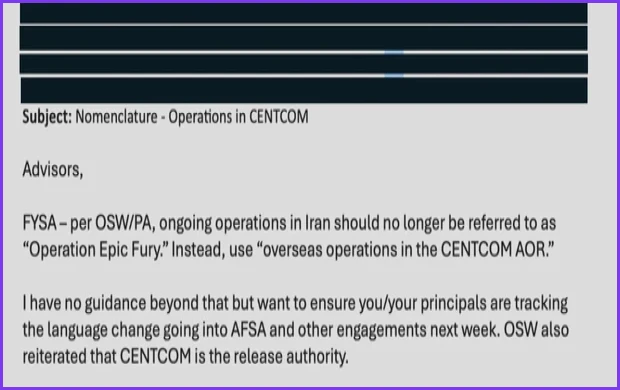
The Pentagon has instructed military personnel to stop using the term "Operation Epic Fury" to describe ongoing U.S. military operations in Iran, according to an internal Air Force email from August. The directive was issued three months after the Trump administration declared that the named operation had officially concluded.
The internal email, dated August 7, was distributed as U.S. Air Force leaders traveled to Orlando, Florida, to attend the 2026 Air Force Sergeants Association. High-level public affairs officers were directed to instruct military leaders to avoid the "Operation Epic Fury" moniker. Instead, they were told to refer to the conflict using broader language, specifically "overseas operations in the [U.S. Central Command Area of Responsibility]." Defense officials, speaking on the condition of anonymity, revealed that this guidance was not restricted to the Air Force but was disseminated across the entire Department of Defense during August and September.
According to the email, the directive came from the central public affairs office of Defense Secretary Pete Hegseth, which is led by chief Pentagon spokesman Sean Parnell. The message reiterated that U.S. Central Command must approve any publicly released information regarding the conflict with Iran.
The Pentagon recently confirmed that Operation Epic Fury officially ended on May 5. This was the same day Secretary of State Marco Rubio told reporters at the White House: "The operation is over. Epic Fury is — the president notified Congress — we're done with that stage of it. We're now on to this Project Freedom." Four days earlier, on May 1, President Donald Trump had informed Congress that "hostilities" had "terminated." Prior to this confirmation, both the Pentagon and U.S. Central Command had declined to disclose the operation's formal end date for months.
The May 5 conclusion date raises significant questions about how the military tracks and categorizes service members killed or wounded after the operation's official end, as well as why the naming directive was issued months later. The broader conflict with Iran, which began six months ago when U.S. and Israeli forces launched attacks on Iran, has continued despite the end of the named operation. While a ceasefire began in early April, the U.S. and Iran have continued to exchange periodic fire, punctuated by occasional pauses.
On July 7, President Trump formally notified Congress that "military action" against Iran had resumed. In a message addressed to Republican Senator Chuck Grassley of Iowa, the Senate's president pro tempore, Trump declared the April ceasefire "over" following the collapse of bilateral talks. Since then, Iranian forces have continued targeting U.S. troops and commercial vessels, while the U.S. has conducted periodic retaliatory strikes, including two rounds of strikes that drew Iranian counterattacks.
A Defense Department official explained the current operational posture: "Following the April ceasefire, the administration stated Operation Epic Fury had concluded on May 5. Subsequent activities have included Freedom of Navigation operations and strikes to further diminish threats posed by the IRGC [Islamic Revolutionary Guard Corps] to commercial shipping, Gulf countries, and American forces."
The discrepancy in the official timeline has directly affected how military casualties are reported. In July, the Defense Department's public website originally categorized four service members who died that month as killed in action during Operation Epic Fury, even though the operation had supposedly ended two months prior. On July 18, 1st Lt. Tyler James Feehan, Staff Sgt. Angel Rampersad, and Pfc. Isabella Gonzales were killed when an Iranian missile struck their sleeping barracks at Muwaffaq Salti Air Base in Jordan. The next day, July 19, Staff Sgt. Michael Emmanuel Swinton was killed in Iraq during a controlled detonation of an Iranian attack drone.
Over the weekend of July 25, the Pentagon moved these four deceased service members into a newly created category labeled "overseas operations." This administrative shift technically reduced the official death toll of Operation Epic Fury from 18 to 14. When journalists questioned the change in July, chief spokesman Sean Parnell blamed the issue on a "temporary data disruption" and "site anomalies" that were being resolved, while the Pentagon declined at the time to reveal when Epic Fury had actually ended. A Pentagon official recently stated: "Since Operation Epic Fury has concluded, the Department classifies casualties as overseas operations in the CENTCOM area of responsibility."
Despite this explanation, the Pentagon's Defense Casualty Analysis System still lists five service members wounded in June and one killed in July under the Operation Epic Fury banner, and the public database does not list an end date for the operation.
Historically, the U.S. military has published clear start and end dates for named operations to establish campaign phases and determine eligibility for military awards. These dates also allow Congress, service members, and the public to track the scope of American military involvement abroad. For example, Operation Enduring Freedom in Afghanistan ran from October 7, 2001, to December 31, 2014, before transitioning into Operation Freedom's Sentinel.
In the case of the Iran conflict, Secretary Rubio appears to be the only administration official to have publicly and explicitly stated that Operation Epic Fury had concluded, though he did not specify the May 5 date. On the same day as Rubio's remarks, Secretary Hegseth briefed reporters at the Pentagon, referring to Epic Fury in the past tense but stopping short of explicitly declaring it over. Hegseth contrasted Epic Fury with the new "Project Freedom," which he described as a defensive maritime mission to protect commercial shipping through the Strait of Hormuz. In an April briefing following the temporary ceasefire, Hegseth had declared that Epic Fury achieved a "decisive military victory."
May 5 also marked the last time the Pentagon held a press briefing on the war with Iran. On that day, President Trump announced that Project Freedom would be put on hold for a "short period of time" to facilitate negotiations. The current status of Project Freedom remains unclear.
Related Articles

Mr. Udoy is a professional Web Developer and Blogger with 7+ years of experience in the tech world. He specializes in web architecture and digital storytelling. As the driving force behind worldincidents.com, he focuses on delivering high-quality, well-researched content to a global audience.