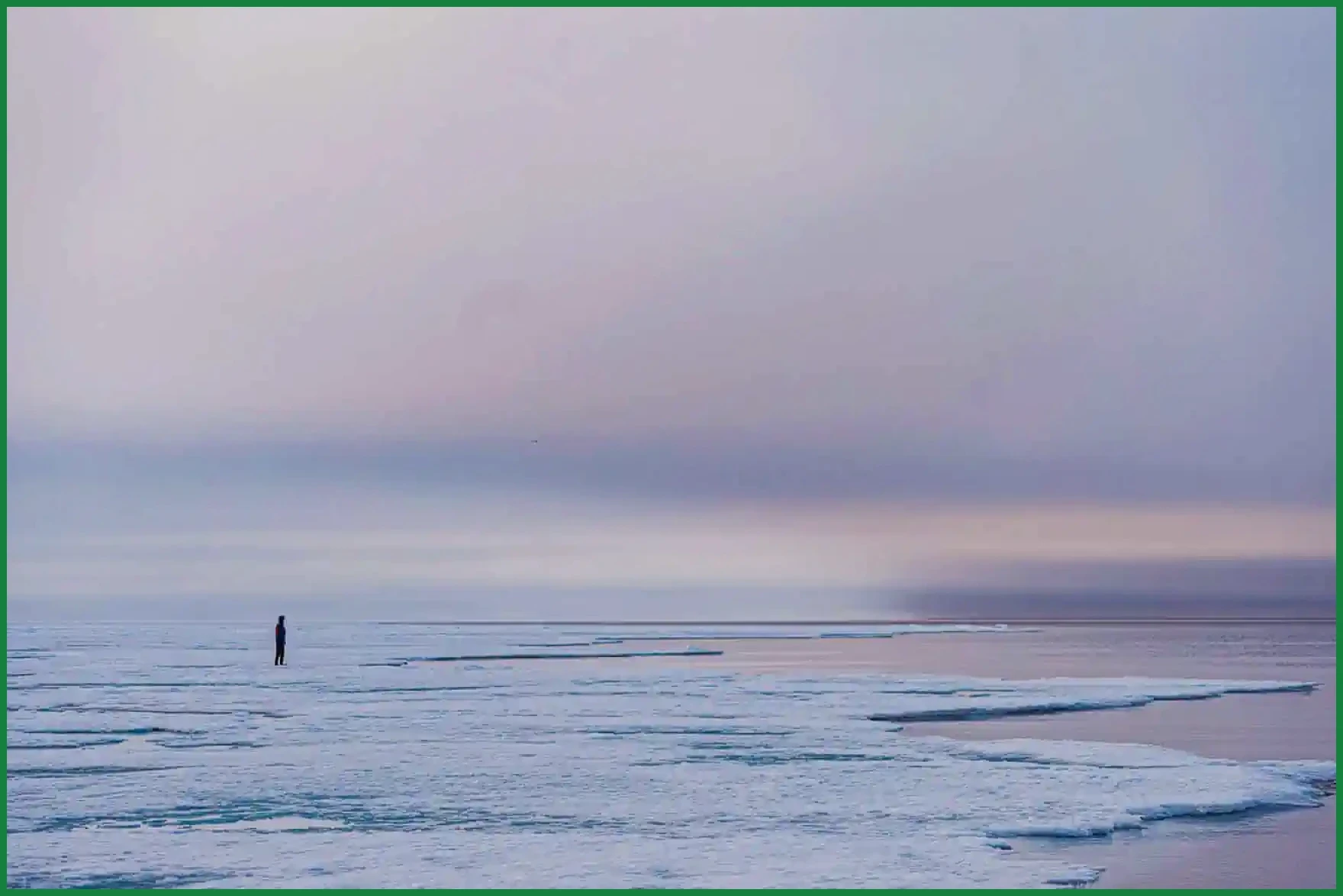
In the high reaches of the Arctic, a vast marine habitat renowned for staying open year-round is facing an unusual consequence of global heating: the threat of more ice, not less. Known to 19th-century whalers as the North Water, to the Kalaallit of Greenland as Pikialasorsuaq ("the great upwelling"), and to the Inuit of Nunavut as Sarvarjuaq ("the place that never freezes"), this 85,000-square-kilometer polynya—an area larger than Austria—is the focus of both rapid ecological change and a major international conservation push.
The ecological engine of this polynya relies on a massive, crescent-shaped "ice arch" that forms seasonally across Nares Strait at its northern tip. This natural bridge blocks sea ice from drifting south out of the Arctic Ocean, leaving the waters of the polynya open to sunlight and air. This open water fuels summer algae blooms that support a complex food web, attracting migrating whales, seals, walruses, polar bears, and millions of seabirds. However, nearly 20 years ago, the Nares Strait ice arch failed to form for the first time. Today, it frequently fails to take shape, allowing sea ice to drift southward and choke the open water during the spring. David Harning, a climate scientist at the University of Colorado, Boulder, warned that if the ice bridge permanently disappears, the region could experience "a drastic reduction in productivity – a collapse of the polynya."
To understand these changes before the ecosystem is altered beyond recognition, Inuit hunters and southern scientists have launched collaborative monitoring efforts. In Grise Fiord, Nunavut—Canada's northernmost public community, a hamlet of 144 residents located closer to Murmansk in Russia than to Toronto—Inuit hunter Terry Noah is at the forefront of this research. Racing across the sea ice on a snowmobile, Noah deploys submersible instruments through seal breathing holes to measure ocean temperatures and conditions. "This science work, it’s the first step to preparing," Noah said.
Noah retrieves data from his custom-made winches, processes it in his shipping container-based mobile lab, and beams it south to his research partner, Andrew Hamilton, a scientist at the University of Alberta. Hamilton analyzes the data to track changes in Jones Sound, which empties into Baffin Bay. Noah, who sometimes travels with his 13-year-old daughter, Madison, uses smart glasses and satellite internet to share real-time images and data on social media, updating a traditional culture of knowledge transfer for the digital age. "I get to take my friends out here," Noah noted. "And while we’re hunting, we’re collecting data."
The push to study the polynya coincides with a complex diplomatic effort to establish a binational, Inuit-managed protected area. In 2017, the Pikialasorsuaq commission recommended that Canada and Greenland jointly create an internationally protected zone. Canada took a major step forward in March of this year by designating the Sarvarjuaq marine protected area on its side, establishing a 1,000-kilometer conservation corridor from just south of the open Arctic Ocean to northern Baffin Island. Greenland, however, has lagged behind in its protection commitments. Sara Olsvig, a member of the Greenlandic parliament and chair of the Inuit Circumpolar Council, emphasized the need for caution, stating that conservation initiatives must not undermine Indigenous rights. "Some of the very good initiatives within conservation and nature preservation, and so forth, have unfortunately also resulted in violations of the rights of Indigenous peoples," Olsvig explained, arguing against rushing the process when fundamental cultural rights are at stake.
Despite political delays, scientists are moving quickly to expand their research. In the autumn of 2025, researchers convened in Nuuk to discuss establishing a comprehensive "observatory" to monitor the polynya from both the Canadian and Greenlandic sides. However, coordinating these efforts is logistically challenging, as many Inuit do not possess passports, making physical cross-border collaboration difficult. Hamilton stressed that combining local Indigenous knowledge with scientific measurements is vital. "Being able to connect the knowledge of these communities between Canada and Greenland is super important in order to really understand how that environment is changing, because they’re the ones that are there every day of the year, all year long," Hamilton said. He added that while instruments are necessary to measure shifts 300 meters below the surface, local daily observations are critical for a holistic understanding.
Looking forward, Noah and Hamilton hope to scale up their monitoring model. Noah has held discussions about training residents in other High Arctic communities, including Pond Inlet, Resolute, and Arctic Bay, to establish a unified observation network. For Noah, blending hunting with scientific data collection represents a natural continuation of the Inuit relationship with the land, providing vital insights for both local communities and global climate researchers.
Noah pulls his sled carefully over a seal’s breathing hole, about the circumference of a basketball. Using a custom-made winch, he lowers a submersible instrument into the sea below the ice.
But Noah’s circle is widening. Wearing smart glasses that beam images to social media via portable satellite internet, he is a globally connected Inuk, part of a generation that grew up sharing hunting stories on Facebook.
Related Articles

Mr. Udoy is a professional Web Developer and Blogger with 7+ years of experience in the tech world. He specializes in web architecture and digital storytelling. As the driving force behind worldincidents.com, he focuses on delivering high-quality, well-researched content to a global audience.