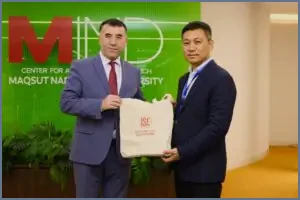
The arrest of an Uzbek professor working in Kazakhstan on espionage charges has sent shockwaves through the region's academic community, triggering widespread alarm over the state of academic freedom and due process. Dr. Ikboljon Qoraboyev, a 46-year-old international relations professor originally from Andijan, Uzbekistan, was taken from his home in Astana on July 3, but the details of his detention remained hidden for nearly two months.
According to reports from BBC Uzbek and RFE/RL’s Kazakh Service, Azattyq, individuals in civilian clothes detained Qoraboyev at his residence, where he lived with his wife and three children. A relative later revealed that the family was informed he is being charged under Article 176 of Kazakhstan’s Criminal Code. This article defines espionage as the collection, theft, or storage of state secrets by a foreign national to transfer them to a foreign state or international organization for use against Kazakhstan's national interests. A conviction carries a prison sentence ranging from 10 to 15 years.
Despite the severity of the allegations, both Kazakh and Uzbek authorities have maintained absolute silence in response to media inquiries. Qoraboyev’s employer, Maksut Narikbayev University (MNU) in Astana, quickly distanced itself from the scholar. When questioned by the independent Kazakh outlet Vlast, the university stated that Qoraboyev "is not currently a professor at the university" and directed all further inquiries to "relevant competent authorities." The university has also scrubbed Qoraboyev's name from its website and the website of the Center for Global and Regional Governance, which he previously headed.
The secrecy surrounding the case has raised serious concerns about Qoraboyev's legal rights. Relatives told BBC Uzbek that a state-appointed lawyer initially assigned to him "came and left without a trace." The family has since hired a private attorney, but the lawyer has been denied access to Qoraboyev. Because the case involves state secrets, the National Security Committee of Kazakhstan must grant permission for legal access, a permit the committee is reportedly delaying.
Colleagues and international scholars believe the charges may be linked to Qoraboyev's recent academic research. In April, he completed an unpublished paper titled "Comparative legal, political and strategic narratives around important minerals in Kazakhstan and Uzbekistan." His colleagues emphasized that the paper was compiled entirely from publicly available information. Qoraboyev had also been active in organizing high-profile academic events. In May, he posted on LinkedIn about a workshop on critical minerals and connectivity hosted by his center, which brought together diplomats, policymakers, and scholars from Central Asia, France, the Netherlands, and the European Union. In June, he co-hosted a roundtable on China-Central Asia relations with Fudan University, and earlier in the summer, he welcomed the head of cooperation at the EU Delegation to Kazakhstan for a guest lecture.
The academic community has reacted with profound concern. Maia Chankseliani, a professor of comparative and international education at the University of Oxford who co-authored a paper with Qoraboyev in 2020, expressed her shock upon learning of his detention. "I know Ikboljon as a scholar and colleague, and it was extremely disturbing to learn that he had already been in detention for almost two months," she said. Chankseliani noted that academic freedom is heavily shaped by the actual conditions in which academics work, warning that the case could severely damage the international trust Kazakhstan has worked hard to build. "If international academics, or Kazakhstani academics working with international colleagues, begin to feel uncertain about whether ordinary academic activity is safe, that could undermine the international openness Kazakhstan has worked very hard to create," she warned.
To address these concerns, an appeal was launched on Change.org on August 31, calling on the government of Kazakh President Kassym-Jomart Tokayev to guarantee Qoraboyev's fundamental rights, including a fair hearing, legal representation of his choice, and humane detention conditions.
Local academics, speaking on the condition of anonymity due to fear of state retaliation, described an atmosphere of growing fear and self-censorship. One scholar, using the pseudonym Amina, described the initial reaction among colleagues as "horror," noting that many are now reconsidering scheduled research trips to Uzbekistan. Another scholar, referred to as Bekzod, pointed out that Qoraboyev had no access to state secrets. "If he is accused on the basis of compiling publicly available materials and then publishing or sending them for a review, this puts many local and international scholars at risk of similar accusations and creates an atmosphere of fear," Bekzod said.
This is not the first time a prominent scholar in Kazakhstan has faced state security charges. In February 2019, noted Kazakhstani Sinologist Konstantin Syroezhkin was arrested on treason charges, an arrest that was also kept secret for months. Syroezhkin was subsequently convicted in a closed trial and sentenced to 10 years in prison under Article 175, though President Tokayev eventually pardoned him in 2024.
Qoraboyev represents the highly internationalized academic sector that Central Asian governments have actively promoted. He holds a PhD from the University of Toulouse, master's degrees in international and European law from the University of Montpellier 1, and a bachelor's degree from the University of World Economy and Diplomacy in Tashkent. He also holds affiliations with the United Nations University Institute on Comparative Regional Integration Studies and the Hague Research Institute. His arrest exposes a lingering undercurrent of suspicion between Kazakhstan and Uzbekistan, even as both countries publicly champion regional integration and cooperation.
Related Articles
Meet Md. Rubel Rana
As a core contributor to Worlddincidents.com, Rubel Rana brings a unique perspective to the world of journalism. Whether it’s deep-diving into historical trivia or covering the latest global headlines, Rubel Rana is committed to delivering high-quality, high-impact articles. Their writing blends meticulous research with a compelling voice, helping readers stay informed and curious about the world around them.
2 thoughts on “Uzbek Professor Arrested on Espionage Charges in Kazakhstan”