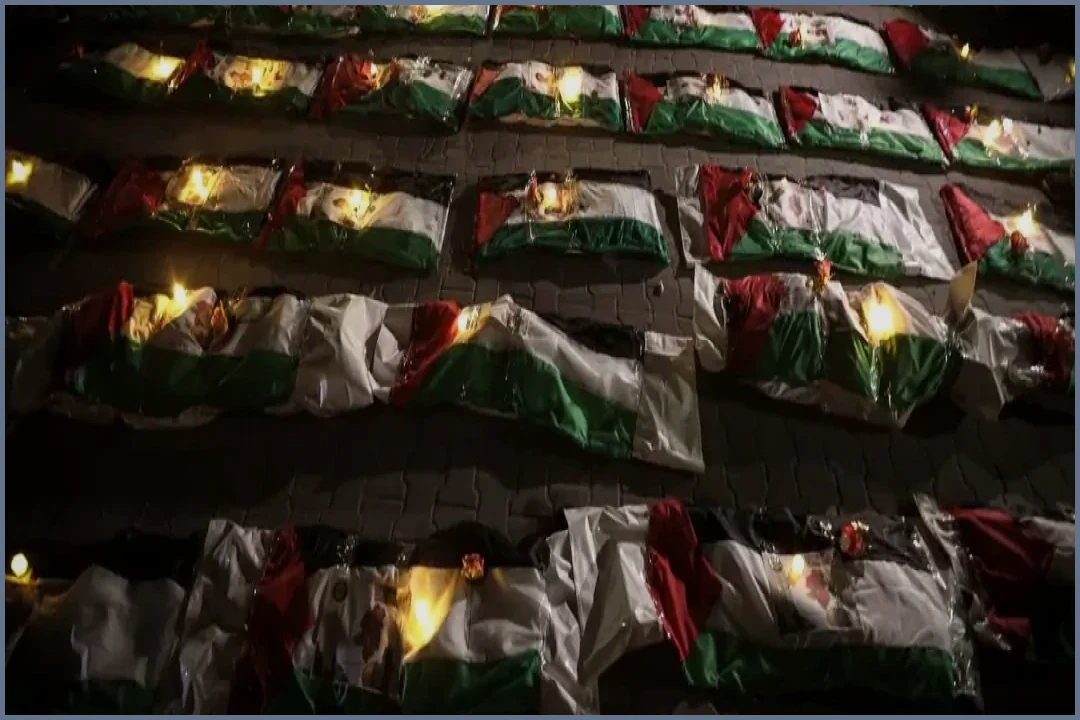
A profound sense of mourning returned to Gaza City on Saturday as families gathered to receive the remains of approximately 100 Palestinians recovered from the rubble of homes destroyed in Israeli airstrikes. For more than two years, the families had been unable to reach their loved ones trapped beneath the debris. The long-delayed farewell finally took place in the southeastern Zeitoun neighbourhood, where the recovered bodies and skeletal remains were brought before grieving relatives.
Outside the Imam al-Shafi’i Mosque, rows of remains wrapped in Palestinian flags were laid out. Families walked among the makeshift biers, lighting candles, placing flowers, and setting up photographs alongside the names of the victims, who included children, women, men, and the elderly. While some relatives searched for loved ones they had not seen since the bombings, others stood quietly over remains that were barely recognizable, identified only by specific remnants or personal items that survived the destruction.
The recovery operation was carried out in recent days by Gaza’s Civil Defense teams, who pulled the remains from the ruins of homes belonging to the Rahim, Balawi, Malaka, and Qanbour families. This effort is part of an ongoing initiative to retrieve thousands of Palestinians still buried beneath collapsed buildings across the enclave. However, the search and recovery teams are severely hampered, operating with only a few excavators and heavily worn equipment due to Israeli restrictions on importing the machinery necessary for such large-scale recovery operations.
Among those who came to say goodbye was Maryam Hassan al-Balawi. She stood before the remains of her family alongside her only surviving daughter, Malak. Expressing her profound loss, Maryam explained that her husband and children were killed in the strikes, leaving her with no one else. She shared that her daughter Malak continues to weep daily for her father and siblings, asking why their home was targeted when they had done nothing wrong.
Maryam also recalled a poignant final request made by her husband before his death. He had asked her to shroud and bury him with her own hands if he were to die. For more than two years, she was unable to fulfill that promise as his body remained trapped under the ruins. Despite the overwhelming sorrow, Maryam noted that the recovery of the remains brought her a sense of closure after years of visiting the ruins daily. She expressed that seeing them finally brought out of the rubble provided a measure of peace to her heart.
Nearby, Jadallah Rahim stood beside the remains of 32 of his relatives, all of whom were killed when their family home was struck on February 19, 2024. According to Rahim, more than 15 of the victims were children and approximately 10 were women. He emphasized that their only action was choosing to remain in their home, which was suddenly bombed, killing almost everyone inside instantly. Out of the 33 people who were in the house at the time of the attack, a young girl standing nearby was the sole survivor.
Rahim stressed that the victims should not be viewed merely as statistics, pointing to the names placed next to the remains to show they were real people with lives and families. He added that while the recovery brought an end to years of waiting, it also reopened deep emotional wounds, bringing back intense grief, pain, and tears. He pointed out a young girl who was crying as she moved among the remains of her grandfather, parents, siblings, and grandmother, all of whom she lost in the bombing.
Despite the pain, the families expressed that recovering the bodies allowed them to finally give their loved ones a proper burial. As night fell over the Zeitoun neighbourhood, candles remained lit next to the flagged remains. A mass funeral procession is scheduled to take place on Sunday morning to carry the victims to their final resting places.
The recovery effort is part of the second phase of a project managed by the Civil Defense, which is targeting 147 destroyed homes in Gaza City as well as the northern and central areas of the Gaza Strip, where an estimated 1,072 bodies are believed to still be under the rubble. The first phase of the project, which began in November 2025, resulted in the recovery of approximately 333 bodies and remains from 54 destroyed buildings. According to Gaza's Health Ministry, the conflict since October 2023 has resulted in at least 73,651 Palestinian deaths and 174,575 injuries, though families emphasize that the numbers alone cannot capture the scale of their personal losses.
She wants her father and her brothers and sisters.”“She says: ‘What did I do, Dad?
Related Articles

Md. Kazi Bijoy is a dedicated tech enthusiast and content creator with a passion for digital innovation. With years of experience in the tech industry, he specializes in breaking down complex topics into easy-to-understand guides. When he isn’t writing, he explores the latest gadgets and researches emerging trends in the digital world.