The expanding military relationship between Myanmar's ruling junta and Moscow has entered a new phase, marked by joint military exercises and emerging reports of Russian mercenaries active on the battlefield. In July 2026, the Myanmar military and Russia’s Airborne Forces, known as the Vozdushno-desantnye voyska Rossii (VDV), conducted a joint training exercise named Tiger-2026. This exercise was quickly followed by a visit from the military-appointed President Min Aung Hlaing to Russia, where he met with President Vladimir Putin and signed several agreements on military and economic cooperation, declaring Myanmar a "reliable partner." While official state-to-state collaboration grows, evidence suggests that Russian "soldiers of fortune" may also be operating directly in the country's ongoing civil war.
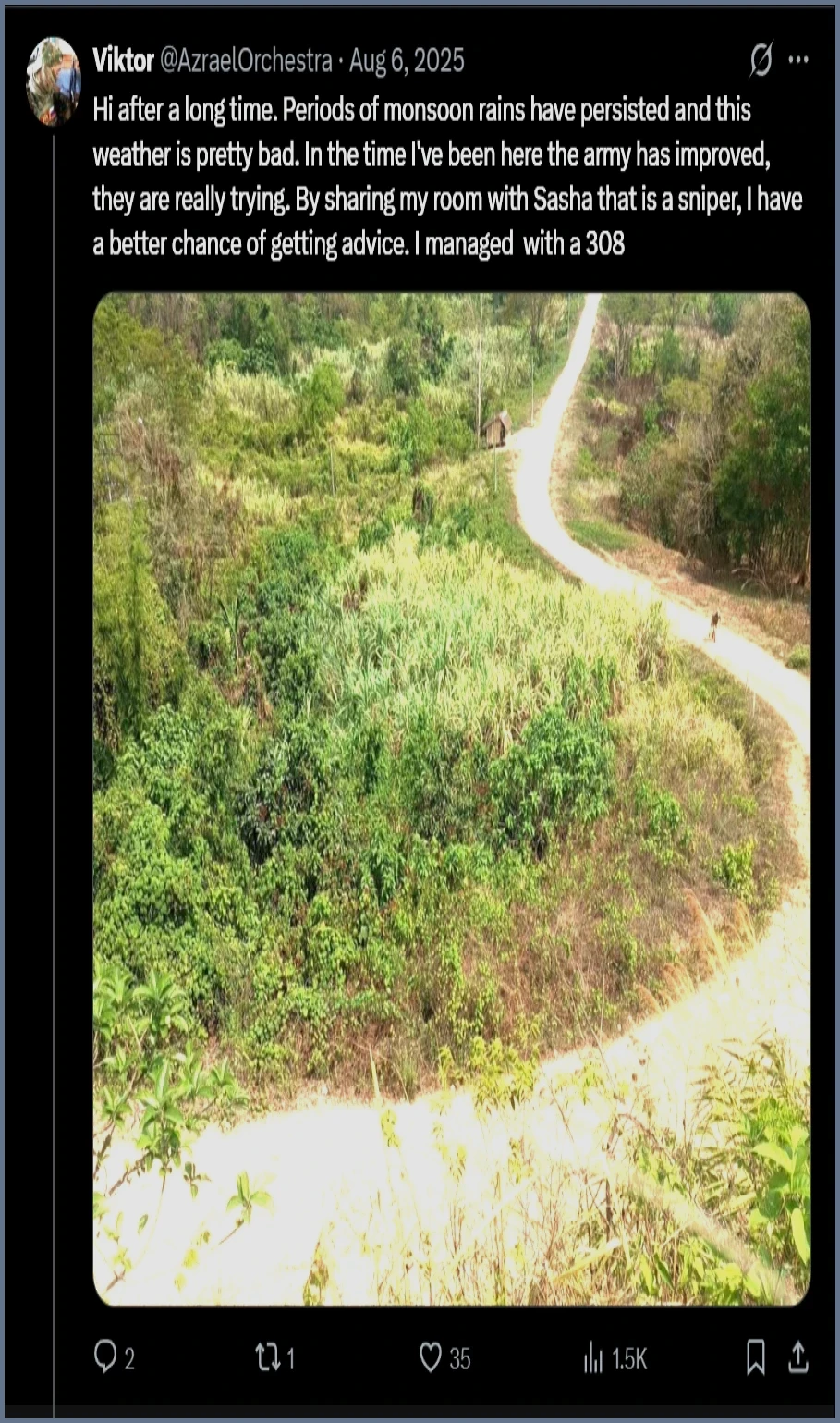
A recent open-source investigation has shed light on these unofficial combatants. An anonymous tip led to the identification of social media posts from Viktor Azrael, a Swedish-Estonian national with ties to Russian military networks and the now-defunct Wagner Group. In 2023, Azrael claimed on social media that he had met Wagner personnel in Syria and later traveled to Russia to join the private military company. By August and September of 2025, Azrael was posting updates that depicted him conducting sniper training with Myanmar military personnel, with posts dated August 6, September 2, and September 5, 2025. Later posts showed him alongside a Russian national named Sasha, with evidence suggesting they traveled through conflict zones in southeastern Myanmar, potentially within Karen State. Azrael even claimed that Russian fighters had engaged in sniper duels with American volunteers fighting alongside the democratic resistance, though these claims remain unverified.
The presence of foreign fighters in Myanmar is a phenomenon that predates the modern state's founding. During the early years of World War II, the American Volunteer Group—popularly known as the Flying Tigers—operated out of airfields in British Burma. Funded and equipped by the Chinese Nationalist government, these American pilots defended Rangoon from Japanese air raids. This volunteer group was distinct from the Chinese Expeditionary Force, which operated as a formal national military. Following independence, the government of U Nu faced challenges from Kuomintang (KMT) forces that occupied parts of eastern Shan State after being driven out of China by Mao Zedong’s communist armies. These KMT forces were supported by Air America, a covert airline controlled by the U.S. Central Intelligence Agency (CIA), which delivered supplies and backed Hmong irregulars in Laos and the broader Indochina conflict. The U Nu administration formally protested these covert operations at the United Nations.
On the opposing side of the Cold War, ideological solidarity drew foreign volunteers to the region. In 1968, when the Communist Party of Burma established its Northeastern Military Region, its ranks included Chinese volunteers carrying copies of Mao Zedong’s "Little Red Book." The political and military lineages of several present-day ethnic armed organizations in the northeast, such as the United Wa State Army, the National Democratic Alliance Army, and the Myanmar National Democratic Alliance Army (MNDAA), can be traced back to this Maoist revolutionary network.
Meanwhile, in the south, the Karen National Union (KNU) under General Saw Bo Mya actively employed foreign mercenaries and military contractors during the 1980s. French mercenaries, many of whom were former members of the French Foreign Legion, arrived in the KNU-administered territory of Kawthoolei to serve as military instructors, defensive planners, and advisers. Myanmar military commanders under Ne Win believed these French fighters played a key role in building the KNU's extensive network of fortifications along the Thailand-Myanmar border, and claimed to have recovered personal items and letters belonging to the Frenchmen on the battlefield. Even after major military offensives in the 1990s dismantled these border fortifications, reports of foreign mercenaries in the borderlands persisted throughout the late 1990s and 2000s.
The conflict has also attracted humanitarian volunteers. In 1996, following missionary trips and a meeting with Aung San Suu Kyi, former U.S. Special Forces officer David Eubank founded the Free Burma Rangers (FBR). While officially a humanitarian group providing medical training and assistance, the FBR has worked closely with the KNU and other resistance groups, occasionally participating in the armed protection of civilians. Following the 2021 military coup, the FBR's role expanded significantly as they helped organize resistance forces and set up training programs for young urban evacuees who fled to KNU-controlled territories.
More recently, foreign volunteers motivated by political conviction rather than financial gain have joined the resistance. On the India-Myanmar border, Azad, a U.S. national and veteran of the Syrian Civil War, operates with the left-wing Anti-Fascist Internationalist Front (AIF). Driven by an ideological commitment to fight authoritarianism, the AIF has claimed involvement in active combat, including drone and sniper operations, and has highlighted a female-operated drone unit called the "Witch." This growing international solidarity is also visible in legal actions; in August 2026, India's National Investigation Agency filed court documents alleging that groups of Americans and Ukrainians were arrested while trying to enter Myanmar or support resistance forces by training them in drone assembly, operation, and logistics.
Support networks extend beyond active combatants. Khant, a trooper with the People's Defense Force (PDF) in southeastern Myanmar, reported that foreign sympathizers and diaspora networks have provided critical tactical gear, including night vision goggles, without the exploitative practices of typical arms dealers. In March 2026, Australian authorities detained an Australian national returning from the Thailand-Myanmar border, suspected of being part of these support networks. On the other side, Chinese veterans and private security personnel have also played a role. The MNDAA has historically recruited former members of China’s People’s Liberation Army (PLA), with reports of Chinese nationals fighting alongside the group during its 2015 attempt to retake Laukkai. While there is less evidence of Chinese mercenaries participating in the major Operation 1027 offensive launched in October 2023, China's security footprint in Myanmar continues to grow. Before the 2021 coup, the Chinese private security firm Frontier Security Group (FSG)—which had former Blackwater head Erik Prince on its board—was permitted to protect Chinese jade mining operations in northern Myanmar. Following Operation 1027, Beijing and the Min Aung Hlaing regime agreed to establish a joint security company to safeguard Chinese investments, particularly strategic infrastructure like the port, pipeline, and economic corridor projects in Kyaukphyu, Rakhine State.
The potential for a deeper Russian presence has been a subject of concern for years. In 2016, Russian personnel were spotted in Meiktila in central Myanmar, where they were working with the Myanmar Air Force to train pilots and officers and assist with helicopter repairs. While this early contact did not involve the Wagner Group, it established an operational relationship years before the 2021 coup. In May 2023, the independent Russian outlet Verstka published a report analyzing a map seen behind Wagner founder Yevgeny Prigozhin during an interview with blogger Konstantin Dolgov. The map featured Myanmar colored in white, distinct from countries with active Wagner deployments, suggesting the country was at least being considered for strategic or technical support.
The convergence of formal military cooperation, private military networks, and independent adventurers raises critical questions about the future of Myanmar’s civil war. A permanent Russian or Chinese security presence could fundamentally alter the strategic environment of Southeast Asia, impacting the security calculations of neighboring giants India and China. While the conflict is primarily a struggle over Myanmar's internal future, its battlefields continue to attract a diverse array of foreign actors driven by money, ideology, adventure, or belief in the cause.
Related Articles

Md. Kazi Bijoy is a dedicated tech enthusiast and content creator with a passion for digital innovation. With years of experience in the tech industry, he specializes in breaking down complex topics into easy-to-understand guides. When he isn’t writing, he explores the latest gadgets and researches emerging trends in the digital world.