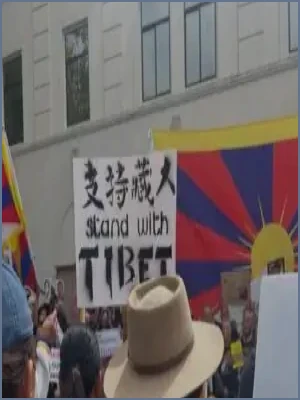
The self-immolation of Lobga Rangzen on the steps of the United Nations was a calculated act, chosen to highlight the failure of the global body to address the Tibetan cause. Since 1950, when Tibet first appealed to the UN, the organization has passed resolutions in 1959, 1961, and 1965, with the 1961 resolution specifically invoking the right to self-determination. However, the issue effectively vanished from the UN agenda after the People’s Republic of China assumed its seat in 1971. Rangzen’s death served as a stark indictment of six decades of international silence.
In the weeks following the incident, Tibetan communities held global demonstrations, and the UN secretary-general’s spokesperson issued condolences, while the U.S. State Department reaffirmed its support. Yet, this attention proved fleeting. Within days, media coverage evaporated, and governments retreated to boilerplate expressions of sympathy. Despite the persistent efforts of the Central Tibetan Administration and human rights organizations in Washington, Geneva, and Brussels—which have successfully pushed for legislation like the Resolve Tibet Act—Beijing’s position remains rigid. The last formal dialogue, consisting of nine rounds of talks between the Dalai Lama’s envoys and Beijing from 2002 to 2010, has been moribund for over 15 years.
The traditional strategy of seeking international pressure to force change in Tibet has reached its limit. Decades of condemnations and calls for dialogue have failed to move the Chinese Communist Party (CCP). However, Beijing remains deeply sensitive to pressure from within the Chinese-speaking world. The CCP’s control over Tibet relies not only on security spending but on the manufactured acquiescence of the Han majority. Since 1959, state propaganda has portrayed old Tibet as a barbaric serf society, with myths such as the "Sister Drum" song—a 1990s hit by a Han composer—still cited by Chinese internet users as evidence of Tibetan savagery.
This narrative is the foundation of CCP rule, yet it is increasingly fragile. In 2025, the Tibet Autonomous Region (TAR) generated only 31.8 billion yuan in local revenue against 310 billion in spending. Central transfers of 253.88 billion yuan, accounting for over 80 percent of the budget, fund both livelihood programs and a massive stability-maintenance apparatus. As China’s economy slows, resentment is growing among Han nationalists who question the fiscal burden of these subsidies and the "super-citizen treatment" granted to ethnic minorities. The CCP fears a public that begins to ask not why the government pays for Tibet, but what that money is actually buying and who it benefits.
Organizations like Chinese Youth for Tibet, a bilingual platform founded to engage the Chinese-speaking public, are now at the forefront of this shift. Last year, Chinese state security in Changsha detained Zhang Yadi, a 22-year-old Han student and member of the group, on suspicion of “inciting separatism.” The CCP’s decision to treat a small volunteer media project as a state security threat highlights the danger it perceives in Han-Tibetan cooperation. Despite this, these advocates often fall into an institutional blind spot, as Western foundations and newsrooms maintain a divide between "China desks" and "Tibet desks," leaving Chinese-speaking advocates unfunded and unprotected.
The rise of Han-driven activism represents a significant development in the Tibet issue. While international advocacy must continue, the diminishing returns of traditional diplomacy were made clear by the tragedy at the UN. The future of Tibet may depend on the growing awareness among China’s Chinese-speaking majority. Those who wish to change Tibet’s future should prioritize funding and protecting the individuals working to challenge the CCP’s narrative from within.
Related Articles

Md. Kazi Bijoy is a dedicated tech enthusiast and content creator with a passion for digital innovation. With years of experience in the tech industry, he specializes in breaking down complex topics into easy-to-understand guides. When he isn’t writing, he explores the latest gadgets and researches emerging trends in the digital world.