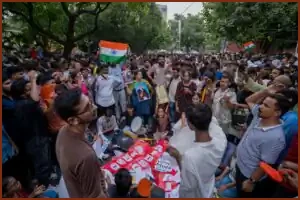
On August 14, Jammu and Kashmir Chief Minister Omar Abdullah issued a warning to New Delhi regarding a potential Gen Z protest in the restive Himalayan region. Abdullah highlighted the endless administrative hurdles placed by the lieutenant governor against his local government, most recently the stalling of a crucial reservation report designed to address grievances within the open-merit category. Shortly after, on September 2, Abdullah’s Cabinet ministers took to the streets of Srinagar. Holding placards that boldly detailed the Narendra Modi administration's repeated political incursions in Kashmir, the ministers marched toward the headquarters of the Bharatiya party, the Hindu-nationalist party led by Modi. The demonstration was quickly shut down by police forces answerable to the lieutenant governor, who scuffled with the ministers and shoved them into vans like common criminals.
Despite television crews and YouTubers capturing the aggressive police response, the incident failed to spark outrage on India’s primetime television networks that evening. Protests in Modi’s India are rarely broadcast on mainstream television unless they escalate dramatically, as seen during the 2020-2021 farmers' march to Delhi or the recent summer Gen Z protests over medical entrance exam paper leaks. Even then, the media coverage often serves as a damage-control effort for the government, framing protesters as foreign-funded actors intent on undermining the country's territorial integrity.
This systematic dismantling of the right to protest raises fundamental questions about the survival of democratic institutions. In 1789, American Founding Father Benjamin Franklin was asked whether the Constitutional Convention had established a republic or a monarchy, to which he famously replied, "A republic, if you can keep it." Franklin believed that the right of citizens to protest and force a government retreat in the face of repression was non-negotiable. However, modern political scientists Steven Levitsky and Daniel Ziblatt, in their 2018 book "How Democracies Die," described how demagogues can systematically hollow out democratic rights while maintaining the outward appearance of a democratic system.
This democratic paradox is highly visible in contemporary Kashmir, where the Modi administration has restricted federal rights. After downgrading Jammu and Kashmir (J&K) to a union territory and stripping its partial autonomy in August 2019, the central government has delayed the restoration of statehood while working to silence local political dissent. A large portion of the Indian public approves of this projection of force, aligning with the ruling party's broader civilizational goal of asserting Hindu interests, reclaiming "Hindu pride," renaming cities, removing Mughal history from school textbooks, and reducing Muslim representation in parliament.
In Kashmir, where the Muslim majority cannot be legally blocked from election, the central government has concentrated executive power in the hands of a handpicked Hindu Lieutenant Governor, Manoj Sinha. Sinha is a veteran party figure from Uttar Pradesh, the primary theater of the Ram Janmabhoomi movement that culminated in the opening of a grand temple in January 2024—one of Modi’s primary political achievements alongside the revocation of Kashmir's autonomy. Commenting on this administrative shift, Chief Minister Omar Abdullah noted in a recent podcast that officers who previously found ten ways to execute his orders now find ten reasons why they cannot be done.
Meanwhile, India's secular opposition coalition has grown hesitant to champion Kashmiri issues. This represents a shift from January 2023, when opposition leader Rahul Gandhi concluded his Bharat Jodo Yatra in Srinagar on a freezing, snowy morning. At the time, Gandhi invoked India’s syncretic heritage, drawing parallels between the Buddhist concept of "shunyata" (ego-less consciousness) and the Sufi concept of "fanaa" (annihilation of the individual ego before God). However, after the BJP swept the overwhelmingly Hindu Jammu region in the April-May 2024 national elections and subsequent provincial elections, the Congress party and its allies concluded that prioritizing Muslim minority grievances would lead to defeat at the ballot box. This has led to their silence on Kashmir and other sensitive issues, including the incarceration of activist Umar Khalid and Uttar Pradesh Chief Minister Yogi Adityanath's controversial "bulldozer thuggery" targeting Muslim properties. Modi himself joked about this shift after his 2019 electoral victory, mocking the opposition's sudden reluctance to wear the mask of secularism.
Given this national landscape, Waheed Para, a senior leader of the Jammu and Kashmir Peoples Democratic Party (PDP), argued that J&K should not rely on national parties to advance its cause. Para pointed to Ladakh's successful negotiations with New Delhi, which were driven by local regional solidarity. While PDP president and former Chief Minister Mehbooba Mufti wrote to Abdullah to urge collective action, Para emphasized that they do not wish to undermine the chief minister's mandate by taking independent initiatives. Despite the central government promising the Supreme Court in December 2023 that J&K’s statehood would be restored after elections, it has reneged on that commitment without facing any judicial censure.
This institutional abandonment highlights the need for local political unity in Kashmir, yet the region remains fractured by political rivalry on social media and podcasts. Local politicians frequently criticize Abdullah’s National Conference for failing to deliver on its campaign promises, which included restoring federal guarantees and creating 100,000 jobs for unemployed youth. While these criticisms reflect the frustration of J&K's population, the National Conference operates under highly diminished authority and faces an immense ideological apparatus. Hindu nationalist groups operate through 57,000 separate cells across India, with 1.5 million volunteers working to marginalize minority voices, particularly in Kashmir.
Upon taking office, Abdullah attempted to repair relations with New Delhi to secure federal funding and concessions. While the funding materialized, the central government refused to grant political concessions, remaining committed to its goal of installing a Hindu chief minister in Kashmir. This lack of progress allowed rival politicians to attack Abdullah on social media, expressing outrage over issues ranging from the central government's waqf legislation and the rise of liquor shops in Srinagar to the Israel-U.S. conflict with Iran. However, most of these critics limit their defiance to X (formerly Twitter) and television cameras, avoiding direct confrontations with law enforcement. Only Abdullah and Mufti have demonstrated physical grit on the streets—Abdullah when he forced entry into a martyrs' memorial in July 2025, and Mufti when she led protests against land encroachments in New Delhi in February 2023.
While Lieutenant Governor Sinha describes J&K as being "at the threshold of a new future" with massive infrastructure spending, a digital economy, and a "cultural renaissance," critics point to a severe crackdown on local expression, including Sinha's banning of 25 books last year. To challenge this environment, analysts suggest that Kashmiri leaders look to the organizational model of India's recent Gen Z student movement. Dubbed the "Cockroaches"—a term adopted by the students in response to a comment by the chief justice—the movement successfully pressured the government over medical entrance exam paper leaks. Unlike traditional political parties, the Gen Z movement built a broad coalition, uniting middle-class youth who supported nationalist policies with left-wing activists clad in Marxist-styled khadi kurtas chanting Faiz Ahmad Faiz's anti-fascist anthem "hum dekhenge." By operating from within the ruling party's core demographic, the movement created a psychological advantage that the opposition had failed to achieve in 12 years.
For the National Conference, the path forward requires building a similar broad-based coalition in Jammu to demand the restoration of statehood. Rather than relying on the Congress party's failed moral appeals, the National Conference must appeal to the material interests of Jammu's voters. This includes local business communities concerned about an influx of outside competitors, unemployed youth, disgruntled students, and disaffected members of the ruling party. To counter the right-wing's efforts to marginalize the region, J&K's political factions must establish local solidarity, as fragmentation will only cement their marginality.
Related Articles
Meet Md. Rubel Rana
As a core contributor to Worlddincidents.com, Rubel Rana brings a unique perspective to the world of journalism. Whether it’s deep-diving into historical trivia or covering the latest global headlines, Rubel Rana is committed to delivering high-quality, high-impact articles. Their writing blends meticulous research with a compelling voice, helping readers stay informed and curious about the world around them.