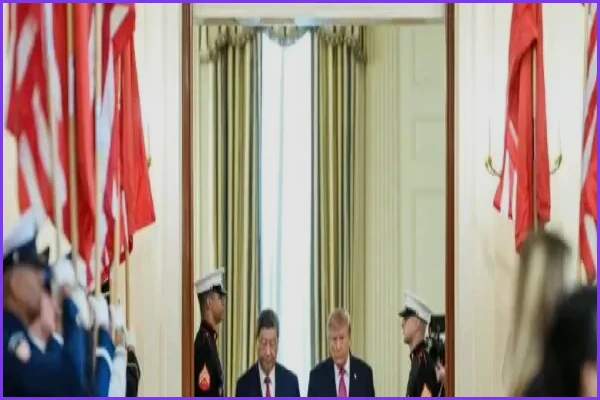
At the bilateral summit in September 2026, U.S. President Donald Trump and Chinese President Xi Jinping both highlighted the historical alliance between the United States and China during World War II, recalling how the two nations fought together as Allies. While the United States and the Republic of China were indeed wartime partners against Japan and other Axis powers, this sudden invocation of shared memory at the summit has sparked deep concern, particularly in Japan. Analysts warn that China's contemporary use of World War II history goes far beyond a simple commemoration of past cooperation.
To understand the source of these concerns, observers point to the stark evolution of China's historical narrative over the past decade. During the 70th anniversary of the end of World War II in 2015, relations between Washington and Beijing were relatively stable. At that time, China emphasized its role alongside the United States and other Western powers in establishing the postwar international order, framing its diplomacy around the concept of a "New Model of Major-Country Relations." If the recent summit remarks were merely intended to signal a return to that 2015 era of cooperative diplomacy, they would be easily understood within the context of Chinese foreign policy.
However, the geopolitical landscape has shifted dramatically since 2015. The 2020 COVID-19 pandemic and Russia's 2022 invasion of Ukraine drew widespread international condemnation, pushing Beijing and Moscow into a closer, more explicit opposition to Western nations. This alignment has heavily influenced how China deploys its historical narratives. During a May 2024 official visit to China by Russian President Vladimir Putin, which coincided with the 75th anniversary of Sino-Russian diplomatic relations, the two leaders issued a joint statement. The document declared that China and Russia would firmly defend the victory of the Second World War and the postwar order enshrined in the United Nations Charter, opposing any "negation, distortion, and falsification" of history. They also pledged to jointly promote a "correct view" of World War II history during the 80th anniversary celebrations in 2025.
This coordinated campaign intensified in March 2025. At a press conference during China's National People's Congress, State Councilor Wang Yi declared that China and Russia had fought together in Asia and Europe "at the cost of blood." He asserted that the two nations would build on this shared history to defend the fruits of their wartime victory, uphold the United Nations-centered international system, and push the global order toward a "more just and reasonable direction." Through these declarations, Beijing and Moscow explicitly linked their historical partnership to a shared ambition of reshaping modern global governance.
The narrative was further weaponized on May 9, 2025, during Russia's Victory Day celebrations. President Xi visited Russia and issued another joint statement with Putin, explicitly naming Japanese militarism and Nazi Germany as their wartime adversaries. The statement warned that both nations would resist any efforts to revive past militarism or Nazism. It specifically targeted Tokyo, asserting that the Japanese government must learn from its historical crimes, exercise caution regarding the Yasukuni Shrine, and completely sever ties with the militarism that once brought deep disasters to the peoples of the world and Japan itself.
By late 2025, China's historical discourse underwent a qualitative shift, directly targeting regional security issues. Beijing began connecting its World War II narratives to the invalidity of the San Francisco Peace Treaty, the Taiwan issue, and the status of Okinawa—areas critical to China's geopolitical ambitions within the First Island Chain. This rhetorical escalation occurred alongside rapid military expansion, with Chinese forces extending their operations into the Second Island Chain, the Western Pacific, and the South Pacific.
Following comments made by Japanese Prime Minister Takaichi Sanae in November 2025, China's verbal offenses against Japan expanded to challenge Tokyo's entire security apparatus under the label of "neo-militarism." When Putin visited China again in May 2026, the resulting Sino-Russian joint statement formally incorporated condemnation of Japan's "neo-militarism" and "remilitarization." Beijing subsequently began inserting anti-militarism language into bilateral statements with other countries. This campaign culminated at the UN General Assembly in September 2026, where Chinese representatives and Russian Foreign Minister Sergey Lavrov jointly accused Japan of pursuing a dangerous path of remilitarization and neo-militarism.
Against this backdrop, the recent decision by Trump and Xi to raise their wartime alliance at the September 2026 summit takes on a more troubling meaning. For Japan and other regional allies, China's invocation of World War II history is no longer a benign nod to the past, but an active diplomatic tool aligned with Russian cooperation and aimed at undermining the established security order in the Indo-Pacific.
Related Articles

Md. Kazi Bijoy is a dedicated tech enthusiast and content creator with a passion for digital innovation. With years of experience in the tech industry, he specializes in breaking down complex topics into easy-to-understand guides. When he isn’t writing, he explores the latest gadgets and researches emerging trends in the digital world.