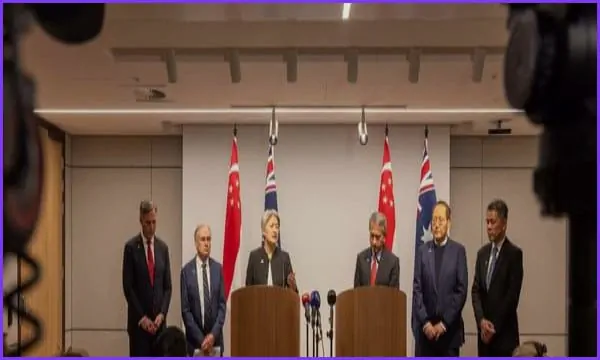
The 15th Singapore-Australia Joint Ministerial Committee (SAJMC) convened in Adelaide, South Australia, this week to coordinate bilateral cooperation across a broad spectrum of policy areas. The biennial meeting, which brings together senior government ministers, focused on foreign affairs, defense, and trade, emphasizing a shared commitment to resilience in an increasingly unstable global environment.
The primary outcome of the summit was the signing of a new Protocol on Economic Resilience and Essential Supplies. This agreement signals a strategic shift for both nations, as they define national security not only through traditional defense capabilities but also by securing the essential goods necessary to maintain public services and living standards. The protocol establishes the Australia-Singapore Economic Resilience Dialogue, a mechanism designed to facilitate practical cooperation and address shared challenges during periods of global disruption.
Energy security remains a core priority for this partnership. Australia currently supplies approximately one-third of Singapore’s liquid natural gas (LNG), while more than half of Australia’s petroleum imports are refined in Singapore. By creating formal, issue-specific consultation processes, both governments aim to ensure these vital supply chains remain functional, even when broader global systems face stress or failure. Officials stated that this approach is not a move toward economic disengagement; both countries remain committed to open, rules-based commerce and the World Trade Organization as the primary forum for resolving trade disputes.
Beyond economic supplies, the two nations signed the Industrial Base Resiliency Arrangement (IBRA) to bolster defense supply chain security. This arrangement aims to streamline equipment transfers, foster industry partnerships, and facilitate information exchanges to mitigate risks. It also allows for the cross-sustainment of common defense platforms and prioritizes defense order delivery requests.
This defense cooperation reflects the deep, practical integration between the two nations. Singapore maintains a significant defense footprint in Australia due to its own limited land, operating training presences at the Royal Australian Air Force (RAAF) Oakey Army Aviation Center in Queensland for helicopter training, and at RAAF Base Pearce near Perth for fixed-wing fighter training.
The joint communiqué from the SAJMC also addressed regional concerns, specifically regarding the South China Sea. Both nations expressed serious concern over unilateral actions that threaten regional stability and increased risks of miscalculation. They firmly supported the right of unimpeded transit passage for vessels and aircraft in accordance with international law as reflected in UNCLOS. By formalizing these processes, Australia and Singapore seek to navigate regional complexities with greater confidence and coordinated responses.
You have reached the limit of 2 free articles this month.
The creation of such a mechanism reflects the current era, where major disruptions are now expected rather than seen as isolated events. The COVID-19 pandemic demonstrated how quickly governments could restrict the export of medical equipment and other critical goods. The current war in the Middle East has highlighted how reliant the world is on energy flows, and how a more globally destabilized environment may make such wars more frequent.
Related Articles

Md. Kazi Bijoy is a dedicated tech enthusiast and content creator with a passion for digital innovation. With years of experience in the tech industry, he specializes in breaking down complex topics into easy-to-understand guides. When he isn’t writing, he explores the latest gadgets and researches emerging trends in the digital world.