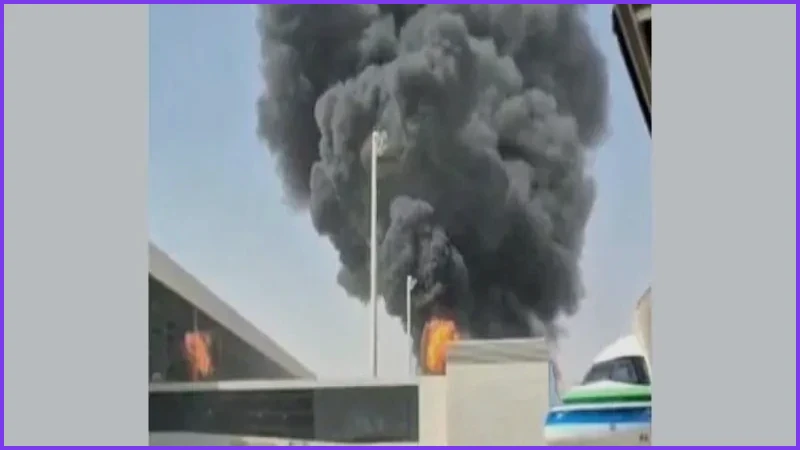
King Khalid International Airport in the Saudi capital of Riyadh was struck by a projectile on Sunday, marking the second such attack on the facility in as many days. A spokesperson for the Saudi military confirmed that the projectile caused a fire within one of the passenger halls. According to the Saudi civil aviation authority, there have been injuries resulting from the strike. Maj Gen Turki al-Maliki, the spokesman for the Saudi-led military coalition, stated that air defences had intercepted a missile near the airport in Riyadh while authorities were actively dealing with the fire.
This latest incident follows a deadly attack on the same airport just one day prior, which resulted in 13 deaths and left 308 people injured. Saturday’s strike was the deadliest single attack on a Gulf Arab country since the war between Israel, the US, and Iran began in February. The Saudi civil aviation authority reported that the victims included four Saudi nationals, two people from Bangladesh, and one person each from the US, Jordan, Palestine, Syria, Sudan, and Egypt. Additionally, the Indian embassy in Saudi Arabia confirmed on Sunday that an Indian man had succumbed to injuries he sustained in that attack.
Yemen’s Houthi rebels have claimed responsibility for the strikes. Their military spokesman, Brig Gen Yahya Saree, vowed that the group would continue its “escalating operations deep inside Saudi Arabia.” The Houthis warned passengers and airlines to avoid Saudi airports and airspace, declaring that Saudi airports are “potential targets and sites for operations,” excluding those in the holy cities of Mecca and Medina. The group stated they had targeted the airport with a mix of ballistic and cruise missiles, as well as drones, over the past 24 hours.
The Houthis justified the attacks as a response to Saudi support for government forces in Yemen’s ongoing civil war, as well as an alleged air strike on Sanaa International Airport. While Houthi-run Al Masirah TV claimed the “Saudi enemy” had launched that strike, Saudi Arabia has not confirmed it, and the report remains unverified. Abdullah Al-Alimi Bawazir, vice-president of Yemen's internationally recognised government, has called for “decisive actions” from regional and international partners.
International reactions have been swift. US Secretary of State Marco Rubio condemned the attacks and confirmed that a US citizen was killed in the strikes. President Donald Trump indicated that the US would “make a decision” and “move very quickly” regarding potential military action against the Houthis. Meanwhile, UK Defence Secretary Wes Streeting noted that the UK could “potentially” provide further support to Saudi Arabia, and Foreign Secretary Ed Miliband expressed that he was “appalled” by the violence. The Saudi-led coalition has characterized Saturday's attack as a “war crime” and pledged to respond.
The regional situation is becoming increasingly tense, with the UK Foreign Office advising against all travel to parts of Saudi Arabia, including areas within 10km (6.2 miles) of the border with Yemen, while other western embassies have warned their nationals about travel in the region. The conflict has intensified since the Houthis seized strategic stretches of the Red Sea coast, leading to a cycle of retaliatory strikes. The Houthis currently hold approximately 25% of Yemeni territory and as much as 80% of the country's population, with the Saudi government fearing the group aims to establish an Iranian-aligned satellite state on its southern border. Prior to the events of the last 24 hours, Riyadh's airport was struck on Thursday, an attack that killed three Saudi nationals, and there were two other deadly attacks on Saudi airports in Abha and Riyadh in the two days prior to that.
Related Articles

Mr. Udoy is a professional Web Developer and Blogger with 7+ years of experience in the tech world. He specializes in web architecture and digital storytelling. As the driving force behind worldincidents.com, he focuses on delivering high-quality, well-researched content to a global audience.