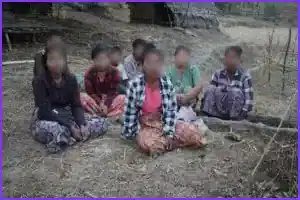
Survivors of a brutal military raid in Myanmar’s Rakhine State have shared harrowing first-hand accounts of a three-day ordeal in 2024, during which soldiers allegedly tortured and executed at least 70 men. The massacre, which took place in the village of Byain Phyu, was reportedly carried out as a retaliatory act of vengeance following major battlefield defeats suffered by the ruling junta.
On February 12, 2026, five survivors of the atrocity, including three women, spoke about their experiences from Ponnagyun Township, where they are currently living in displacement. Their testimonies paint a vivid picture of the events that unfolded between May 29 and May 31, 2024, in their home village of about 2,000 residents, located on the outskirts of Sittwe, the capital of Rakhine State.
The raid began unexpectedly at 8:00 a.m. on May 29, 2024, when six trucks carrying approximately 200 heavily armed military personnel arrived at Byain Phyu. While military patrols were common in the area, they usually occurred late in the day or at night. The soldiers quickly split into two groups to surround the village and prevent anyone from escaping, while a third group used loudspeakers to order all residents to gather at the village center immediately.
Soldiers dragged sick, elderly, and physically challenged residents out of their homes at gunpoint. They also intercepted commuters heading toward Sittwe. Among them was Kyaw Kyaw Aung, an artist on his way to sell his paintings; soldiers forced him back to the village, confiscating his motorcycle and his knapsack containing his artwork.
At the village center, an officer believed to be an army major ordered all the men and teenage boys to the outskirts of the village near a local tea shop. Approximately 800 men were blindfolded, had their hands bound behind their backs, and were later moved to the western edge of the village. Meanwhile, women and children were ordered to sit along the cobbled streets while soldiers questioned anyone they deemed suspicious.
Hla Hla Khin, whose husband and son were among the men taken away, recalled that the residents initially did not suspect the horror to come, assuming the soldiers were merely looking for specific individuals to question. However, the situation deteriorated rapidly at 7:00 p.m. when the sound of screams echoed from the village periphery. By 8:00 p.m., gunshots began to ring out at regular intervals, continuing until 4:00 a.m. the following morning.
At dawn, residents saw thick smoke rising from a cemetery located 100 meters away. Ma Wong Than, whose father was among those detained, realized then that the military was cremating the bodies of executed villagers. Shortly after, a middle-aged Burmese trader from Bago, who had been staying in the village, was released by soldiers after proving his ethnic Burmese identity. He informed the waiting women that about 70 men had been tortured and shot multiple times, with their bodies being buried or burned at the cemetery and near a nearby lake.
The trader also revealed that soldiers had subjected the captives to extreme cruelty, including forcing thirsty men to drink soldiers' urine from plastic bottles. One middle-aged man who protested this treatment was beaten so severely with rifle butts that he died from his injuries two days later. At least ten other residents were left unable to walk or speak as a result of the severe torture.
Saw Tamana Mue, a dockworker of Karen ethnicity who was staying in the village with his Rakhine Buddhist wife, corroborated the trader's account. He was released on the morning of May 30 alongside the trader and about 100 elderly and sick residents, but only after being tortured himself. He recalled that the 800 blindfolded men were divided into three groups and forced to kneel. He described hearing the torture and killings begin after sunset, estimating the death toll exceeded 70. He also witnessed about six men who attempted to escape being stabbed multiple times and shot dead. Saw Tamana Mue, who narrowly escaped death, noted that soldiers suspected him of being a member of the Karen National Liberation Army (KNLA).
The massacre occurred against the backdrop of significant military setbacks in the region. By mid-2024, the rebel Arakan Army (AA) had seized control of about 70 percent of Rakhine State and southern Chin State, leaving only four key townships—Sittwe, Kyaukphyu, Maungdaw, and Manaung—under junta control. The AA's political wing, the United League of Arakan (ULA), had already established administrative structures in surrounding villages, including Byain Phyu.
Prior to the raid, the AA had demanded the military's surrender in Sittwe and intensified its attacks in neighboring areas after capturing the commercial hub of Kyauktaw. The battle for Kyauktaw was a major defeat for the military, resulting in heavy casualties and the surrender of nearly 300 soldiers. Survivors of the Byain Phyu massacre recalled that military officers repeatedly mentioned the Kyauktaw defeat during the raid, stating that the attack on the village was direct retaliation to avenge their fallen comrades and that the village would be erased.
Soldiers also accused the villagers of actively supporting the rebels, claiming they had information that each household paid 2,000 kyats (approximately $0.95) to the AA monthly and provided the group with recruits and intelligence. The military compiled a list of 11 suspected ULA functionaries within the village. These men were forced to kneel in a row, questioned, beaten with chains, and subsequently shot dead. Four of them were already unconscious from beatings before they were shot.
Maung Wong, a 17-year-old survivor whose father later disappeared from Pathein prison, was among those tortured and held in Sittwe prison for eight months before his release. He witnessed the execution of the suspected ULA members.
Sittwe remains a highly strategic target for both sides, serving as a key commercial hub and the center of a major multi-modal connectivity project funded by India. A military defeat in Sittwe would severely hamper the junta's ability to defend other parts of Rakhine State. In response to the AA's advances, the military has reportedly conducted regular raids, burned homes, and carried out targeted killings in at least 30 villages surrounding Sittwe, including Aung Dine, Kyar Ma Thauk, Myit Nar, and War Bo, forcing thousands of residents to flee.
You have reached the limit of 2 free articles this month.
Another young officer instructed the women and children to sit on both sides of the cobbled roads. He and some soldiers looked closely at the women and children, paused to question those who appeared “suspicious,” and ordered them to remain seated until “further instructions.”
Related Articles

Meet Md. Rubel Rana
As a core contributor to Worlddincidents.com, Rubel Rana brings a unique perspective to the world of journalism. Whether it’s deep-diving into historical trivia or covering the latest global headlines, Rubel Rana is committed to delivering high-quality, high-impact articles. Their writing blends meticulous research with a compelling voice, helping readers stay informed and curious about the world around them.