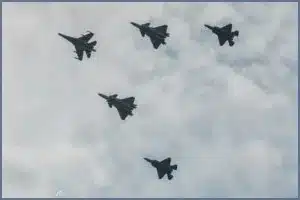
The People’s Liberation Army (PLA) Air Force has integrated an artificial intelligence system capable of drafting plans for large-scale strike operations. The system’s deployment was disclosed in a CCTV documentary aired in early August to commemorate the 99th anniversary of the PLA. According to the documentary, the technology has already been utilized in multiple missions. It is designed to prioritize targets from a pool of hundreds, coordinate dozens of formations, and assign specific tasks to more than 100 tactical units.
This technological shift aligns with instructions issued by Xi Jinping in late July, where he mandated that the PLA strengthen the military application of unmanned intelligent technologies and build an intelligent military system. While these goals have been pursued for years, the current level of emphasis is significant as Beijing seeks to reach modernization benchmarks by 2027, the 100th anniversary of the PLA’s founding.
The AI system is intended to manage a volume of decisions that would overwhelm human planners, as traditional calculation methods struggle to keep pace with the high-speed movement of aircraft and targets. Unlike autonomous weapon systems that select and engage targets directly, this software functions higher in the command chain. It serves as a support tool, recommending how aircraft, electronic warfare assets, and supporting capabilities should be combined before commanders authorize the execution. Humans remain responsible for the final decisions.
Despite this, the system’s ability to compress hours of complex campaign planning into minutes creates a tension between China’s diplomatic posture and operational realities. Beijing has long maintained that AI should support rather than replace human judgment, a stance emphasized in statements at the Convention on Certain Conventional Weapons. However, the speed of the new system risks reducing human authority to a formal rubber stamp, potentially creating a gap between diplomatic rhetoric and practice.
The logic behind this move is to gain decision superiority, which is increasingly vital to military effectiveness. By compressing the planning cycle, commanders can adapt faster to battlefield conditions. Yet, even if humans remain formally in control, the pace of conflict may be altered enough to reshape how that control is exercised. When planning occurs in minutes, the room for independent human assessment—such as evaluating civilian harm or the necessity of an attack—shrinks significantly. Under high-tempo operations, such as a coordinated air offensive across the Taiwan Strait, the human role risks becoming limited to rapid approval of AI-ranked options.
This raises concerns regarding automation bias and accountability. If a strike based on an AI-generated plan results in unlawful effects, it remains unclear whether responsibility lies with the commander or the system's designers. These issues have implications across the Indo-Pacific, as the ability to generate complex strike packages at machine speed could outpace traditional crisis management tools like military hotlines. Consequently, nations in AUKUS and the Quad may need to develop strategies to counter potential algorithmic shocks. As these systems proliferate, the global arms race is effectively receiving an algorithmic boost, increasing the risk that humans may eventually lack the time or agency to intervene in machine-speed warfare.
You have reached the limit of 2 free articles this month.
It is important to highlight that the planning system is far from being an isolated project; it fits a broad Chinese pattern. Recent disclosures span AI integration across logistics, intelligence analysis, and battlefield management, pointing to Beijing’s vision for an end-to-end algorithmic command ecosystem. Viewed together, this strategy maintains human oversight in name while embedding machine speed into every stage of military operations. In effect, the service member remains in the loop not to exercise operational control, but to co-sign the machine’s momentum.
Related Articles

Mr. Udoy is a professional Web Developer and Blogger with 7+ years of experience in the tech world. He specializes in web architecture and digital storytelling. As the driving force behind worldincidents.com, he focuses on delivering high-quality, well-researched content to a global audience.
1 thought on “China’s Military Deploys AI to Plan Large-Scale Strike Operations”