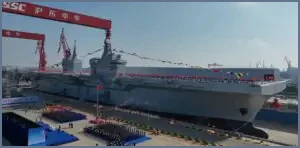
Beijing has reached a significant milestone in the development of unmanned naval platforms. On October 30, the Chinese military announced the successful launch and recovery of an unmanned combat aerial vehicle (UCAV) from its drone carrier, the Sichuan. This event represents the first instance of a drone carrier utilizing a catapult system to both launch and recover a UCAV.
The Sichuan is a Type 076 amphibious assault ship, also known by the NATO reporting name Yulan. It is the first vessel of its kind to be equipped with an electromagnetic catapult and arresting gear, technology that China has previously utilized only on its newest aircraft carrier, the Fujian. The drone involved in the test was a GJ-21 reconnaissance and strike stealth drone, estimated to weigh over 10 tons. This weight necessitates a catapult for takeoff, as the drone would be unable to launch from a short flight deck without such assistance.
While the People's Liberation Army (PLA) described the achievement as a world first, no imagery or footage of the event has been released as of this writing. This lack of visual confirmation contrasts with the 2025 release of video footage documenting the Fujian’s initial catapult launches. China’s interest in this platform first became apparent in 2024, when satellite imagery revealed a large catamaran that analysts identified as a drone carrier. The Sichuan represents a significant evolution, as it is designed to handle heavier, more capable unmanned systems.
China is not alone in the pursuit of drone carrier technology. Turkiye’s Anadolu, an amphibious assault ship, is capable of launching and recovering UCAVs, though it lacks a catapult system, which limits the weight and size of the drones it can operate. Iran previously converted a commercial container ship, the Shahid Bagheri, into a drone carrier, claiming it could remain operational for a year without refueling. However, that vessel was sunk by U.S. forces during Operation Epic Fury in February. Meanwhile, South Korea is actively planning to develop drone carriers, and nations including the United Kingdom, France, Italy, and Spain are exploring similar concepts or integrating unmanned systems into existing aircraft carrier operations.
For the Chinese military, these tests are essential for gathering data, which military thinkers view as the "new oil" necessary to power "intelligentized warfare." President Xi Jinping has emphasized the importance of unmanned systems and autonomous technology, calling for the rapid development of strategies and tactics to utilize them in potential conflicts during his report to the 20th National Congress. Despite this high-level directive, debates continue within the PLA regarding the ideal level of autonomy for these systems. A PLA Daily article noted that "final decisions rest with human commanders, safeguarding against errors stemming from AI’s black-box nature." Proponents of the concept emphasize that unmanned systems are more cost-effective than manned fighter jets, both in terms of procurement and the training of operators.
The United States has taken a different approach, focusing on integrating unmanned aircraft into its existing fleet of 11 aircraft carriers and large-deck amphibious ships rather than building dedicated drone carriers. The U.S. Navy previously demonstrated the capability in 2013, when an X-47B became the first unmanned aircraft to launch and land on an aircraft carrier, the USS George H.W. Bush. However, the U.S. Navy later redirected its UCLASS program toward aerial refueling, resulting in the MQ-25 Stingray. Currently, the U.S. is pursuing collaborative combat aircraft projects with companies such as Boeing, General Atomics, Anduril, and Northrop Grumman to enhance the capabilities of manned fighter aircraft.
Beyond high-end combat, Chinese drone carriers could serve as a coercive force in gray-zone activities. In the South China Sea, these vessels could deploy unmanned systems to conduct intelligence, surveillance, and reconnaissance, identifying non-Chinese vessels that Beijing claims are violating its maritime interests. In a Pacific contingency, drone swarms could be used to map, jam, or strike adversary defenses. A recent report from the Center for Strategic and International Studies (CSIS) noted that such swarms force adversaries to burn through expensive interceptors and expose their sensors. Even if the drones are destroyed, they can act as decoys, drawing fire away from more valuable assets like naval strike groups and fighter aircraft.
While China’s status as a dominant shipbuilder allows it to experiment with platforms like the Sichuan at a lower cost and higher speed than its competitors, the combat effectiveness of these drone carriers remains unproven. The only real-world test of the concept, Iran’s Shahid Bagheri, was destroyed before it could demonstrate its utility in combat. Whether China’s investment in the Sichuan will translate into a decisive combat advantage remains a subject of ongoing debate.
Related Articles

Md. Kazi Bijoy is a dedicated tech enthusiast and content creator with a passion for digital innovation. With years of experience in the tech industry, he specializes in breaking down complex topics into easy-to-understand guides. When he isn’t writing, he explores the latest gadgets and researches emerging trends in the digital world.