Christopher Nolan has transformed the classic Homeric legend into a sprawling, ambitious epic that centers on the profound, often invisible, anguish of soldiers returning from war. The film serves as an exploration of postwar disillusionment, where the struggle to reconcile one's prewar self with the trauma of combat can span years or even lifetimes. Nolan depicts this internal odyssey through a series of hallucinations, flashbacks, and confrontations with arbitrary, dysfunctional deities who interact with mortals on nearly equal terms.
Matt Damon stars as Odysseus, portraying the military commander from Ithaca with a careworn, melancholic intensity. Serving under the Greek king Agamemnon, played by Benny Safdie in a Batman-esque helmet, Odysseus finds himself entangled in a war with Troy that he recognizes as a mere pretext for commercial trade route competition, rather than the romanticized elopement of Helen with Paris. The film features Lupita Nyong’o as both Helen and Agamemnon’s assassin, Clytemnestra, while Jon Bernthal portrays Menelaus.
The tactical victory at Troy is realized through a haunting, monumental horse statue that the city’s defenders unwittingly drag inside their walls. This deception requires Odysseus to sacrifice his cousin and comrade, Sinon, played by Elliot Page, leaving the hero burdened with permanent guilt. Cinematographer Hoyte van Hoytema captures this narrative with Imax-sized landscapes, avoiding traditional maritime color palettes in favor of a stark, lonely aesthetic.
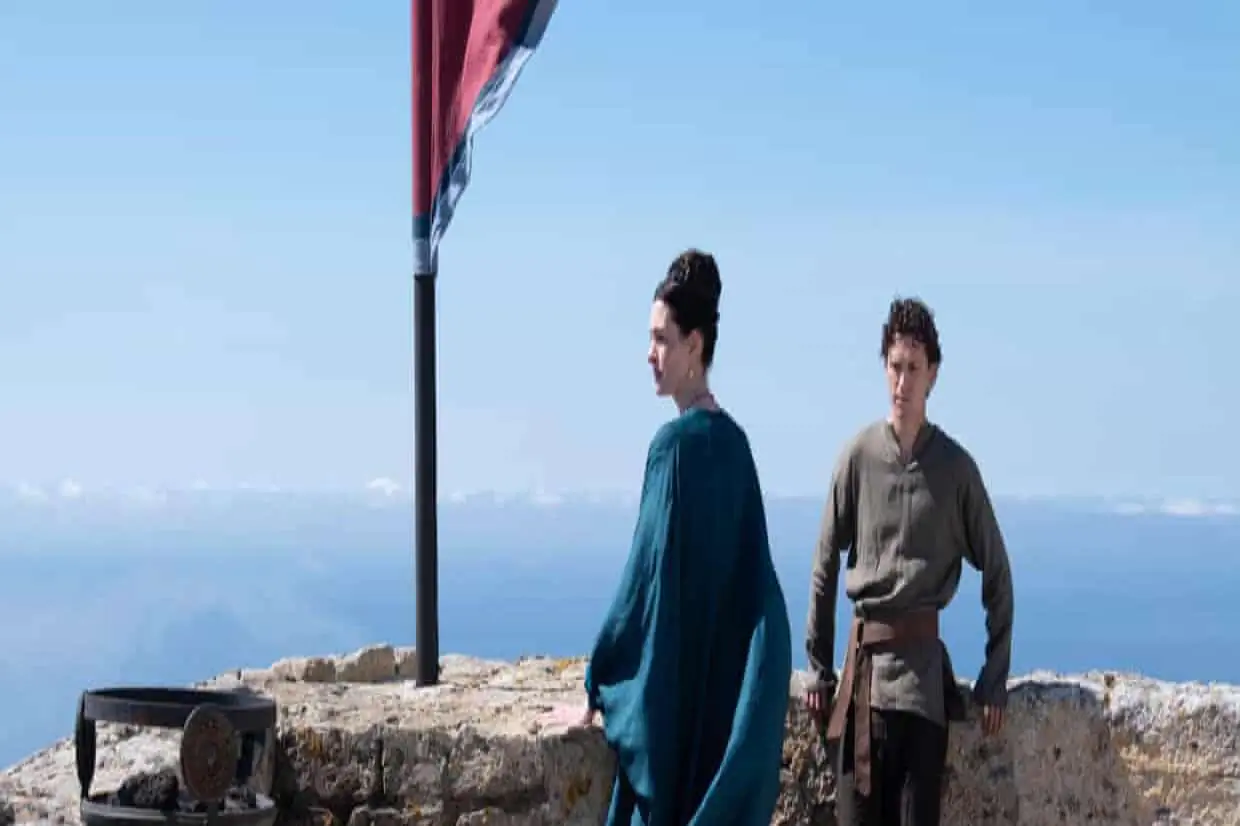
As Odysseus and his men endure a chaotic journey home, they face mythical figures such as the Cyclops, the Laestrygonians, Circe, played by Samantha Morton, and Calypso, portrayed by Charlize Theron. Zendaya appears as the sorrowing goddess Athena, who acts as the hero's primary ally. Meanwhile, back in Ithaca, Penelope, played by Anne Hathaway, is forced to manage a dangerous power vacuum. She must entertain greedy suitors, most notably the cruel Antinous, played by Robert Pattinson, who frequently abuses the blind manservant Eumaeus, portrayed by John Leguizamo. Odysseus’s son, Telemachus, played by Tom Holland, embarks on his own journey to locate his father.
The film’s portrayal of the underworld is particularly striking, featuring shrouded spirits that resemble the witches from Macbeth. In the final act, as Odysseus nears his home, he adopts the guise of a beggar before beginning a mysterious transformation into a god-like figure. Though the film omits the character of Autolycus, the name Odysseus—meaning "victim of enmity"—remains central to the narrative. The result is a three-hour vision of existential struggle that offers no simple wisdom, but rather a persistent, grim determination to survive the aftermath of loss.

Md. Kazi Bijoy is a dedicated tech enthusiast and content creator with a passion for digital innovation. With years of experience in the tech industry, he specializes in breaking down complex topics into easy-to-understand guides. When he isn’t writing, he explores the latest gadgets and researches emerging trends in the digital world.