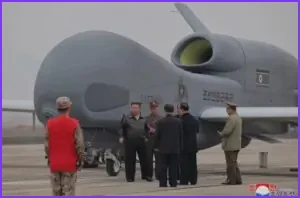
North Korea’s growing capacity to conceal, disperse, and deploy its nuclear weapons, missiles, and drones is increasingly outpacing the South’s ability to neutralize these threats. Both nations have been closely monitoring conflicts in Iran and Ukraine, recognizing that these wars mirror the deep strike contest they anticipate for the Korean Peninsula. Consequently, both Koreas have intensified the development of low-cost, long-range attack drones, with several systems expected to reach operational status in the near future.
While ballistic missiles, long-range artillery, and nuclear weapons have historically defined the military balance and deterrence, armed drones are now becoming a critical factor. These systems threaten to widen the surveillance gaps already faced by the South Korean military, particularly as Pyongyang continues to diversify its launch platforms. This shift complicates the Lee administration’s timeline for securing wartime operational control from the United States, as South Korean forces will require enhanced capabilities to meet established qualitative standards.
Long-range, unarmed aerial vehicles have been part of the regional military landscape for two decades. The first notable instance occurred in 2010 during the shelling of Yonpyeong Island, when a North Korean reconnaissance drone was detected. Subsequent incursions have occurred periodically; in 2014, three North Korean drones were recovered less than 50 miles from the border, and in December 2022, five drones flew over Seoul, including the presidential office, before returning North. In October 2024, North Korea alleged that South Korean drones had overflown Pyongyang. While Seoul officially denied this, public analysis of images released by the North suggested a visual match to South Korean reconnaissance technology.
Historically, these cross-border flights have involved rudimentary, unpowered, or fixed-wing systems. There is no confirmed evidence that either side has utilized armed drones in such operations. However, both nations possess broader inventories with significantly higher capabilities. North Korea has been developing indigenous reconnaissance models since the 1980s, unveiling high-altitude, long-endurance (HALE) and medium-altitude, long-endurance (MALE) drones in 2023. The latter is reportedly capable of launching missiles, though inventory numbers remain limited.
South Korea’s own development, which resumed in the 1990s, initially focused on tactical surveillance. By the late 2000s, the Agency for Defense Development (ADD) began working on the KUS-FS, a domestic MALE drone, while the Republic of Korea Air Force procured Global Hawks from the United States, with four delivered by 2020. The KUS-FS is projected to enter service in 2027.
The conflicts in Ukraine and Iran have accelerated interest in massed, inexpensive, armed drones. In 2024, Kim Jong Un ordered the establishment of a mass-production system for suicide attack drones. Reports indicate that thousands of North Korean laborers and possibly engineers have been sent to a factory in Russia to assist in producing copies of Iranian Shahed one-way attack drones. Meanwhile, South Korea’s ADD is developing the KUS-LM, or "K-LUCAS," which features capabilities comparable to American one-way attack systems and is slated for deployment before 2030, with trials already underway on land and sea.
Related Articles

Meet Md. Rubel Rana
As a core contributor to Worlddincidents.com, Rubel Rana brings a unique perspective to the world of journalism. Whether it’s deep-diving into historical trivia or covering the latest global headlines, Rubel Rana is committed to delivering high-quality, high-impact articles. Their writing blends meticulous research with a compelling voice, helping readers stay informed and curious about the world around them.