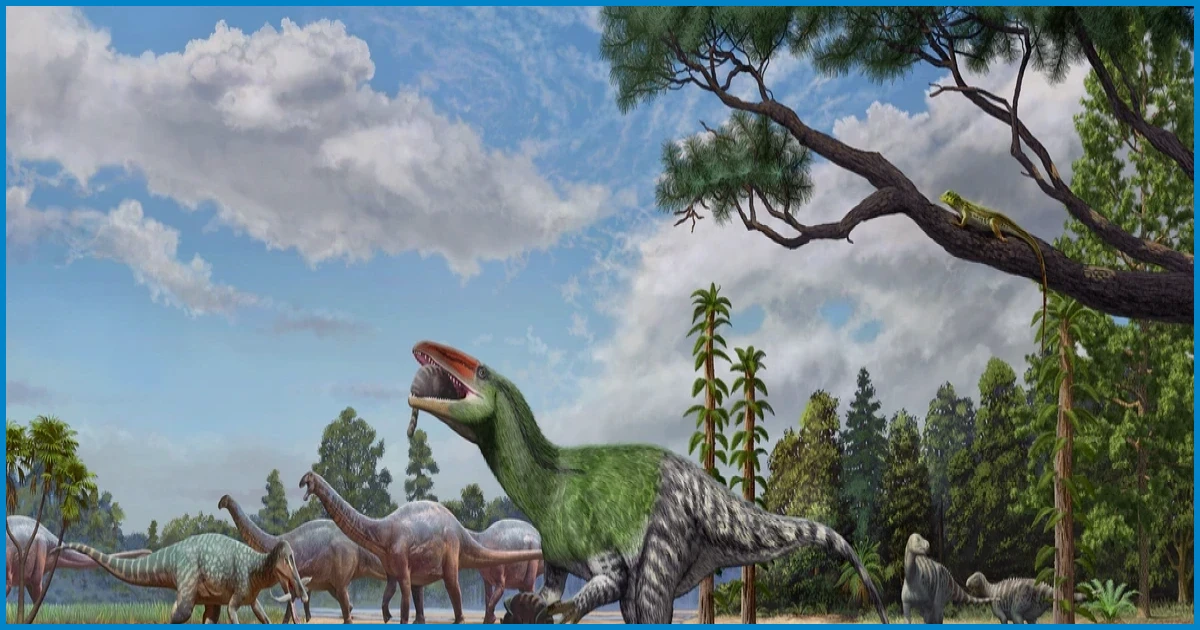
A previously unknown species of dinosaur, described as a long-clawed predator roughly the size of a tiger and a cousin of the Tyrannosaurus rex, has been identified after a fossil remained tucked away in a British museum for a century. The discovery, detailed in the Royal Society Open Science research journal, identifies the creature as Invictibellatrix amberina, a member of the two-legged carnivore group known as megaraptorans.
The specimen that led to this identification consists of a chunk of the back of a skull. It was originally part of a collection of 1,000 specimens found on the Isle of Wight, off the south coast of England, by Reginald Walter Tooley. The Natural History Museum in London acquired the fossil in 1924, where it sat in a storage drawer until recently.
Dr. Cassius Morrison of University College London, who served as the lead author of the study, noted that it was a real mystery that the fossil had been overlooked for such a long duration. To classify the find, researchers performed a CT scan on the skull fragment to build a 3D model, which was then compared against the skulls of other carnivorous dinosaurs, including raptors, spinosaurs, and tyrannosaurs. Several unique features observed in the model led researchers to conclude they had discovered a new species.
Researchers estimate that Invictibellatrix lived during the Early Cretaceous period, approximately 120 million years ago, making it one of the earliest and smallest known megaraptorans. The dinosaur is believed to have stood nearly 5 feet tall and reached lengths between 10 and 13 feet. It likely possessed feathers and hunted small mammals, lizards, and smaller dinosaurs.
While Dr. Morrison noted that the dinosaur was not the apex predator of its era, he suggested it would have been a formidable threat had it coexisted with humans. He remarked that humans would have been perfectly sized prey, at about a third of the predator's body weight, and that the animal would have definitely chased us. He contrasted this with the T. rex, which he suggested would not have bothered with humans due to our relatively small size.
The name Invictibellatrix translates from Latin to unconquered female warrior, while the term amberina references the amber found in the rock where the fossil was originally discovered. The researchers stated that they chose this name to provide strength and hope to those who are victimized, bullied, oppressed, or discriminated against, serving as a reminder not to give up when facing such odds.
Related Articles

Meet Md. Rubel Rana
As a core contributor to Worlddincidents.com, Rubel Rana brings a unique perspective to the world of journalism. Whether it’s deep-diving into historical trivia or covering the latest global headlines, Rubel Rana is committed to delivering high-quality, high-impact articles. Their writing blends meticulous research with a compelling voice, helping readers stay informed and curious about the world around them.