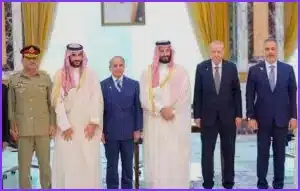
The signing of the Mecca Joint Defence Agreement on August 7, involving Saudi Arabia, Pakistan, and Turkiye, has prompted a period of intense scrutiny within New Delhi’s strategic circles. The Indian External Affairs Ministry, through its spokesperson, confirmed that the government is currently examining the implications of this development, which some observers have dubbed an “Islamic NATO,” specifically regarding its impact on national security and regional stability. While the official response remains measured, emphasizing that India will safeguard its national interests, the broader strategic community has expressed significant alarm. Some analysts view the pact as a potential master stroke for Pakistan, India’s long-standing rival, even as others suggest the agreement may be more about optics than immediate substance.
Although the specific details of the agreement have not yet been fully disclosed, the pact aims to establish a collective deterrence mechanism among a GCC member, a NATO member, and the only nuclear-armed Islamic state. Data from the 2026 Global Firepower Index (GFI) highlights the significant military potential of this trio, which collectively commands 1.4 million active personnel, over 6,000 tanks, 3,415 military aircraft, 844 naval assets, and a combined defense budget exceeding $124 billion. For context, India’s own military strength, which ranks fourth in the GFI behind the U.S., Russia, and China, consists of 1.4 million active personnel, 3,913 tanks, 2,183 military aircraft, 343 naval assets, and an $86 billion defense budget. While a direct crisis remains unlikely, the potential for the pact to be invoked against India presents a new variable for New Delhi to consider.
The pact does not appear to target a single adversary, as there is no common enemy among the three nations, excluding a hypothetical stance against Israel. Instead, the agreement seems designed for signaling and hedging. Saudi Arabia may be signaling a move away from the U.S. security umbrella, effectively closing the door on joining the Abraham Accords. Similarly, Turkiye’s participation could indicate a shift in its NATO position, while Pakistan appears to be leveraging its role as a mediator in the Iran conflict to demonstrate its military outreach despite ongoing economic vulnerabilities. U.S. President Donald Trump has welcomed the pact, potentially viewing it as a form of security burden-sharing, though critics argue this perspective ignores the long-term instability such a bloc could introduce to the region.
For India, the rise of this alliance poses complex challenges. It could complicate India’s ability to conduct cross-border counterterrorism operations and potentially threaten the India-Middle East-Europe Economic Corridor (IMEC) due to India’s proximity to Israel. With 8.8 million Indian nationals residing in the Gulf and the GCC accounting for 15.4 percent of India’s total trade, the region is of critical importance. The recent free trade agreement signed in February underscores this economic reliance. Consequently, experts argue that India must move beyond its current West Asia policy, which is largely anchored to the UAE and Israel through frameworks like the I2U2 group. To secure its interests, including the maintenance of free sea lines of communication through the Gulf of Aden, the Red Sea, and the Gulf of Oman, India needs to deepen its defense and intelligence cooperation with individual Gulf nations. Ultimately, the Mecca pact serves as a reminder that India must transition from being a valued economic partner to an indispensable security stakeholder in a region undergoing a structural shift in its security architecture.
You have reached the limit of 2 free articles this month.
Related Articles

Mr. Udoy is a professional Web Developer and Blogger with 7+ years of experience in the tech world. He specializes in web architecture and digital storytelling. As the driving force behind worldincidents.com, he focuses on delivering high-quality, well-researched content to a global audience.
1 thought on “India Evaluates Strategic Impact of New Mecca Defence Pact”