Campaigning for Taiwan's 2026 local elections has entered its final week ahead of the vote scheduled for November 28. The surprising campaign cycle features critical mayoral battles and municipal contests across key metropolises and districts, with results expected to significantly shape Taiwan's national political discourse and set the stage for the 2028 presidential race.
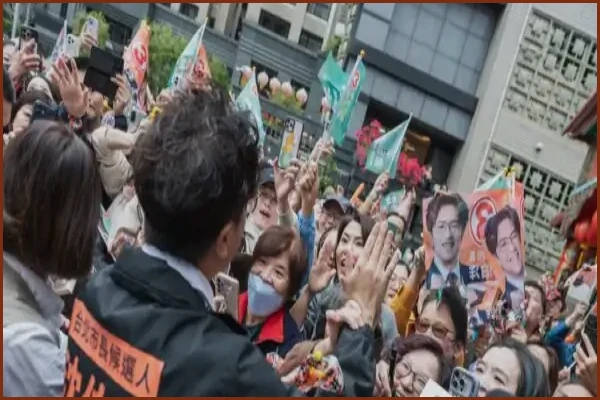
In the capital city of Taipei, Democratic Progressive Party (DPP) candidate Puma Shen has emerged as a formidable challenger in a municipality that historically favors the pan-Blue camp. Shen, a one-term legislator previously known for his firm stance on China, has gained traction through strong public speaking and extensive policy expertise. His campaign has sparked the widespread "Ocean Current" phenomenon, generating public enthusiasm that is boosting DPP candidates nationwide. Even if Shen loses, he is projected to achieve the best performance for a DPP candidate in Taipei since Chen Shui-bian won the mayoral election in 1994 before eventually securing the presidency. Conversely, incumbent Kuomintang (KMT) mayor Chiang Wan-an has faced public visibility challenges, compounded by controversies including a police raid on a Taipei gay bar shortly before the late-October pride parade and criticisms regarding reduced urban greenery. Seeking to fortify his standing while keeping 2028 presidential prospects alive, Chiang named Taichung Mayor Lu Shiow-yen as his campaign chair, signaling a willingness to back her potential 2028 presidential bid in exchange for present campaign support.
In Taichung, Taiwan's second-largest city and the core metropolis of central Taiwan, the mayoral contest carries heavy presidential implications. Outgoing KMT mayor Lu Shiow-yen is widely expected to seek the party's 2028 presidential nomination. Her designated successor, former KMT chair Johnny Chiang, faces DPP challenger Ho Hsin-chun in a campaign largely focused on transit infrastructure and expanding Taichung's international profile. While the DPP previously captured Taichung under Lin Chia-lung from 2014 to 2018, Ho remains the underdog against Chiang. Expectations are high for Chiang to secure more than 60 percent of the vote; failing to reach that benchmark could raise sharp questions regarding Lu's mayoral record and weaken her prospective presidential bid.
Further south in Kaohsiung, Taiwan's third-largest city and a traditional DPP stronghold, succession dynamics are also unfolding. Outgoing DPP mayor Chen Chi-mai has remained highly popular despite his initial 2020 loss to the KMT's Han Kuo-yu. However, Chen's anointed successor, Lai Jui-lung, has struggled with candidate recognition, even releasing a campaign commercial that poked fun at his own low public profile. Lai faces veteran KMT legislator Ko Chih-en, who has launched aggressive attacks claiming the DPP prioritizes partisan politics over public welfare. Although public sector workers in Kaohsiung historically lean toward the KMT, it remains uncertain whether Ko can replicate Han's 2020 breakthrough in the southern region against the weaker-than-expected DPP campaign.
The competitive balance shifts in New Taipei, Taiwan's most populous city. KMT candidate Lee Shu-chuan, a civil engineer by training and experienced administrator, is seeking to succeed outgoing mayor Hou You-yi, the party's 2024 presidential candidate. However, Lee's difficulties on the campaign trail and challenges in articulating a distinct policy platform have allowed DPP candidate Su Chiao-hui to gain ground. Su, an experienced politician and daughter of former premier Su Tseng-chang, had already narrowed the polling gap prior to the wider impact of Shen's "Ocean Current" movement in the greater Taipei area. A DPP victory in New Taipei would echo the political shockwaves of the 2020 "Han wave" in Kaohsiung, raising broader questions about whether the KMT is losing its traditional base in northern Taiwan among swing voters and younger demographics.
Beyond the major metropolitan centers, third-party dynamics between the KMT and the pan-Blue-leaning Taiwan People's Party (TPP) are generating strategic friction. In Chiayi City, TPP candidate Chang Chi-kai is running with official KMT endorsement after winning a primary, though his campaign was recently marred by controversy after he was filmed urinating in a bush while campaigning. He faces strong opposition from DPP candidate Wang Mei-hui, who built her political base in the Chiayi City Council. In Hsinchu City, the KMT and TPP are jointly supporting Ann Kao, an independent who departed the TPP following corruption allegations of public fund embezzlement, of which she was later acquitted. Kao retains strong popularity, utilizes KMT blue in her campaign branding, and is expected to defeat DPP nominee Chuang Ching-cheng.
Inter-party cooperation between the KMT and TPP remains fractured elsewhere. Official partnership was suspended in Zhubei, the administrative capital of Hsinchu County, after the parties failed to agree on a joint candidate. Despite the split, prominent KMT figures including political commentator Jaw Shaw-kong and Taipei Mayor Chiang Wan-an have actively campaigned for TPP figures in Zhubei, defying party alignment led by KMT chair Cheng Li-wun. Chiang has also made frequent public appearances alongside TPP acting chair Huang Kuo-chang and prominent streamer Holger Chen to bolster his own Taipei re-election effort. Huang, currently holding no formal office, had previously stepped aside for Lee Shu-chuan in the New Taipei race and continues to seek prospective pan-Blue alliances.
The local outcome will directly impact internal leadership within the main opposition party. KMT Chair Cheng Li-wun, who harbors 2028 presidential ambitions, faces scrutiny over her strong pro-unification stance. Should the KMT underperform on November 28, internal party rivals are expected to press for her resignation. Cross-strait policy has also surfaced late in the campaign following a controversial event hosted by KMT figures Ting Shou-chung, 1992 Consensus architect Su Chi, and former legislative speaker Wang Jin-pyng. The group proposed a 10-year cross-strait integration roadmap featuring a shared economy by 2030, a common currency by 2032, and unification discussions under frameworks like "One Country, Two Systems" by 2036. The KMT central headquarters quickly moved to distance the party from the proposal as candidates enter the final days before voters head to the polls.
It remains to be seen whether other controversies emerge before the voting on November 28. Whatever the result, these local races will set the stage for national elections, in terms of who emerges as potential frontrunners for future races.
Related Articles

Meet Md. Rubel Rana
As a core contributor to Worlddincidents.com, Rubel Rana brings a unique perspective to the world of journalism. Whether it’s deep-diving into historical trivia or covering the latest global headlines, Rubel Rana is committed to delivering high-quality, high-impact articles. Their writing blends meticulous research with a compelling voice, helping readers stay informed and curious about the world around them.