Stock Market Crash: Shocking Truth vs Recession in 2026
Rubel Rana
April 26, 2026
Stock Market Crash: Shocking Truth vs Recession in 2026
Stock Market Crash: Shocking Truth vs Recession in 2026
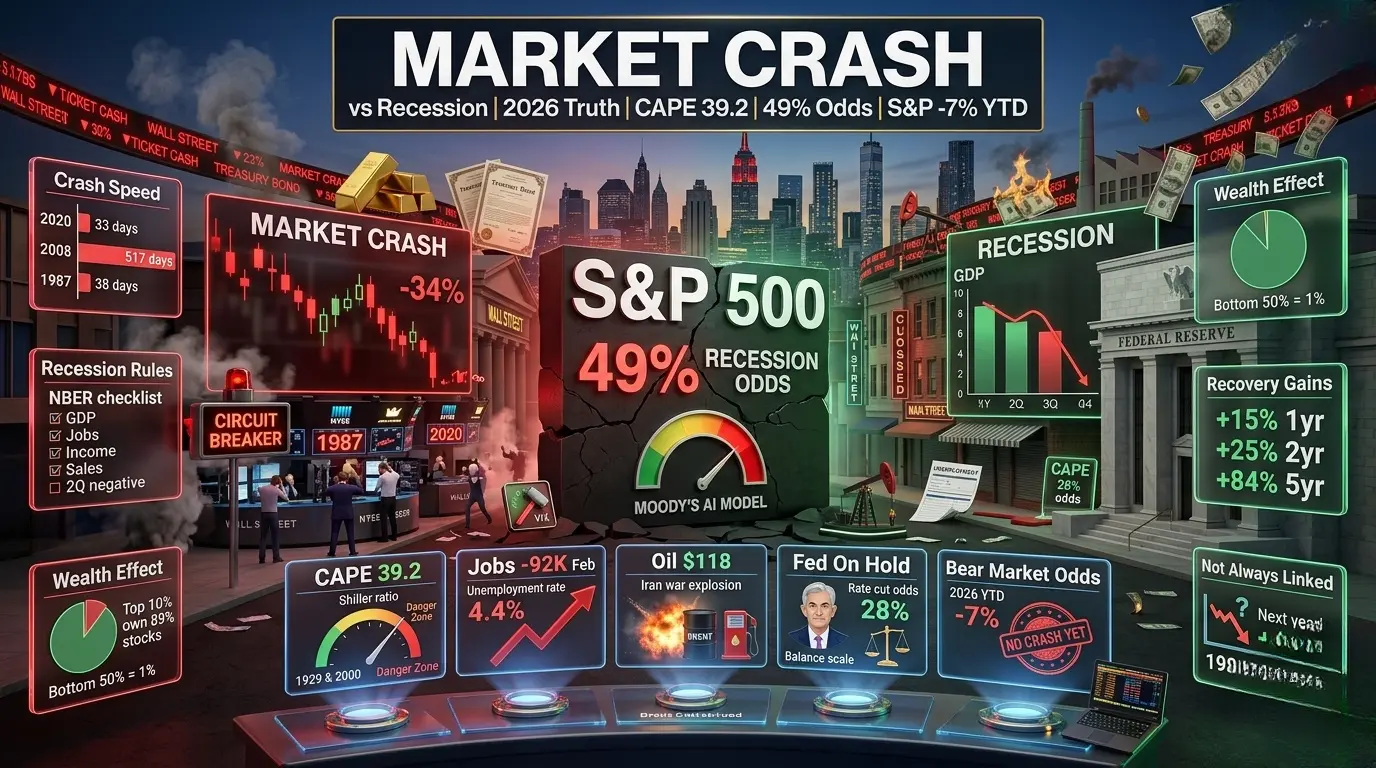
Investors often confuse a stock market crash with a recession, but they are not the same. A market crash is a sudden, severe drop in stock prices. A recession is a prolonged economic contraction. In 2026, the S&P 500 is down 7% year to date, the Nasdaq is down 10%, and recession odds hit 49% on Moody’s AI model. Yet no official recession has been declared. Understanding the difference between a market crash and recession helps you protect your portfolio. This market crash guide explains causes, history, and what to do now.
The market crash term describes a rapid decline of 20% or more in major indexes, often in days. The 2020 COVID crash saw the S&P 500 fall 34% in 33 days. A recession, defined by the NBER, is a significant decline in economic activity lasting more than a few months. GDP, employment, income, and sales must fall. A market crash can happen without a recession. A recession can occur without a market crash. In 2026, we have neither confirmed yet.
Market Crash vs Recession: Key Differences
The market crash is a financial market event. It reflects investor sentiment, liquidity, and panic. The stock market is forward-looking and often prices in recessions 6-9 months early. That means a market crash can be a warning sign, not proof, of recession. Recession is a real-economy event. It shows up in GDP, jobs, and consumer spending.
Since 1980, the S&P 500 has fallen 20% to 55% during recessions. But the market crash of 1987 saw stocks drop 22.6% in one day with no recession. The 2022 bear market fell 25% with no official recession. So a market crash does not guarantee recession. Still, Moody’s AI model says recession odds are 49% as of February 2026. That model has a 100% record: every time it crossed 50%, recession followed within a year.
Market Crash: How Fast It Happens
Event
Decline
Days to Bottom
Recession?
1929 Crash
-89%
989
Yes
1987 Crash
-34%
38
No
2000 Dot-Com
-49%
929
Yes
2008 Financial Crisis
-57%
517
Yes
2020 COVID Crash
-34%
33
Yes, brief
2022 Bear Market
-25%
282
No
2026 YTD
-7%
Ongoing
TBD
The market crash speed varies. COVID was the fastest bear market ever. The 2000 crash was slow. A market crash today could look like either. History says 2026 is risky: the S&P 500 Shiller CAPE ratio hit 39.2 in February. That is the highest since 2000. Only two times in history was it higher: 1929 and 2000. Both ended in a market crash and recession.
A recession needs two quarters of negative GDP. Q4 2025 GDP was revised down to 0.7% from 1.4%. Q1 2026 data is not final, but estimates are 0.3%. The market crash fear comes from jobs: the U.S. lost 92,000 jobs in February 2026 vs expectations of +59,000. Unemployment rose to 4.4%. Inflation is above the Fed’s 2% target. The Iran war pushed oil to $118 in March, raising costs.
Mark Zandi of Moody’s says “almost all the economic data has turned soft since the end of last year.” The market crash risk rises when GDP slows, jobs fall, and inflation stays high. The Fed is on hold. Futures show only a 28% chance of one cut by end of 2026. Kevin Warsh, Trump’s Fed nominee, may cut more, but he told the Senate he made no promises. A markt crash often forces Fed action.
Market Crash: 2026 Warning Signs
Valuations: Shiller CAPE at 39.2. Average is 17. The markt crash risk is high when stocks are expensive.
Recession Model: Moody’s AI at 49%. Crosses 50% = 100% recession history.
Oil Shock: Iran war cut 20% of crude supply. Brent hit $118. Energy stocks are up, but consumers hurt.
Labor Market: Job losses in February. Unemployment rising.
Sentiment: 72% of Americans have negative economic views. 40% expect worse in a year.
Fed Division: FOMC split on rates. Three members dissented in December 2025. Uncertainty fuels markt crash odds.
Yet the market crash has not happened. S&P 500 earnings for 2026 are still solid. 81% of companies beat estimates so far. The index recovered from the Iran war dip. The markt crash needs a catalyst. That could be oil staying high, Fed policy error, or earnings collapse.
Market Crash: Can It Cause a Recession?
Yes, but not always. A market crash destroys wealth. Households spend less. Companies cut investment. Banks tighten lending. That can trigger recession. The 1929 markt crash led to the Great Depression. The 2008 crash caused the Great Recession. But the 1987 markt crash saw GDP grow 4.2% next year. No recession.
The wealth effect matters. The top 10% own 89% of stocks. A markt crash hits them hardest. They cut luxury spending, not essentials. The bottom 50% own 1% of stocks. So a markt crash may not crush consumption unless it lasts. In 2026, households are still spending. Retail sales rose 0.4% in March. A markt crash today might not cause recession if jobs hold.
Recession: Can It Happen Without Market Crash?
Yes. The 1990 recession saw stocks fall only 20%. The 2001 recession saw a -49% market crash, but the recession was mild. In 2022, no recession was declared despite a 25% bear market. Recession depends on GDP and jobs, not stocks. The markt crash is one input, not the definition.
Market Crash: What History Says Happens Next
Since 1926, the S&P 500 had three straight years of 10%+ gains only eight times. 2023, 2024, and 2025 were 24%, 23%, and 16%. After such runs, the next year averaged -2.4%. But results vary. In 1996-1998, the fourth year was +26%. In 1950-1952, the fourth year was +12%. A markt crash is not guaranteed.
After a markt crash, returns are strong. Since 1980, the S&P 500 averaged 15% one year after a 20% fall. Two years later: 25%. Five years: 84%. The markt crash is painful short term, but stocks recover. The 2008 crash took 4 years to recover. The 2020 crash took 5 months. Time in market beats timing a markt crash.
Market Crash: 2026 Scenarios
Scenario
Odds
S&P 500 Move
GDP Impact
Soft Landing
30%
+8% to +12%
+1.5% growth
Mild Recession
45%
-15% to -25%
-0.5% to -1.5%
Market Crash + Deep Recession
20%
-30% to -45%
-2% to -4%
Stagflation
5%
-10% to -20%
0% + 5% inflation
Kalshi puts 2026 recession odds at 28% as of April 1. That rose from under 20% in February due to Iran war and oil. A markt crash probability is not quoted, but history says it rises with recession odds. If oil stays over $100, markt crash odds jump.
Market Crash: How to Protect Your Portfolio
You cannot time a market crash. But you can prepare. First, hold cash. A markt crash creates buying opportunities. Stocks fell 34% in 2020. Buyers made 100% in 12 months. Second, diversify. Bonds, gold, and T-bills do well when stocks fall. Bond funds had 10 months of inflows to March 2026. That is contrarian bearish, but bonds hedge a market crash.
Third, buy quality. Companies with strong cash flow survive a market crash. The S&P 500 earnings are still up. GE Vernova raised guidance. Boston Scientific beat. Fourth, use ETFs. The Vanguard Dividend Appreciation ETF holds stable payers. The iShares 20+ Year Treasury ETF rises when rates fall in a markt crash. Fifth, stay invested. The market has 100% success recovering from a markt crash.
Market Crash: What Not to Do
Don’t panic sell. A market crash locks in losses. The average investor underperforms by 3% per year due to timing.
Don’t use leverage. Margin calls force sales in a market crash.
Don’t chase memes. A markt crash punishes speculation first. SEI token is down 96% from ATH.
Don’t ignore valuations. A markt crash starts when CAPE is high. It is 39 now.
Market Crash: 2026 Timeline So Far
Jan 2026: S&P 500 at record high. CAPE 39.2. Feb: Iran war starts. Oil $118. Moody’s recession model 49%. Mar: Jobs -92,000. GDP revised to 0.7%. Market crash fears rise. Apr: S&P down 7% YTD. Trump extends Iran ceasefire. Earnings beat. S&P closes record high Apr 22. Futures down Apr 23. A maret crash has not happened, but volatility is high.
The Bank of England’s Sarah Breeden warned Apr 23: “The thing that really keeps me awake at night is the likelihood of a number of risks crystallising at the same time.” She cites war, AI bubble, and private credit. A markt crash often needs multiple triggers. In 2026, we have them.
FAQ Section
1. Is a recession coming in 2026?
Possibly. Moody’s model says 49% odds. Kalshi says 28%. GDP is slowing and jobs fell in February. But no official recession yet. Two quarters of negative GDP are needed.
2. What is the difference between a crash and a bear market?
A crash is a sudden drop of 20%+ in days or weeks. A bear market is a 20%+ drop lasting at least two months. Crashes are faster and scarier.
3. Did the market crash in 2022?
No official crash. The S&P 500 fell 25% peak to trough over 282 days. That is a bear market, not a flash crash. There was no recession declared.
4. Can the Fed stop a crash?
Sometimes. Rate cuts and liquidity help. In 2020, the Fed cut to zero and bought bonds. The crash ended in 33 days. But in 2008, cuts did not stop the decline.
5. Should I sell stocks now?
Not based on fear alone. History shows markets recover. If you need money in 1-2 years, reduce risk. If your horizon is 10+ years, stay invested and buy dips.
6. What is the Shiller CAPE ratio?
It is price divided by 10-year average inflation-adjusted earnings. It smooths cycles. Above 30 is expensive. It was 39.2 in Feb 2026, near 2000 levels.
7. Do recessions always follow crashes?
No. 1987 had a 22% one-day crash and no recession. 2022 had a bear market and no recession. But most deep crashes do come with recession.
8. What assets do well in a crash?
Treasury bonds, cash, gold, and defensive stocks like utilities and consumer staples. Long-term Treasuries rose when stocks fell in 2008 and 2020.
Meet Md. Rubel Rana
As a core contributor to Worlddincidents.com, Rubel Rana brings a unique perspective to the world of journalism. Whether it’s deep-diving into historical trivia or covering the latest global headlines, Rubel Rana is committed to delivering high-quality, high-impact articles. Their writing blends meticulous research with a compelling voice, helping readers stay informed and curious about the world around them.

1 thought on “Stock Market Crash: Shocking Truth vs Recession in 2026”