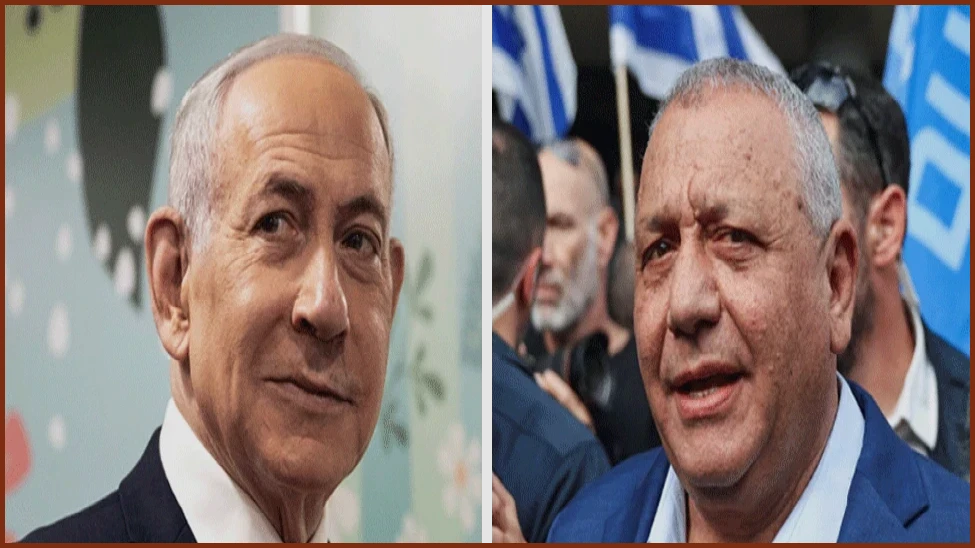
Benjamin Netanyahu has announced his willingness to join a rotating national unity government in Israel that would see opposition leader Gadi Eisenkot take office as prime minister first.
In a social media statement published on Saturday, Netanyahu stated that his responsibility as a leader obligated him to put everything aside, including the traditional principle of the largest parliamentary party taking precedence. Under the proposed arrangement, Netanyahu said he would initially serve as an alternate prime minister.
Following Netanyahu's comments, Eisenkot responded by inviting the caretaker prime minister to genuine and accelerated negotiations over the next 24 hours to test the seriousness of the proposal. Eisenkot emphasized that talks would focus on a detailed proposal his party sent to Netanyahu last Sunday, noting that until now they had received no response.
The sudden shift comes after Eisenkot accused Netanyahu's right-wing Likud party on Friday of stalling coalition negotiations. Eisenkot claimed Likud had failed to present any concrete proposals over the preceding two weeks as the deadline approaches.
Eisenkot was tasked earlier this month by Israeli President Isaac Herzog with forming a government within a 28-day window following consultations with all parliamentary parties after the bitterly contested election in October. The official deadline to finalize a coalition is set for December 6.
The parliamentary breakdown in the 120-seat Knesset leaves both major political groups short of a majority. Eisenkot's centrist Yashar party alongside three other Jewish opposition factions won a combined 48 seats in October's vote, while Netanyahu's political bloc secured 53 seats.
Former Prime Minister Naftali Bennett, who leads the Beyachad party—the fourth member of the Jewish opposition coalition—expressed support on Thursday for a unity government involving Likud with Eisenkot serving first as prime minister. Following Netanyahu's announcement on Sunday, Bennett praised the decision, stating Netanyahu was right to join a unity government based on an alliance of those who serve.
Meanwhile, two Arab-led political alliances, the United Arab List and the Joint List, captured an unprecedented 19 seats after a surge in turnout among Arab voters. Although their seat count positions them as potential key players, all but one of the Jewish parties pledged prior to the election that they would not partner with them to form a governing coalition.
Israel's political history reflects a continuous reliance on coalition governance, as no single political party has ever won an outright majority in the Knesset. Between 2019 and 2022, Israel experienced one of its most politically unstable periods, holding five separate elections as Netanyahu and rival political figures struggled repeatedly to build lasting alliances. In recent political exchanges, opposition figures have also accused Netanyahu of attempting to delegitimize the election outcome.
Related Articles

Md. Kazi Bijoy is a dedicated tech enthusiast and content creator with a passion for digital innovation. With years of experience in the tech industry, he specializes in breaking down complex topics into easy-to-understand guides. When he isn’t writing, he explores the latest gadgets and researches emerging trends in the digital world.