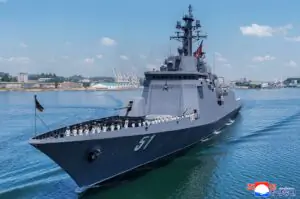
North Korea is rapidly accelerating its naval capabilities, signaling a major shift in its defense priorities toward building a nuclear-armed fleet of large surface warships. On July 3, 2026, Supreme Leader Kim Jong Un observed the launch of nuclear-capable cruise missiles from the guided-missile destroyer Kang Kon (52), which is preparing for commissioning. This launch occurred less than two weeks after the Korean People’s Army Navy (KPAN) formally commissioned the 5,000-ton destroyer Choe Hyon (51) on June 23, 2026. The Choe Hyon represents North Korea’s largest domestically produced surface warship to date.
During the commissioning ceremony for the Choe Hyon, Kim declared that the KPAN had entered a “new era” following “over 70 years” of naval stagnation. This push indicates that Pyongyang has elevated the navy within its military hierarchy, backed by the rapid construction of large surface combatants, the development of new naval bases, and the modernization of existing facilities. Security analysts warn that if this expansion continues, it could challenge allied maritime dominance, complicate U.S. nuclear deterrence efforts, and potentially encourage more aggressive actions from the Kim regime, increasing the risk of conflict on the Korean Peninsula. Fortunately, the United States, South Korea, and Japan can still counter this developing threat.
This rapid naval expansion marks a significant departure from North Korea’s historical difficulties in shipbuilding. In the 2010s, the KPAN struggled to construct and field even smaller vessels. The shift toward a modernized force began to take shape in 2023 when Kim emphasized KPAN growth to increase its strategic role. In February 2026, during the 9th Congress of the Workers’ Party of Korea, Kim unveiled a new five-year defense plan. This strategy aims to upgrade all military bases, strengthen the southern border, and elevate conventional weapons to a “world-class” standard.
Under this plan, Kim announced in March 2026 that the KPAN must construct at least two vessels of the Choe Hyon class or larger every year. The ultimate goal is to field a fleet of at least 12 large surface combatants by the early 2030s. In June 2026, Kim expanded these ambitions, directing his regime to accelerate the design and construction of a massive 10,000-ton guided-missile cruiser and to build additional naval bases. To support these quotas, North Korea appears to be expanding its shipyards in Chongjin and Nampho.
This accelerated pace contrasts sharply with the prolonged development of North Korea’s previous naval projects. Before building the Choe Hyon, Pyongyang’s naval efforts focused on two classes of 2,000-ton corvettes: the Amnok and Tuman classes. The Amnok-class vessels, which feature a reduced radar cross-section, are armed with a 100mm main gun, anti-submarine rocket launchers on the bow, missile launchers for anti-air and potentially anti-ship missiles, and a close-in weapon system similar to the Soviet AK-630. However, when the Amnok-class Patrol Ship No. 661 debuted in state media in August 2023, experts noted its weapons and sensors were severely obsolete compared to Western and other Asian designs. Furthermore, No. 661 took over a decade to complete, with construction starting in 2011, entering service in 2017, and finally debuting its capabilities in 2023.
The Tuman-class corvettes faced similar delays. Initial construction began in 2011 and finished in 2013, but the vessels underwent extensive reconstructions starting in 2014 and 2017, suggesting major design or armament issues. While state media has not officially announced their commissioning, reports indicate at least one Tuman-class vessel is active on the register. The rapid, successful rollout of the Choe Hyon-class destroyers highlights how quickly Pyongyang has overcome these past industrial bottlenecks to build a formidable surface fleet.

Md. Kazi Bijoy is a dedicated tech enthusiast and content creator with a passion for digital innovation. With years of experience in the tech industry, he specializes in breaking down complex topics into easy-to-understand guides. When he isn’t writing, he explores the latest gadgets and researches emerging trends in the digital world.