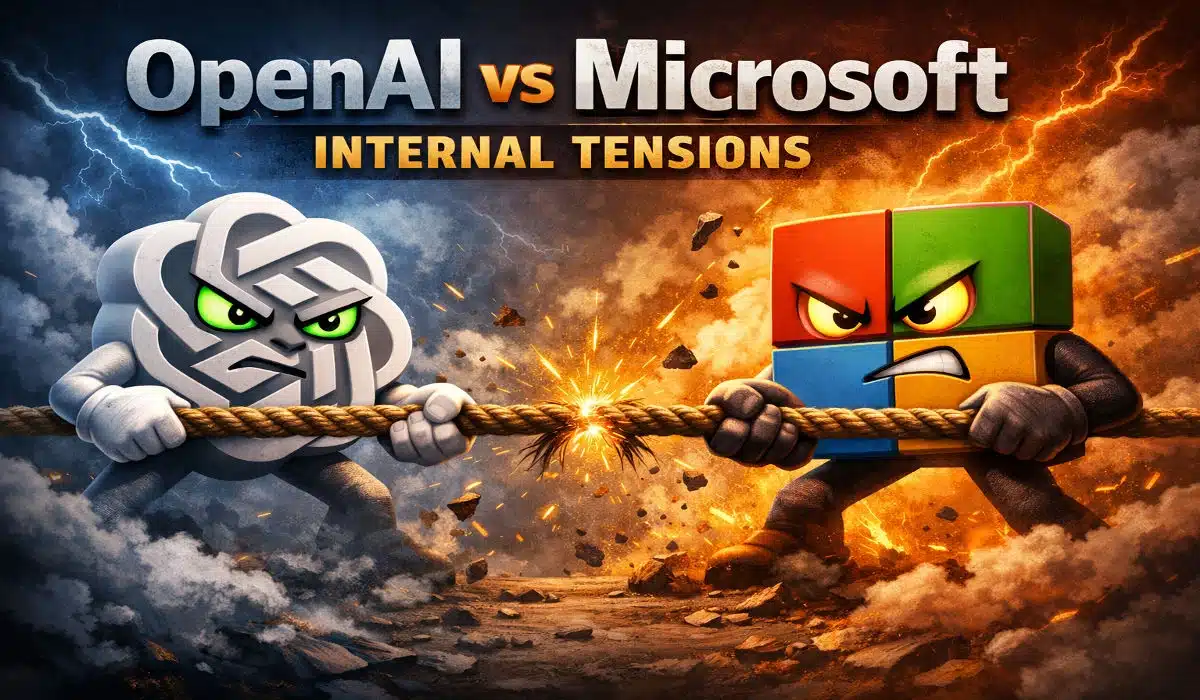
As of April 14, 2026, the alliance that defined the generative AI era is facing its most significant test. What began as a $13 billion “foundational partnership” has evolved into a complex web of OpenAI vs Microsoft Internal Tensions. While Microsoft CEO Satya Nadella once claimed he was “all in” on OpenAI, 2026 has seen both companies building redundant systems to reduce their mutual dependency.
Microsoft’s Move Toward Self-Sufficiency
The primary catalyst for the current OpenAI vs Microsoft Internal Tensions is the rise of Microsoft’s internal AI division, led by Mustafa Suleyman. In early April 2026, Microsoft launched its MAI (Microsoft Artificial Intelligence) model family, including MAI-Transcribe-1 and MAI-Image-2.
These models are built entirely in-house, directly competing with OpenAI’s Whisper and DALL-E. For Microsoft, this is about “cost of goods sold.” Relying on OpenAI’s models via Azure is expensive; by using their own MAI models, Microsoft can significantly boost its margins on Copilot and Azure AI Foundry. This move has reportedly left OpenAI’s leadership feeling that Microsoft is “strip-mining” their research to build a rival.
The Amazon Pivot
Perhaps the most shocking development in the OpenAI vs Microsoft Internal Tensions is OpenAI’s recent move to diversify its cloud infrastructure. On April 14, 2026, an internal memo from OpenAI’s revenue chief, Denise Dresser, revealed that OpenAI is deepening its collaboration with Amazon Web Services (AWS).
OpenAI’s leadership argued that the exclusive reliance on Microsoft’s Azure was “holding them back” from reaching enterprise clients who prefer AWS Bedrock. By making GPT-5 and subsequent models available on Amazon, OpenAI is effectively ending the “exclusive” nature of the Microsoft partnership that investors once viewed as a moat.
The “Stargate” Conflict and Data Center Wars
Financial friction is another major pillar of the OpenAI vs Microsoft Internal Tensions. The ambitious “Stargate” supercomputer project—a $100 billion data center venture—has become a point of contention.
Microsoft’s Stance: Facing a stock price correction in early 2026, Microsoft has become more cautious about massive capital expenditures.
OpenAI’s Response: Sam Altman has reportedly explored independent funding for data centers and custom chips, signaling that OpenAI no longer wants to be at the mercy of Microsoft’s hardware roadmap.
The Recapitalization and the Public Benefit Corporation (PBC)
The internal friction reached a legal peak in late 2025 and early 2026 as OpenAI moved to transition into a for-profit Public Benefit Corporation (PBC). Microsoft, which holds a 27% stake after the recapitalization, has reportedly used its “nuclear option” to stall negotiations.
Microsoft is demanding a larger share of the new PBC than OpenAI is willing to offer. Sam Altman has described these negotiations as containing “points of tension,” while Microsoft insiders suggest the tech giant is “making OpenAI sweat” to maintain its lead in the AI race.
Copilot vs. ChatGPT
The battle for the end-user has also intensified. While Microsoft integrates “Agentic AI” into the Windows OS via Copilot, OpenAI has launched its own ChatGPT Pro Plan and independent OS-level assistants. The OpenAI vs Microsoft Internal Tensions are visible to the average consumer as both companies fight for “primary AI” status on the desktop, often duplicating features in a way that confuses enterprise customers.
Microsoft’s Move Toward Self-Sufficiency
The primary catalyst for the current OpenAI vs Microsoft Internal Tensions is the rise of Microsoft’s internal AI division, led by Mustafa Suleyman. In early April 2026, Microsoft launched its MAI (Microsoft Artificial Intelligence) model family, including MAI-Transcribe-1, MAI-Voice-1, and MAI-Image-2-Efficient.
These models are built entirely in-house, directly competing with OpenAI’s Whisper, DALL-E, and Voice Engine. For Microsoft, this is a strategic push toward “self-sufficient AI” to reduce the high licensing costs paid to OpenAI. By deploying these MAI models within Microsoft Foundry and Copilot, Microsoft is effectively moving line items off OpenAI’s balance sheet and onto its own. This move has reportedly left OpenAI’s leadership feeling that Microsoft is using its partnership access to build a rival stack that undercuts OpenAI’s enterprise value.
IPO Timelines vs. Staggering Losses
Financial friction has reached a boiling point in the OpenAI vs Microsoft Internal Tensions due to OpenAI’s projected $14 billion loss for 2026. While CEO Sam Altman is reportedly pushing for a 2026 public listing following a recent $122 billion recapitalization, Microsoft and internal skeptics like CFO Sarah Friar are urging caution.
Microsoft, which recently saw its stake in the new OpenAI Public Benefit Corporation (PBC) valued at over $100 billion, is wary of a premature IPO that could expose the partnership’s financial vulnerabilities. This tension is further complicated by Elon Musk’s ongoing legal battle against the PBC restructuring, which Microsoft fears could tie up its equity in years of litigation. OpenAI’s decision to consume 2 gigawatts of Trainium capacity through its new $100 billion Amazon partnership is seen by many as a direct financial retaliatory move against Microsoft’s tightening grip on computing resources.
The Talent and “Observer” Friction
The OpenAI vs Microsoft Internal Tensions have recently manifested in a quiet but fierce battle for talent and governance. In early 2026, Microsoft officially dissolved its non-voting observer seat on the OpenAI board—a move that was publicly framed as “confidence in OpenAI’s new governance” but was internally seen as a strategic distancing to avoid antitrust scrutiny.
Simultaneously, Microsoft’s aggressive hiring of former OpenAI engineers for its Microsoft Foundry and Agentic AI divisions has created deep-seated resentment within Sam Altman’s team. OpenAI insiders have reportedly labeled Microsoft’s recruitment tactics as a “talent raid,” aimed at building MAI models using the very expertise that OpenAI painstakingly cultivated. This “brain drain” has forced OpenAI to implement stricter non-compete clauses and massive retention bonuses, further ballooning their $14 billion projected loss for 2026. This competition for the world’s best AI researchers is perhaps the most personal and damaging aspect of the OpenAI vs Microsoft Internal Tensions, as it directly threatens OpenAI’s ability to maintain its lead in the race toward AGI.
FAQ
Q1: Why is OpenAI partnering with Amazon in 2026?
Ans: To reach more enterprise customers. The exclusive Microsoft partnership limited OpenAI’s ability to cater to businesses already integrated into the AWS ecosystem.
Q2: What are Microsoft’s MAI models?
Ans: These are foundational AI models built entirely in-house by Microsoft’s AI team (led by Mustafa Suleyman) to reduce reliance on OpenAI and lower operational costs.
Q3: Is the Microsoft-OpenAI partnership over?
Ans: No. Legally, the partnership is secured through at least 2030 (and 2032 for certain IP rights). However, the OpenAI vs Microsoft Internal Tensions suggest a shift toward competition in the frontier model space.
Conclusion
The OpenAI vs Microsoft Internal Tensions do not signify an immediate breakup—the 2025 agreement extends Microsoft’s IP rights through 2032—but the “honeymoon phase” is officially over. Both companies are now operating as “frenemies,” collaborating on legacy systems while racing to build independent futures.
read more: Instacart Acquires Instaleap

Mr. Udoy is a professional Web Developer and Blogger with 7+ years of experience in the tech world. He specializes in web architecture and digital storytelling. As the driving force behind worldincidents.com, he focuses on delivering high-quality, well-researched content to a global audience.