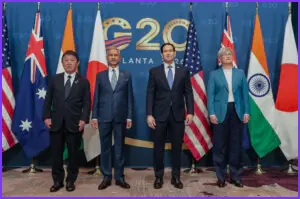
Foreign ministers representing the Quad nations—the United States, India, Japan, and Australia—convened in Atlanta, Georgia, on October 31 on the sidelines of the G20 Foreign Ministers' Meeting. The session marked the third gathering of Quad foreign ministers in 2026, following prior talks hosted in New Delhi in May and Manila in July. The sequence of diplomatic engagements reflects a steadily expanding agenda across the Indo-Pacific ahead of the long-awaited Quad Leaders' Summit, which is anticipated to take place in Manila later this month.
Expectations surrounding the upcoming leaders' meeting have grown significantly since the 2025 Quad Leaders' Summit, originally slated to be hosted in New Delhi, was cancelled. The upcoming convening in Manila will mark the first top-level Quad summit since U.S. President Donald Trump returned to the White House. Observers note that the summit could offer crucial momentum and address ongoing speculation about the stability of the alliance amid cascading global conflicts, constraints on energy and technology supply chains, and rising commentary about an emergent G3 power structure involving China, Russia, and the United States managing spheres of influence.
Despite the focus on executive leadership, the Quad's foreign minister engagements throughout 2026 have yielded concrete policy outcomes. Highlighting the October 31 Atlanta meeting was an intention to provide more than $85 million in technical and financial assistance aimed at facilitating trusted artificial intelligence access across the Indo-Pacific. Additionally, the United States committed $10 million toward promoting infrastructure and specialized facilities in India and Association of Southeast Asian Nations (ASEAN) member countries designed to recover critical minerals from waste streams.
These economic and technological measures coincide with alignment among Quad partners against unfair commercial practices. In their joint statement following the Atlanta session, the foreign ministers voiced shared concern over arbitrary export restrictions, non-market policies, and practices leading to overcapacity that disrupt global supply chains in vital sectors. Furthermore, the grouping strengthened its institutional standing in the region by defining member states as ASEAN Comprehensive Strategic Partners. During their July session in Manila, the Quad explicitly backed the practical implementation of the ASEAN Outlook on the Indo-Pacific (AOIP), focusing on maritime security, transnational security, economic resilience, emerging technologies, and emergency response.
To reinforce commercial collaboration, the ministers announced the establishment of the first Quad Business Leaders' Forum in Atlanta. The forum is designed to bridge a long-standing gap by establishing a dedicated private-sector platform connecting government officials, policy experts, and corporate leaders from India, the United States, Japan, and Australia. In a related step to bolster project funding, export credit agencies from the four Quad nations are scheduled to meet in Tokyo on November 18 to explore opportunities for joint public finance mobilization.
Energy security also featured prominently in the diplomatic negotiations following the launch of the Quad Initiative on Indo-Pacific Energy Security in May 2026. Joint statement updates confirmed that the inaugural Quad Fuel Security Forum was held in September 2026 to enhance regional fuel security by expanding strategic petroleum reserves and stockholdings. This focus responds directly to persistent market disruptions linked to the ongoing crisis in the Strait of Hormuz. Although Asian crude oil imports recovered by October 2026 to levels seen prior to the Iran conflict, significant pressure remains in downstream derivatives and refined products like diesel due to operational constraints on refining capacity in Russia and the Middle East.
The Atlanta joint statement also provided progress reports on multiple operational initiatives first outlined during the New Delhi meeting in May. In September 2026, member states completed the second Quad-at-Sea Ship Observer mission. During the same month, Japan's Ministry of Defense hosted the second Indo-Pacific Logistics Network Tabletop Exercise, further operationalizing defense and logistics interoperability among the member nations.
Through three minister-level sessions spanning New Delhi, Manila, and Atlanta, the Quad has systematically defined shared priorities, transitioned policy proposals into action, and expanded public and private engagement mechanisms. As member states prepare for the upcoming summit in Manila, the alliance enters the final stretch of 2026 with an established routine that officials hope to scale further in the coming year.
Related Articles

Md. Kazi Bijoy is a dedicated tech enthusiast and content creator with a passion for digital innovation. With years of experience in the tech industry, he specializes in breaking down complex topics into easy-to-understand guides. When he isn’t writing, he explores the latest gadgets and researches emerging trends in the digital world.