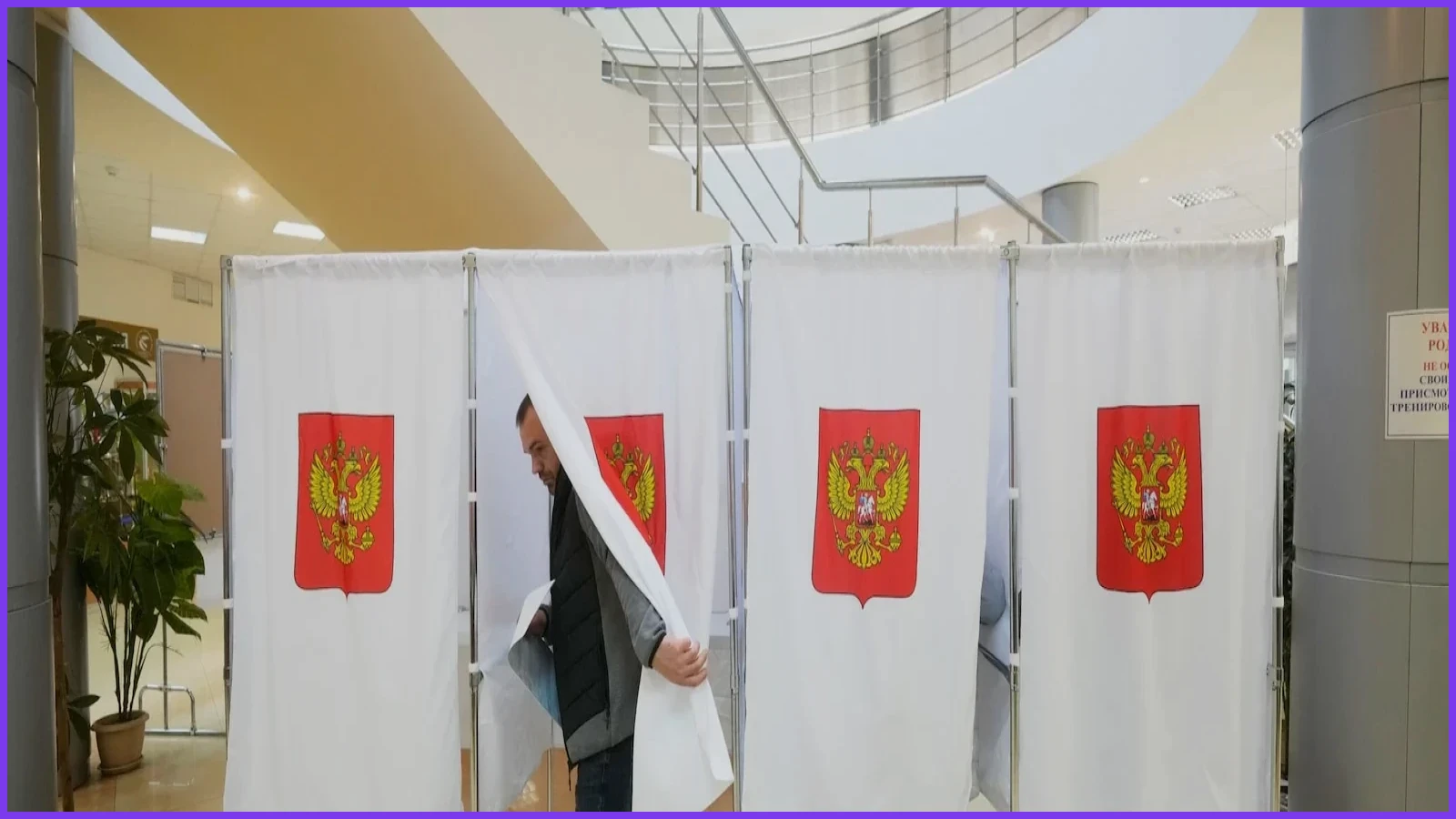
Russia’s liberal opposition Yabloko party reported that one of its election observers lost consciousness while being taken into custody by police at a polling station in St. Petersburg on Saturday. The incident occurred on the second day of the nation’s three-day parliamentary election, which is the first such vote held since the full-scale invasion of Ukraine began on February 24, 2022. The election, which began on Friday and concludes on Sunday, is widely expected to secure the Kremlin’s political dominance, as it features virtually no meaningful opposition.
According to a statement released by Yabloko on Telegram, officials at the polling station accused the party observer of attempting to “disrupt the elections.” They subsequently called the police, who the party claims “used force” against the observer. While it remained unclear whether the individual received immediate medical attention after falling unconscious, the party confirmed he was transported to a police station and charged with disobeying police orders. Russian officials did not immediately provide comment regarding the incident.
Yabloko, the only registered political entity that openly criticized the war in Ukraine, was removed from the ballot by Russia’s Supreme Court last month, leaving only a few dozen candidates in single-constituency races. Many other anti-war politicians have been imprisoned or forced to flee abroad prior to the campaign. Both Yabloko and the Communist Party, which has criticized some government policies while avoiding direct criticism of President Vladimir Putin, reported that many of their election observers were turned away from polling stations.
The parties also documented various irregularities, including the opening of sealed ballot boxes, the refusal to issue paper ballots or provide turnout data for verification, and reports that polling station doors were not secured overnight. On Friday, Yabloko chairman Nikolai Rybakov appealed to Ella Pamfilova, head of the Central Election Commission, regarding the numerous denials of entry and pressure placed on observers. “The scale of what’s happening does not allow us to view this as a misunderstanding,” Rybakov stated.
Russia did not invite observers from the Organization for Security and Cooperation in Europe (OSCE) to monitor the election, with the Russian Foreign Ministry accusing the body of “double standards.” In its place, Russia invited other international organizations and observers from OSCE member states. Pere Joan Pons, President of the OSCE Parliamentary Assembly, criticized the decision as a breach of Russia’s commitments, noting that the “persistent rejection of independent scrutiny follows a deeply worrying pattern of disregard for the principles of transparency, democratic accountability and the rule of law.”
The Russian Central Election Commission stated that more than 380,000 electoral observers were registered before the vote, including representatives from 11 political parties. Of those, 97,040 were linked to the United Russia party, while 42,743 represented the Communist Party. The commission also reported that 1,126 international observers and “electoral experts” from 133 countries and 13 international organizations were registered. Ahead of the vote, Russia introduced a new code of ethics that bans observers from making statements “that could be construed as undermining confidence in the electoral system.”
To boost turnout among the 111 million eligible voters, authorities spread the election over the weekend and permitted electronic balloting. For the first time, the parliamentary election includes residents of four Ukrainian regions that Moscow illegally annexed after the war began, as well as the Crimean peninsula, which was illegally annexed in 2014. The Kremlin aims for the vote to demonstrate public support for the war and provide a veneer of legitimacy, while seeking to eliminate any political risk by suppressing even the slightest signs of dissent. The main Kremlin party, United Russia, is expected to retain its overwhelming control of the State Duma, alongside smaller parties of the “systemic opposition” that typically vote in sync with the government.
Related Articles

Md. Kazi Bijoy is a dedicated tech enthusiast and content creator with a passion for digital innovation. With years of experience in the tech industry, he specializes in breaking down complex topics into easy-to-understand guides. When he isn’t writing, he explores the latest gadgets and researches emerging trends in the digital world.