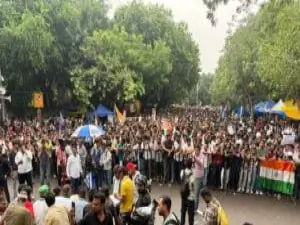
Students gathering at New Delhi’s Jantar Mantar are drawing comparisons to the historic Tahrir Square protests in Cairo, though the objectives of the two movements remain fundamentally distinct. While the Egyptian uprising sought the total dismantling of Hosni Mubarak’s three-decade authoritarian regime, the demonstrators in New Delhi are focused on demanding government accountability and the resignation of Education Minister Dharmendra Pradhan. Despite these differences, both movements are anchored in the shared frustration of a generation that feels its aspirations are being ignored by an unresponsive state.
The Jantar Mantar protest is not a revolutionary attempt to overthrow the government. Instead, it represents a determined effort to compel the state to uphold its constitutional duties and restore public faith in critical institutions. The movement serves as a visual manifestation of a generation facing broken promises, limited opportunities, and governance that many perceive as increasingly arrogant. This sentiment is particularly directed at the Narendra Modi government’s performance over the last 14 years, with protesters arguing that legitimate grievances regarding administrative failures and corruption are frequently met with insults or dismissal rather than genuine engagement.
Public confidence has been further eroded by the government's handling of recurring examination paper leaks. Beyond the reassignment of the education secretary to a different department, officials have failed to propose significant structural reforms. Furthermore, Education Minister Dharmendra Pradhan has not publicly reached out to comfort the students who were forced to retake examinations due to these security breaches.
A unique display of public solidarity has emerged at the protest site, where citizens from across India and abroad are utilizing food delivery platforms like Zomato and Swiggy to send bulk meals—including pizzas, burgers, and local snacks—to the demonstrators. The volume of food has become so substantial that organizers have requested supporters to stop sending deliveries. This spontaneous act highlights the empathy of those unable to join the protest in person.
Ultimately, Jantar Mantar has become a barometer for the social contract in India. The presence of thousands of educated youth traveling hundreds of miles to sleep on Delhi’s pavements serves as a stark message that democratic channels, such as petitions and formal representations, have failed to make their voices heard. As the roar of slogans at the site continues to grow, the government faces increasing pressure to break its silence before it is too late.
It is tempting to compare the students’ protest at New Delhi’s Jantar Mantar with Cairo’s Tahrir Square, the epicenter of the uprising that brought to an end Hosni Mubarak’s nearly 30-year rule.
You have reached the limit of 2 free articles this month.

Md. Kazi Bijoy is a dedicated tech enthusiast and content creator with a passion for digital innovation. With years of experience in the tech industry, he specializes in breaking down complex topics into easy-to-understand guides. When he isn’t writing, he explores the latest gadgets and researches emerging trends in the digital world.