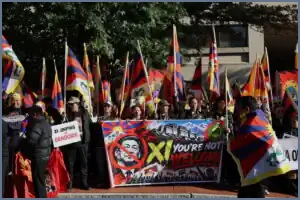
WASHINGTON — A coalition of more than 3,000 protesters, including Tibetans, Uyghurs, Hong Kongers, and Chinese dissidents, flooded the streets of Washington, D.C., on September 24, 2026. The massive demonstration coincided with Chinese President Xi Jinping's high-profile state visit to the White House, where he was hosted by U.S. President Donald Trump. Organizers characterized the mobilization as the largest-ever Tibetan rally in North America, aimed at elevating human rights to the forefront of bilateral discussions.
The protest unfolded as President Xi made his first state visit to the U.S. capital in more than a decade. Inside the White House, President Trump welcomed the Chinese leader for crucial talks covering artificial intelligence, trade policy, and ongoing diplomatic disputes involving Taiwan, Iran, and rare earth minerals. The day's events culminated in a formal state dinner hosted by Trump on Thursday evening. Outside, however, the atmosphere was defined by a diverse assembly of activists demanding political and religious freedom under the banner of the Tibetan Youth Congress (TYC) and supported by various Tibetan advocacy groups.
“Human rights should not be left outside of their talks,” said Tencho Gyatso, president of the International Campaign for Tibet. “The Tibetans, the Uyghurs, the Hong Kongers, the Taiwanese, we want to make sure our voices are also heard there.”
The day of demonstrations began around 9 a.m. outside the Chinese Embassy, where a heavy police presence was deployed to monitor the gathering. Protesters then marched through the capital, carrying Tibetan national flags and signs reading “Xi Jinping is guilty of genocide” and “Tibet was never a part of China.” The march forced the closure of Connecticut Avenue as the crowd moved through Dupont Circle before arriving at the U.S. Capitol, where prominent political figures and community leaders addressed the demonstrators.
Former House Speaker Nancy Pelosi and Representative Jim McGovern, a Massachusetts Democrat, joined the rally at the Capitol to voice their support. McGovern strongly urged the Trump administration to press Xi on human rights issues during their private discussions. “No Xi in D.C. without human rights,” McGovern told the crowd. He also directed sharp criticism at Republican lawmakers, accusing them of declining to join bipartisan efforts to press Beijing. “Are they afraid of Donald Trump? Are they afraid he’ll be offended if they ask him to ask Xi to release prisoners of conscience?” McGovern asked.
Pelosi also spoke to the assembled crowd, calling attention to systemic human rights violations in Tibet and demanding the immediate release of political prisoners. For the Tibetan community, the demonstration carried deep emotional weight, shaped by the recent death of Lobga Rangzen. The 52-year-old longtime independence activist died after self-immolating outside the United Nations headquarters in New York on July 2, leaving a final message calling for Tibetan independence and unity.
To honor his memory and raise awareness, a group of 17 Tibetans set off on foot from the UN headquarters on September 17. The walkers traveled through Philadelphia before arriving in Washington on the evening of September 23, the same day President Xi arrived in the capital. Rangzen Dolkar, one of the participants who left her two children and took time off work for the march, explained that the journey was vital to explaining the situation in Tibet to the public. She noted that the honorary title of "Pawo" is bestowed upon individuals like Lobga Rangzen who sacrifice their lives to draw attention to Tibet.
Jigme Ugen, president of the Tibetan National Congress, emphasized that the scale of the Washington rally proved the vitality of the independence movement. “This is the biggest gathering, as such, to not just protest Xi Jinping, but also to tell the world and the U.S. government that the Tibetan movement, and the call for Tibetan independence, is still very much alive,” Ugen said. He added that activists are no longer looking for simple statements from Washington, pointing out that the U.S. already has legislative frameworks in place, such as the Tibetan Policy and Support Act of 2020, which Trump signed during his first term. “All they need to do is to actually stand on those,” Ugen remarked.
Tsering Chomphel, the president of the Tibetan Youth Congress who traveled from India for the protest, reported that participants had journeyed from New York, New Jersey, Connecticut, Philadelphia, Boston, Chicago, Vermont, and Toronto. “This is the first-ever mass gathering in North America. Whenever Xi Jinping or a Chinese delegation visits, TYC will be there to make sure our voices are heard,” Chomphel said.
Following the Capitol rally, the demonstration transitioned to Franklin Park, located half a mile from the White House. There, representatives from the Uyghur, Taiwanese, Burmese, and Hong Kong communities spoke to the crowd. Misran Dolan, president of the Uyghur American Association, framed the protest as a unified struggle for fundamental freedoms. “Free the Uyghurs. Free the Tibetans. Keep Taiwan free. Keep Hong Kong free. Keep China free,” Dolan declared, estimating that about 200 members of the Uyghur community attended the rally. “All of us here have moved away from our homelands. And now we’re here in the United States … to exercise those rights – freedom of speech, freedom of expression, freedom of religion.”
The coalition also featured Chinese democracy advocates, including approximately 50 members of the Democratic Party of China who traveled from Los Angeles. Representative Zheng Zhou demanded an end to political persecution and called for the release of high-profile dissidents. “We want Xi Jinping to stop persecuting people. We want him to free Jimmy Lai, Ding Jiaxi,” Zhou said. Jimmy Lai, the billionaire founder of Hong Kong's pro-democracy newspaper Apple Daily, was sentenced to 20 years in prison in February 2026 on charges of conspiracy to commit sedition and collusion with foreign forces. U.S. Secretary of State Marco Rubio had previously condemned the sentence as unjust and tragic, calling on Beijing to grant Lai humanitarian parole.
Religious persecution was another focal point of the speeches. Daniel Zhou, a Chinese Christian belonging to an underground church operating outside state-sanctioned systems, spoke about the severe restrictions faced by believers. “Our church leaders have to stay in Chinese jails, leaving their families praying and crying at home, just because they wanted to practice their religion peacefully in China,” he said.
Cynthia Sun, a senior researcher at the Falun Dafa Information Center, shared harrowing accounts of forced organ harvesting in Chinese prisons, referencing the 2019 independent China Tribunal findings that concluded such practices occurred on a significant scale. Sun, who was born in July 1999—the exact month the Chinese government banned the spiritual practice—expressed her hope that the persecution would not persist for future generations. “I don’t want this to be the burden of my children, my grandchildren,” she said.
As night fell, the protesters marched toward the White House, where police had established barricades near 14th Street and Pennsylvania Avenue. The barriers separated the human rights demonstrators from a counter-protest group holding Chinese national flags in support of President Xi. The two sides engaged in a loud shouting match across the street, though Metropolitan Police officers successfully prevented any physical altercations. Inside the executive mansion, the state dinner proceeded while the opposing factions remained divided by the security corridor outside.
Related Articles
Md. Kazi Bijoy is a dedicated tech enthusiast and content creator with a passion for digital innovation. With years of experience in the tech industry, he specializes in breaking down complex topics into easy-to-understand guides. When he isn’t writing, he explores the latest gadgets and researches emerging trends in the digital world.