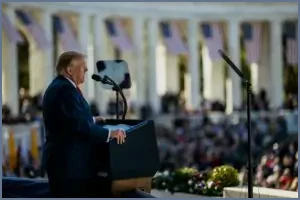
U.S. President Donald J. Trump delivered remarks at a Veterans’ Day ceremony at Arlington National Cemetery in Arlington, Virginia, on Nov. 1, 2026. U.S. foreign policy enters a period of uncertainty as the president prepares for a series of high-stakes summits in Asia. Following a November 3 election in which Democrats secured control of both the Senate and the House, the president finds himself in a weakened position domestically two years before the end of his term. Despite these political challenges at home, the president is scheduled to engage in a packed diplomatic schedule, beginning with meetings in Manila and concluding in Shenzhen and Miami. Later this week, the presidents of the United States and China will meet again in a multilateral setting; it is their third meeting in 2026 following bilateral summits in May and September.
The president, who built his brand on contempt for multilateralism, will spend his first post-midterm weeks in multilateral meetings: the ASEAN–U.S. summit and the first Quad leaders’ meeting in 20 years, both in Manila, then the APEC Leaders’ Meeting in Shenzhen, and in December the G-20 at his own resort in Miami. As Edgard Kagan, a former U.S. ambassador currently with the Center for Strategic and International Studies, noted, foreign travel offers a platform that domestic opposition cannot easily disrupt. While the president built his brand on a skepticism of multilateralism, these summits serve as a critical stage to determine the extent of his remaining international influence.
The value of these meetings often lies in the sideline interactions rather than the formal communiques. Observers will be closely monitoring which leaders seek out the U.S. president and which prioritize meetings with Chinese President Xi Jinping or Premier Li Qiang. Xi skipped the G-20 in 2023 and 2025 but has kept coming to APEC, and this year he is the host. Putin is planning to come to Shenzhen for his first in-person attendance at APEC since 2017, but is expected to skip the G-20 in Miami. This week’s gatherings serve as an immediate test of how regional partners, many of whom have been impacted by Washington’s tariff policies, will interact with a president who has lost his congressional majority.
In Manila, the president’s stay will be brief. He is expected to arrive after the East Asia Summit has already commenced to participate in the ASEAN–U.S. meeting, the Quad summit, and a bilateral session with President Ferdinand Marcos Jr. While the White House hopes for progress on a technology agenda, expectations remain modest. The success of these meetings will be measured by whether the Quad remains functional and if regional leaders continue to align with Washington.
Following the ASEAN events, the president will travel to Shenzhen. The White House has characterized the upcoming meeting with Xi as a routine visit, distinct from their major bilateral summits held in May and September. Unlike the United States, which has shown intermittent interest in APEC, China has utilized the organization to integrate its economy into the global market since 1991. When the U.S. president skipped the leaders’ summit last year, Beijing effectively positioned itself as a champion of free trade.
The Shenzhen visit is primarily focused on securing time with President Xi and potentially organizing a three-way discussion with Russian President Vladimir Putin regarding Iran and denuclearization. However, the host, Beijing, retains control over the staging of these events. While Washington seeks immediate policy wins to address domestic political vulnerabilities, Beijing is focused on long-term rules that serve its interests. China has utilized its year as APEC chair to promote open trade and resilient supply chains, positioning these goals as a contrast to U.S. protectionism.
Hosting the summit presents specific risks for China, as seen in 2018 when leaders failed to issue a joint declaration due to trade disagreements. To declare the Shenzhen summit a success, Beijing must secure a consensus statement, advance regional free trade, manage the trilateral meeting with Trump and Putin, and maintain engagement from U.S. allies.
Related Articles

Mr. Udoy is a professional Web Developer and Blogger with 7+ years of experience in the tech world. He specializes in web architecture and digital storytelling. As the driving force behind worldincidents.com, he focuses on delivering high-quality, well-researched content to a global audience.