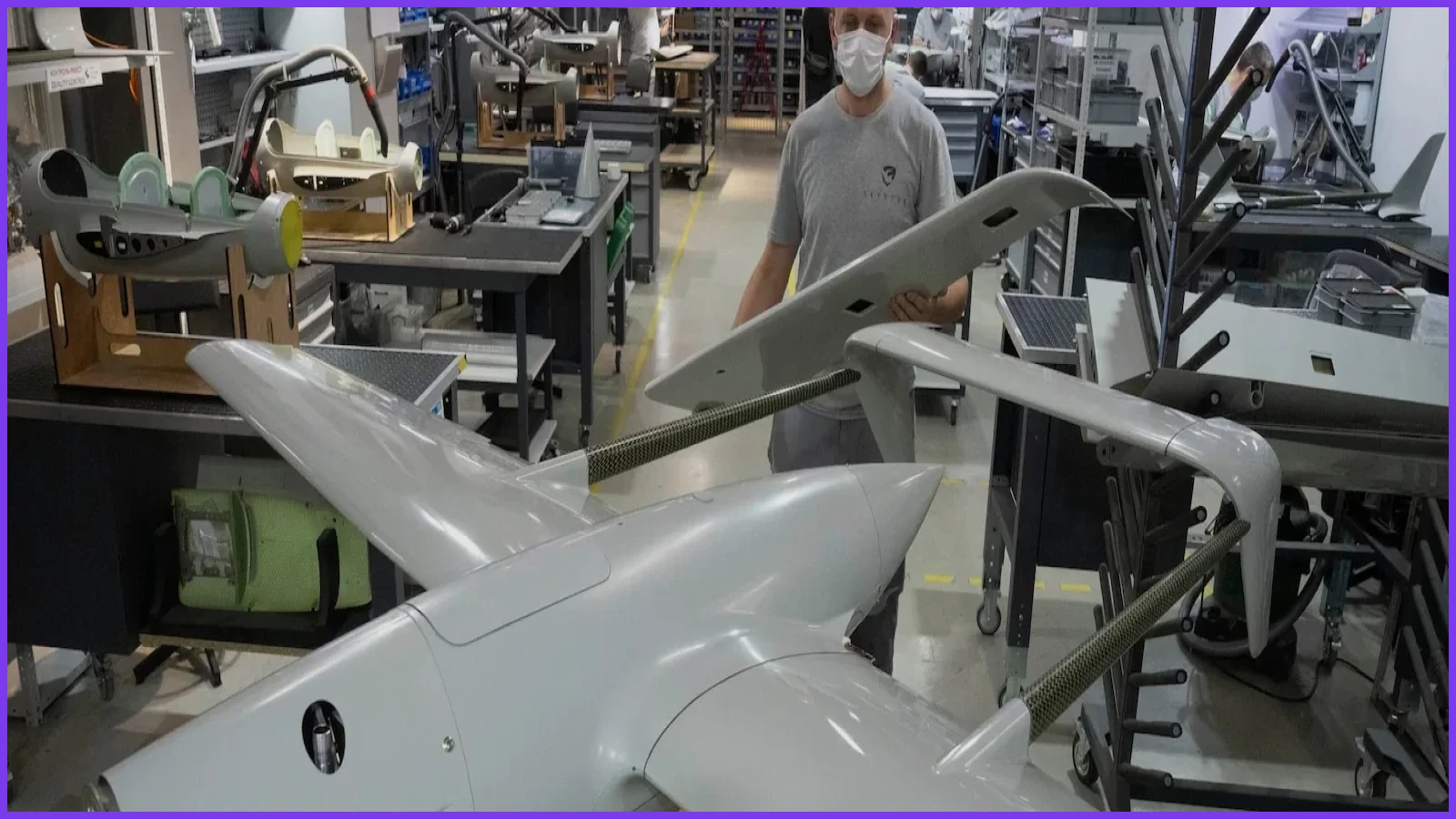
Since Russia launched its invasion more than four years ago, Ukraine has transformed into a global leader in military drone innovation, a development that has allowed its forces to hold a much larger enemy to a stalemate. However, this technological force multiplier has introduced an unsettling strategic vulnerability: the Ukrainian drone industry remains heavily dependent on electronics manufactured in China, a nation that serves as a key ally to Russia. Ukrainian officials and industry leaders are increasingly concerned that the Chinese government could severely restrict access to these essential components. There is also a persistent fear that Chinese factories might prioritize the needs of Russian defense companies, potentially leaving Ukraine without the supplies necessary to maintain its battlefield capabilities.
Over the past two years, Ukraine has made a concerted effort to break its dependence on China by expanding domestic manufacturing capabilities and diversifying its supply chains through imports from Taiwan, Europe, and the United States. These initiatives have successfully reduced the immediate need for Chinese-made flight controllers and electric motors. Despite these efforts, achieving complete independence remains a significant challenge, as allied suppliers often cannot match the lower costs and vastly superior production capacity offered by Chinese firms. Andrii Taganskyi, an executive at the Ukrainian weapons manufacturer Odd Systems, which develops drone cameras, highlighted the gravity of the situation. "If China stops their production to us … we are blinded," Taganskyi said. "This is the scariest part."
Robert Tallost, a researcher at the think tank RUSI, noted that China possesses significant leverage in this dynamic. "China has leverage," Tallost said. "They could direct more material to Russia while restricting supplies to the West." In response to these concerns, China’s Foreign Ministry stated that Beijing maintains a "prudent and responsible" approach to military exports. The ministry added that it opposes the use of civilian drones for military purposes and has urged all parties involved to seek a political settlement to the ongoing conflict.
The difficulty of localizing production is widespread across the industry. A dozen Ukrainian manufacturers reported that critical components—including battery cells, thermal sensors, chips, motors, and magnets—still largely originate from China. Oleksandr Yakovenko of TAF Industries, a major Ukrainian defense firm, explained that transitioning entirely to Western alternatives would be prohibitively expensive. According to Yakovenko, such a shift could increase costs by as much as 60% while simultaneously reducing production output by a similar amount, a tradeoff that he and other executives view as non-viable.
Despite these barriers, Ukrainian drone makers have begun to successfully wean themselves off Chinese components. Oleksii Babenko, founder of the drone manufacturer Vyriy, noted that three years ago, his company relied on China for nearly 90% of its attack drone components. "Today, about 70% to 80% of our components are made in Ukraine," Babenko said. This shift toward domestic production provides a tactical advantage in a grueling war, as domestically produced components can be redesigned in days to meet urgent battlefield requirements, whereas foreign supply chains can take months to implement similar changes, according to Artur Savchii, an analyst at the Kyiv-based think tank Serpens Center for International Security.
Official data reflects this trend, though analysts warn that the numbers may be misleading. At the start of 2024, nearly 90% of Ukraine’s imported drone parts came directly from China, but that figure dropped to 28% in the first eight months of 2026, according to Ukraine Customs data. However, many components now recorded as originating from countries like Poland or the Czech Republic are likely manufactured in China and simply routed through those nations. Furthermore, while Ukraine can assemble batteries, it remains dependent on imported cells, and motors still require imported copper and magnets. While Ukraine can manufacture some electronics, Chinese companies continue to produce them at a significantly larger scale and for roughly half the cost.
Thermal cameras illustrate the complexity of this dependency. Although Ukrainian companies design these cameras, they remain reliant on imported lenses and infrared sensors that cannot be produced domestically. One of the primary raw materials required is germanium, which is abundant in China, making Chinese lenses far more affordable than European alternatives. Taganskyi noted that while the U.S. and Europe do produce sensors, most are reserved for domestic use. He estimated that Europe produces about 600,000 thermal sensors annually, which falls far short of Ukraine’s estimated requirement of 4 million. "Without this 5%, there is no camera," Taganskyi said.
President Volodymyr Zelenskyy recently addressed the advantage Russia holds in its relationship with China. "They are slightly on Russia’s side," Zelenskyy said in a recent interview. "And by ‘slightly,’ I mean not direct weapons supplies, but a greater openness to them, a greater willingness to help them rather than us – and for a country as large as China, ‘slightly’ means a lot." Competing with Russia for the attention of Chinese factories also carries the risk of revealing Ukraine’s specific military needs to the enemy. Babenko emphasized that domestic production is a matter of strategic security, stating, "We should be ready for that situation when China will fully choose the Russian position."
To navigate these challenges, Ukrainian defense companies have adapted by using intermediaries in third countries to keep parts moving, a process one executive described as a "special operation." These restrictions, which were tightened further this summer, have forced companies to incur higher costs and endure supply disruptions. Another executive noted that some firms circumvent export controls by altering product descriptions on government paperwork. "Sometimes you have to be creative," the executive said. Joseph Webster, a senior fellow at the Atlantic Council, noted that the willingness of Chinese factories to do business with Ukrainian buyers, combined with the ease of routing goods through third countries, makes the trade difficult to stop. Military robotics analyst Samuel Bendett concluded, "This dependence is not going to go away in a war where both sides are burning through equipment at a horrifying scale. Where domestic industry cannot keep up, China can."
Related Articles

Md. Kazi Bijoy is a dedicated tech enthusiast and content creator with a passion for digital innovation. With years of experience in the tech industry, he specializes in breaking down complex topics into easy-to-understand guides. When he isn’t writing, he explores the latest gadgets and researches emerging trends in the digital world.