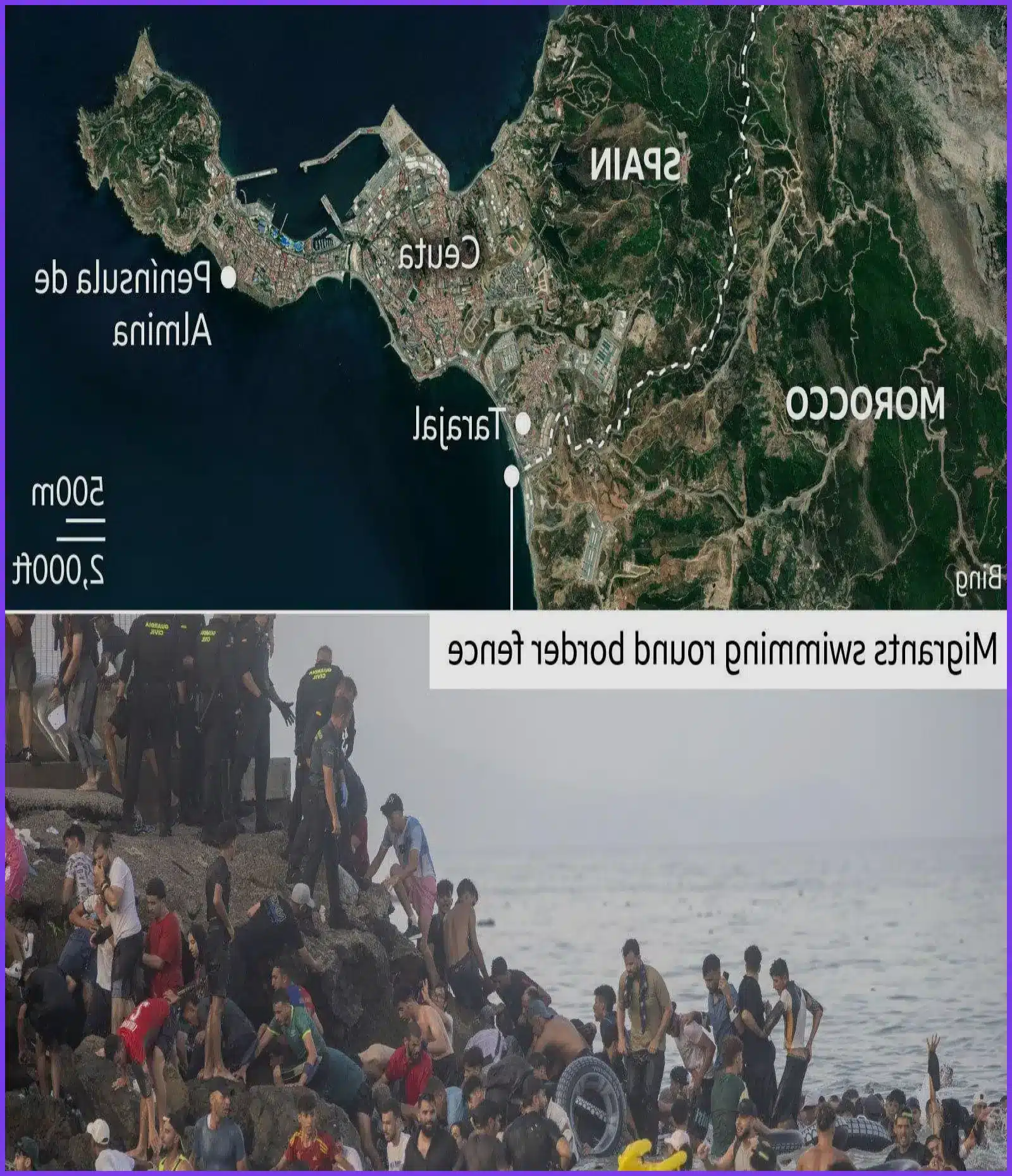
Approximately 49,000 migrants have crossed into Spain's North African territory of Ceuta from Morocco in the last 24 hours, according to official estimates. The surge, which took place via both land and sea, has resulted in a tragic loss of life, with at least 24 people confirmed dead while attempting to reach the Spanish exclave. Some of those who perished were attempting to swim across the water to enter Spanish territory.
This mass arrival follows a recent ruling by Spain’s Supreme Court, which determined that migrants stopped at sea while attempting to reach Ceuta or the nearby exclave of Melilla cannot be summarily returned to Morocco. Prime Minister Pedro Sánchez has characterized the situation as an “attack” on Spain’s territorial integrity and stated that the government is working to return all those who entered illegally to Morocco “as soon as possible.”
In response to the apparent breakdown of border controls on Thursday, Spain has deployed its armed forces to bolster security in both Ceuta and its sister city, Melilla, where between 300 and 400 additional crossings were reported overnight. Prime Minister Sánchez attributed the dangerous events to criminal networks manipulating the recent court ruling, noting that incorrect information had “spread like wildfire in recent hours.” He added that authorities in Morocco are cooperating with plans to return those who entered illegally.
The demographics of those crossing include a significant number of young men, as well as women, children, and infants. Officials estimate that at least 7,000 of the individuals who crossed into the territory in the last 24 hours are minors. While migrants traditionally swim several kilometers from the coast to reach Ceuta, many were able to reach the border fence with relative ease during this recent surge. It remains unclear why Moroccan border guards were not present or why the groups were not stopped or dispersed.
Local residents have described scenes of chaos, with some reporting significant fear. One hospital security guard told Spanish media that the situation felt more aggressive than previous experiences, adding that people were afraid to go out on the street. A migrant who spoke to Reuters expressed regret over the journey, stating, “It's not good at all, and it's not fun either. I mean, people are dying here. I beg you, please, if you haven't come yet, don't come. Don't do it.”
The incident has drawn reactions from across Europe. Italian Prime Minister Giorgia Meloni described the images as “shocking” and labeled the “uncontrolled immigration” a security threat to Europe. While she initially suggested suspending the Schengen agreement with Spain, the Italian foreign ministry later clarified that this would apply specifically to the Italy-Spain border. The Spanish foreign minister criticized these comments as “improper” for a partner country, and the Italian ambassador to Madrid was summoned on Friday.
EU chief Ursula von der Leyen stated the images from Ceuta were “unacceptable” and must “stop immediately,” while German Chancellor Friedrich Merz called for Morocco to “take back illegal migrants immediately.” Finland’s Interior Minister Mari Rantanen expressed support for Meloni’s proposal, alleging that Spain had failed to protect its border.
Ceuta and Melilla, which trace their Spanish history to the 15th century and have enjoyed limited self-government since 1995, serve as the only land borders between the European Union and Africa. They have long been a focal point for diplomatic tensions between Spain and Morocco. The current surge is the largest since 2021, when approximately 8,000 people crossed into Ceuta during a diplomatic dispute between Madrid and Rabat over the sovereignty of the Western Sahara. That diplomatic dispute has flared again recently, after Sánchez traveled to Algeria, which supports independence for the region.
Usually, to try to enter Ceuta, migrants swim several kilometres from further up the coast. This time they appear to have been able to get close to the border fence itself with ease. At the start, some even walked along the rocks on the jetty and around the end of it, but most had to swim out and around to reach the beaches on the other side.
The Schengen Area is a system of open borders spanning 29 European countries that have officially abolished controls at their common borders.
Related Articles

Meet Md. Rubel Rana
As a core contributor to Worlddincidents.com, Rubel Rana brings a unique perspective to the world of journalism. Whether it’s deep-diving into historical trivia or covering the latest global headlines, Rubel Rana is committed to delivering high-quality, high-impact articles. Their writing blends meticulous research with a compelling voice, helping readers stay informed and curious about the world around them.
1 thought on “49,000 Migrants Enter Spanish Territory of Ceuta in 24 Hours”