For years, Beijing has viewed NATO as an outdated relic of the Cold War that should have dissolved alongside the Warsaw Pact. In the eyes of Chinese officials, the alliance is not a defensive body but an offensive one that threatens global stability through eastward expansion and out-of-area interventions. Beijing frequently highlights the 1999 accidental bombardment of its embassy in Belgrade as evidence of NATO’s aggression. Furthermore, China aligns with Moscow’s perspective that NATO’s expansion toward the East ignores Russian security concerns, effectively blaming the alliance for Russia's preemptive military actions in Ukraine.
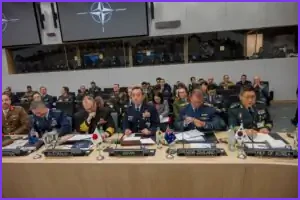
Since China was first added to the NATO agenda in 2019 and later included in the 2022 Strategic Concept, Beijing has interpreted these moves as evidence that the organization intends to establish an "Asian NATO." The chiefs of defense of the United States, Australia, Japan, New Zealand, and South Korea attend a session on “Partners in the Indo-Pacific” at the 194th NATO Military Committee in Chiefs of Defense session in Brussels, Belgium, Jan. 22, 2026. Chinese analysts often posit that Russia currently serves as a vital buffer zone, and without it, they fear NATO would already have a foothold in Asia. While NATO maintains that it has no intention of expanding into Asia, China remains unconvinced. The alliance’s interactions with the "Indo-Pacific Four" (IP4) on issues like cybersecurity, and the independent freedom of navigation operations (FONOPs) conducted by individual member nations, are frequently exploited by China as political tools to characterize the West as an encroaching threat.
It is widely understood that the push to include China on the NATO agenda originated in the United States, specifically during Donald Trump’s first term. European allies, however, have remained largely reluctant. They argue that Russia, not China, represents the most imminent security threat to the alliance. Furthermore, the Washington Treaty restricts NATO’s geographical focus to the area north of the Tropic of Cancer. European nations also tend to view China as an economic challenge rather than a direct hard security threat, often working to moderate the language used in NATO’s official documents to reflect this distinction.
Discussing China within the NATO framework is likely counterproductive. It validates Beijing’s concerns—whether real or imagined—about the alliance’s expansion, which China uses to justify its support for Russia and its negative stance toward the West. Moreover, this focus diverts necessary attention from the primary threat posed by Russia. There are more appropriate forums for addressing China’s role as a hard security actor, including the European Union, the G7, and various bilateral or multilateral formats with ASEAN members. Rather than framing China as an adversary, the alliance should seek dialogue and emphasize that a stable NATO existence benefits global security by deterring a catastrophic war that would ultimately harm Chinese interests as well.
Related Articles

Md. Kazi Bijoy is a dedicated tech enthusiast and content creator with a passion for digital innovation. With years of experience in the tech industry, he specializes in breaking down complex topics into easy-to-understand guides. When he isn’t writing, he explores the latest gadgets and researches emerging trends in the digital world.