On August 17, Chinese President Xi Jinping delivered a commemorative speech marking the 100th anniversary of the birth of former Chinese Communist Party (CCP) General Secretary and President Jiang Zemin, who passed away in 2022. Rather than a simple tribute, the address reframed Jiang's legacy to establish historical continuity and justify Xi's own "new era" of strict political control and security-first governance.
During his speech, Xi lauded Jiang as "a great Marxist," a "great proletarian revolutionary, politician, military strategist, diplomat," and "the core of the party’s third generation central leadership collective." Observers note that the address utilized a classic CCP tactic of making the past serve the present, positioning Jiang's tenure not as a bygone era of liberalization but as the direct foundation of the "new era for socialism with Chinese characteristics" proclaimed at the 19th Party Congress in October 2017.
Xi's speech structured this historical narrative across four main themes. First, it positioned Jiang's leadership as an essential link in the evolution of Chinese socialism from Mao Zedong to the modern day. Tracing Jiang's political life from his entry into the CCP in 1946 to his appointment as general secretary in June 1989, Xi emphasized Jiang's commitment to the "party's basic theory, basic line, and basic strategy," portraying him as a loyal guardian of the party's ideological heritage.
Second, the speech highlighted Jiang as an unwavering defender of the party's absolute authority. Xi pointed to Jiang's response to critical domestic and international crises in the late 1980s and early 1990s—specifically the events of June 1989 and the Taiwan Straits Crisis of 1995–1996. By upholding the "Four Cardinal Principles" and safeguarding national stability, Jiang reportedly concluded that governing the country requires strict governance of the party itself. Xi used this to validate his own modern emphasis on party discipline, asserting that economic modernization demands stronger, centralized CCP leadership.
Third, Xi strongly endorsed the economic "reform and opening" of the Jiang era, including China's entry into the World Trade Organization (WTO), the encouragement of foreign investment, and the "going out" of Chinese enterprises. Xi framed these market reforms not as a departure from Marxism-Leninism, but as an "innovative spirit" adapting Marxism to Chinese realities, mirroring Mao's "Sinification of Marxism." This ideological framing serves to legitimize "Xi Jinping Thought on socialism with Chinese characteristics" as a natural continuation of this adaptive process.
Finally, the speech highlighted a shift in China's strategic outlook. While Jiang's era capitalized on a period of "strategic opportunity" to pursue rapid development, Xi noted that the current environment of "great changes unseen in a century" demands a heightened "sense of crisis" and "bottom-line thinking." As scholar Sheena Greitens has noted, party leaders now treat security and development as equally important, viewing security as the "prerequisite" for development. Ultimately, by absorbing Jiang's legacy, Xi presents his own focus on ideological discipline and security as a necessary adaptation to contemporary challenges.
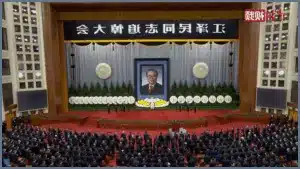
The state funeral for former General Secretary of the Chinese Communist Party and President of China Jiang Zemin, Beijing, China, Dec. 6, 2022.
You have reached the limit of 2 free articles this month.
Related Articles

Mr. Udoy is a professional Web Developer and Blogger with 7+ years of experience in the tech world. He specializes in web architecture and digital storytelling. As the driving force behind worldincidents.com, he focuses on delivering high-quality, well-researched content to a global audience.
1 thought on “Xi Jinping Reframes Jiang Zemin’s Legacy to Support ‘New Era’”