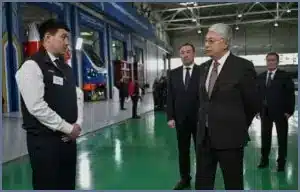
The government of Kazakhstan is systematically tightening its control over Eurasian Resources Group (ERG), a globally significant critical minerals miner, as President Kassym-Jomart Tokayev reshapes the country's business elite. Despite Tokayev's public criticisms of the "oligopolies" that dominated under his predecessor, Nursultan Nazarbayev, key sectors of the Kazakh economy are being concentrated in fewer hands. However, these new captains of industry are far more closely aligned with official state structures than the independent oligarchs of the past.
A prominent sign of this shift is the appointment of Roman Sklyar to ERG's board. In March, Sklyar, who was then serving as Kazakhstan's first deputy prime minister, replaced the lower-ranking Serik Zhumangarin as one of the state's representatives on the mining group’s board. By May, Sklyar ascended to become Tokayev’s chief of staff—a position widely considered the most powerful in Kazakh politics next to the presidency, and one that is rarely held simultaneously with corporate boardroom roles.
This political consolidation coincides with major ownership changes at the Luxembourg-domiciled ERG, which contributes between 2 and 4 percent of Kazakhstan’s gross domestic product (GDP). The company, formerly known as the Eurasian Natural Resources Corporation (ENRC), was long dominated by its three post-Soviet founders: Aleksander Machkevitch, Alijan Ibragimov, and Patokh Chodiev. Today, only Chodiev, an Uzbekistan-born Belgian citizen, is still alive. Last year, the heirs of Machkevitch, a Kyrgyzstan-born Israeli national who died in 2023, sold their 20.7 percent stake to Nature energy solutions Ltd., a company owned by Shakhmurat Mutalip. Chodiev also sold his 18.6 percent stake to the same entity.
Mutalip, who has been described as Kazakhstan's youngest oligarch, successfully secured a 39.3 percent stake in ERG in May. This transaction effectively blocked a rival bid by Shukhrat Ibragimov, the son of late founder Alijan Ibragimov, who had sought to acquire a majority stake. Shukhrat, a Kazakh citizen, became ERG's chairman in 2024 and is now the last remaining board member with family ties to the original founders.
Following Mutalip's acquisition, his childhood friend and employee Kudrat Shamiyev was appointed CEO of Eurasian Group LLP, the Kazakh division of ERG. The 36-year-old Shamiyev, who also serves as the chairman of Integra Construction KZ and the head of Kazakhstan's Taekwondo federation, now oversees operations producing massive quantities of bauxite, iron ore, alumina, and ferrochrome. These industrial inputs are highly sought after in the geostrategic competition between Western nations and China. ERG also produces cobalt in the Democratic Republic of Congo, a critical material for battery manufacturing.
Shamiyev's business philosophy was recently highlighted in social media videos where he discussed Integra Construction KZ. In an exchange with another delegate at an international Taekwondo event, Shamiyev explained their business model, saying, "We do exchange… I own mining company. So, we take resources, we give enough." When the other delegate asked if this was "similar to China-style," Shamiyev replied, "Yes, it is easier for us, easier for now." This embrace of state capitalism aligns closely with Astana's current economic trajectory, which favors heavy political oversight of strategic industries over liberalization.
The state's direct influence over ERG has been growing for over a decade. Kazakhstan's public ownership stake rose from less than 12 percent to 40 percent after the company delisted from the London Stock Exchange in 2013. The delisting occurred while the company was under investigation by the UK's Serious Fraud Office (SFO)—an expensive, decade-long inquiry that was ultimately dropped without any charges being filed. The increased state ownership allowed Astana to appoint two representatives to the five-member board, which has now been streamlined into a four-person board.
These corporate maneuvers unfold against a backdrop of shifting political rules. Last month, Kazakhstan's Constitutional Court ruled that Tokayev is legally eligible to run for the presidency again under a new basic law that went into effect on July 1. This development leaves Tokayev's previous promise not to seek another term—his current mandate runs until 2029—uncertain as a new electoral cycle approaches. Prior to publication, Shamiyev, Nature energy solutions Ltd., ERG, and the Kazakh presidential administration declined to comment on these developments.
At the same time there has been a subtle shift, with the new captains of industry visibly more tethered to officialdom writ large than the Nazarbayev-loyal oligarchs who preceded them.
Entities that the 36-year-old now oversees as part of that role produce giant quantities of iron ore, bauxite, alumina, and ferrochrome, the kind of industrial inputs at the heart of geostrategic competition between Beijing and the West.
Related Articles
Mr. Udoy is a professional Web Developer and Blogger with 7+ years of experience in the tech world. He specializes in web architecture and digital storytelling. As the driving force behind worldincidents.com, he focuses on delivering high-quality, well-researched content to a global audience.