A controversial proposal by the South Korean government to build public housing inside the historic Yongsan Park has triggered intense public outrage, dragging President Lee Jae-myung’s approval ratings to record lows. The decision to target one of Seoul's most symbolic green spaces has united local residents, municipal leaders, and conservationists in fierce opposition, exposing deep-seated frustrations over the country's persistent real estate crisis.
Recent polling from mid-August reveals that President Lee’s approval rating has slipped below the 50 percent threshold for the first time since his administration took office. The housing crisis, alongside controversial prosecutorial reforms, was identified as a primary driver of the decline. The dissatisfaction is particularly acute among young residents of Seoul, where Lee’s performance rating plummeted to an abysmal 31 percent. This demographic is heavily impacted by South Korea's runaway real estate market, where soaring property prices have made homeownership a prerequisite for marriage, subsequently contributing to the country's declining birthrates and widening wealth inequality.
In response to these mounting pressures, President Lee urged his aides on August 13 to "devote all available resources and capabilities to solving housing problems that threaten people’s livelihood and the state’s future." The administration has pledged to lay the groundwork for approximately 1.5 million new publicly funded apartments during Lee's term. However, previous cooling measures have only alienated the public. Restricting the proportion of a loan homebuyers can secure forced many to seek rental leases instead. This shift drove up lease prices and premium payments, ultimately leading to a severe shortage of available leases. Additionally, government proposals to raise the cap on real estate holding taxes and increase market valuation rates for tax assessments have drawn widespread condemnation from both tenants and homeowners.
The latest flashpoint emerged in mid-August when the administration floated the idea of constructing apartment complexes within Yongsan Park—specifically targeting the children's garden area. The Ministry of Land, Infrastructure and Transport quickly followed up, announcing plans to survey areas of the park previously razed by the U.S. military for potential housing development. This move represents a dramatic departure from the historical stance of liberal administrations, which have traditionally resisted developing greenbelts.
Yongsan Park, which currently houses the National Museum of Korea—the world's third most visited museum annually—holds immense cultural, ecological, and historical significance. The 630-acre site was once the Yongsan Garrison, serving as a "little America" in the heart of Seoul. The U.S. 8th Army moved to the base in 1953 to deter North Korean aggression, and the United Nations Command relocated there from Tokyo in 1957. The base remained closed to the public until a 1989 helicopter flight over the site by South Korean President Roh Tae-woo and U.S. President George H.W. Bush led to an agreement that foreign military bases should not occupy a sovereign capital's center.
Although Washington and Seoul signed a formal relocation treaty in 1990, and decided in 2004 to transfer forces south to Camp Humphreys, the handover has been painfully slow. To date, the United States has returned only about 30 percent of the land, with the remainder stalled by negotiations over financial compensation, environmental inspections, and soil cleanup. In 2007, the Roh Moo-hyun administration passed the Special Act on the Creation of Yongsan Park, legally binding the government to develop the returned territory exclusively into a natural, ecological park and leisure space, explicitly banning other forms of development.
Opponents of the housing plan emphasize the deep historical scars associated with Yongsan. The site was occupied by invading Mongols in the 13th century and by China's Qing Dynasty in the 17th century, during which five percent of the Korean population was trafficked. In the first half of the 20th century, Imperial Japanese forces used the garrison to conscript Koreans for foreign wars, before the U.S. military assumed control in 1945. Conversely, Yongsan has also been a historic gateway to the world, introducing modern innovations like steamboats, trams, and multiculturalism to Korea due to its proximity to the Han River and Namsan Mountain.
Seoul Mayor Oh Se-hoon has emerged as a leading opponent of the federal housing proposal, directly challenging the Lee administration's plans. "History won’t forgive me for allowing even a small portion of the park to be turned into apartment sites," Oh declared in a video recorded at the park. "We need to preserve Yongsan’s history and nature for the future generations."
Public sentiment strongly backs the mayor's stance. A survey released on August 24 revealed that two out of three Seoul residents oppose building housing in Yongsan Park. The Seoul Metropolitan Government is currently holding talks with federal officials to present alternative urban planning solutions. This public resistance mirrors a 2016 controversy when the Park Geun-hye administration attempted to build museums in the park, only to back down following widespread public outrage over pouring concrete on the historical site.
While the Lee administration maintains that the vast majority of Yongsan Park will remain untouched, critics argue that introducing apartment complexes will inevitably require destructive auxiliary infrastructure, including new roads, shopping malls, and schools. This development would permanently ruin Seoul's last major opportunity to restore biological diversity and alleviate its cramped urban landscape. Urban planning experts suggest that instead of building high-rises in Yongsan Park, Seoul should pursue organic regeneration. This would involve incorporating dilapidated housing in low-density areas into large-scale, mixed-use developments, moving commercial spaces underground, and optimizing transport infrastructure, while simultaneously expediting negotiations with Washington to secure the remaining garrison land promised decades ago.
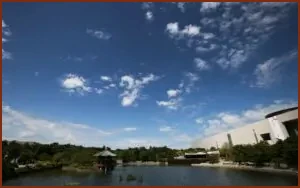
Walking up to the front affords quite a sight. A lone pavilion, with its rooftop faded in jade green, stands in a tree-lined pond. Trace the gaze upward, and there’s the rectangular gap in the museum’s superstructure of concrete covered in granite framing the beautiful expanse of greenery opening up to Namsan Mountain and Namsan Tower. At the back of the premise is a children’s garden, filling the air around the museum with laughter and scampering footsteps.
Related Articles

Mr. Udoy is a professional Web Developer and Blogger with 7+ years of experience in the tech world. He specializes in web architecture and digital storytelling. As the driving force behind worldincidents.com, he focuses on delivering high-quality, well-researched content to a global audience.