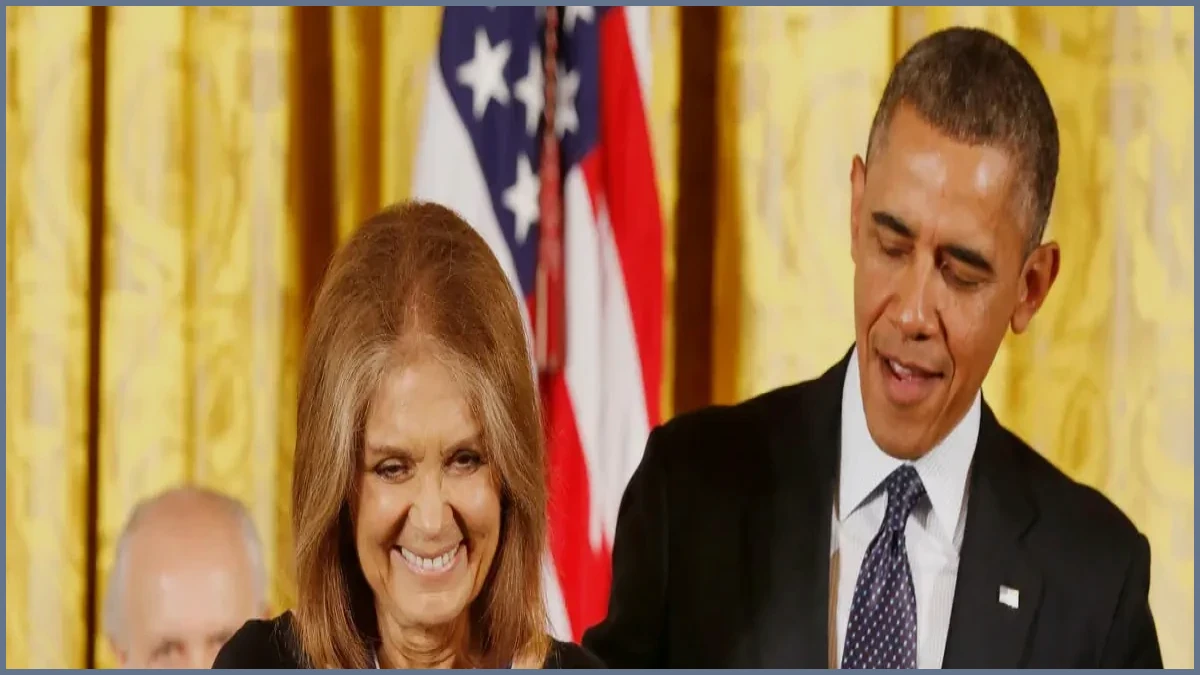
Gloria Steinem, the prominent civil rights activist, journalist, and pioneering leader of the women's rights movement, died on Wednesday, Sept. 2, at the age of 92. Her passing was announced on her official Instagram page, which shared that she died peacefully at her home in New York City, surrounded by loved ones.
"Gloria’s near-century on earth were years well-lived, and she continued working for equality until the very end," the announcement read, honoring her decades-long commitment to social justice.
Born on March 25, 1934, in the suburbs of Toledo, Ohio, Steinem rose from working-class roots to become a central figure in the feminist movement of the late 20th and 21st centuries. Her early life was marked by financial instability; her father worked as a traveling salesman, and the family lived in a trailer home during her early years. In her memoir, "My Life On The Road," she noted that she learned early on that "politics are a part of daily life." After her parents divorced in 1946, Steinem lived with her mother, who struggled with severe mental illness. Serving as a caregiver for her mother was a deeply transformative experience that Steinem frequently drew upon in her writing and advocacy.
Reflecting on this period at age 90 during an appearance on the BBC Radio 4 podcast Young Again with Kirsty Young, she noted: "There are many people in the world who grew up as children looking after their parents … and it caused us to grow up too early, but we’ve all had difficult times in our lives." Despite these hardships, Steinem reconciled with her past. In a 2017 interview with The Guardian, she expressed deep gratitude to her parents, stating she owed "(to) my mother, a huge debt for creating a loving childhood for me when she didn’t have one. My father, for being OK with insecurity. As he always said, 'If I don’t know what will happen tomorrow, it could be wonderful.'" This upbringing, she remarked, "made me look forward to a time when I would be on my own and responsible only for myself."
Steinem pursued her education and graduated Magna Cum Laude from Smith College in Massachusetts in 1956. She then received a fellowship that funded her travel and stay in India from 1957 to 1959. During her time there, she studied nonviolent protest and grassroots activism, which shaped her lifelong perspective on community-driven social change.
It was during this period, in 1957, that a 22-year-old Steinem underwent an abortion in London, which was illegal at the time. She detailed this experience in her 2015 memoir, dedicating the book to the physician who performed the procedure, Dr. John Sharpe. According to her memoir, Sharpe agreed to help her on two conditions: "You must promise me two things. First, you will not tell anyone my name. Second, you will do what you want to do with your life."
Upon returning to the United States in 1960, Steinem began working as a freelance reporter in New York. At the time, women's magazines were widely read but mostly run by men, who restricted female writers to domestic topics like fashion, recipes, and clothing. Editors discouraged women from covering serious issues affecting their lives. Steinem recalled that when she pitched political stories to The New York Times Sunday Magazine, her editor dismissed her, saying, "I don’t think of you that way."
Seeking to bypass these barriers, Steinem went undercover in 1963 to write an investigative piece titled "I Was a Playboy Bunny." She changed her name and worked as a waitress at Hugh Hefner’s Playboy Club, exposing the exploitative working conditions and intense sexualization of women in those roles. The article brought her national fame but also cast a long shadow over her career. In a 2011 interview with ABC News, Steinem reflected on the piece: "It was a professional error of gigantic proportions because I was just beginning to be assigned serious pieces and suddenly I was a bunny. And now, it's followed me all these years and I am always confronted by a moral dilemma. Should I stop people who introduce me as an ex-bunny and say, but I was doing it as a journalist?"
The investigation nevertheless pivoted her career toward political reporting. By the late 1960s, she was writing "The City Politic," a column for New York magazine. In March 1969, she attended a meeting of the radical feminist group the Redstockings, where she discovered the broader feminist movement. Inspired by the stories of American women, she co-founded the National Women’s Political Caucus in July 1971 alongside prominent activists Betty Friedan, Bella Abzug, and Shirley Chisholm.
Steinem also sought to create media that centered women's perspectives. This led to the creation of Ms. magazine, which debuted as an insert in the December 1971 issue of New York before launching as a standalone publication the following year. The magazine's initial 300,000 "one-shot" test copies sold out across the United States in just eight days. Steinem remained with the publication long after, including after its 2001 sale to the Feminist Majority Foundation, continuing to serve on its advisory board and editorial masthead.
Throughout her life, Steinem co-founded several other major organizations, including the Ms. Foundation for Women, the Free to Be Foundation, and the Women’s Media Center. In 1970, she testified before the U.S. Senate in support of the Equal Rights Amendment. During her testimony, she challenged lawmakers, stating: "It seems to me that much of the trouble in this country has to do with the 'masculine mystique'; with the myth that masculinity somehow depends on the subjugation of other people. It is a bipartisan problem; both our past and current Presidents seem to be victims of this myth, and to behave accordingly."
Her activism and journalism earned her numerous accolades, including the Penney-Missouri Journalism Award, the Front Page and Clarion awards, the National Magazine Award, and the Lifetime Achievement in Journalism Award from the Society of Professional Journalists. She was also honored with the UN Society of Writers Award and the University of Missouri School of Journalism Award for Distinguished Service in Journalism. In 2013, President Barack Obama awarded her the Presidential Medal of Freedom, the nation's highest civilian honor.
Steinem's Upper East Side brownstone in New York City became a famous gathering hub where politicians, academics, influencers, and cultural thinkers met in her living room to debate social issues. In 2000, at age 66, she married David Bale, the father of actor Christian Bale. Their marriage lasted three years until David passed away. Steinem had no biological children.
In her later years, Steinem focused heavily on global activism, advocating for LGBTQ rights and the empowerment of women and girls worldwide. In 2011, she co-convened the Frontline Women's Fund alongside Navi Pillay, the former UN High Commissioner for Human Rights. The initiative, part of the Sisterhood Is Global Institute, focused on raising funds and awareness to combat sex trafficking and end female genital mutilation.
Steinem continued writing and speaking well into her final years, publishing her last book, "The Truth Will Set You Free, But First It Will Piss You Off!" in 2019. Her life was portrayed in several media works, including the 2011 HBO documentary Gloria: In Her Own Words, the 2020 television series Mrs. America, and the biography The Education of a Woman by Carolyn Heilbrun. Discussing her legacy in her 2024 interview on the BBC's Young Again podcast, Steinem expressed hope that her life's work "might help individual people… to become more the unique, valuable, loved and lovable person that they want to be."
Related Articles

Meet Md. Rubel Rana
As a core contributor to Worlddincidents.com, Rubel Rana brings a unique perspective to the world of journalism. Whether it’s deep-diving into historical trivia or covering the latest global headlines, Rubel Rana is committed to delivering high-quality, high-impact articles. Their writing blends meticulous research with a compelling voice, helping readers stay informed and curious about the world around them.