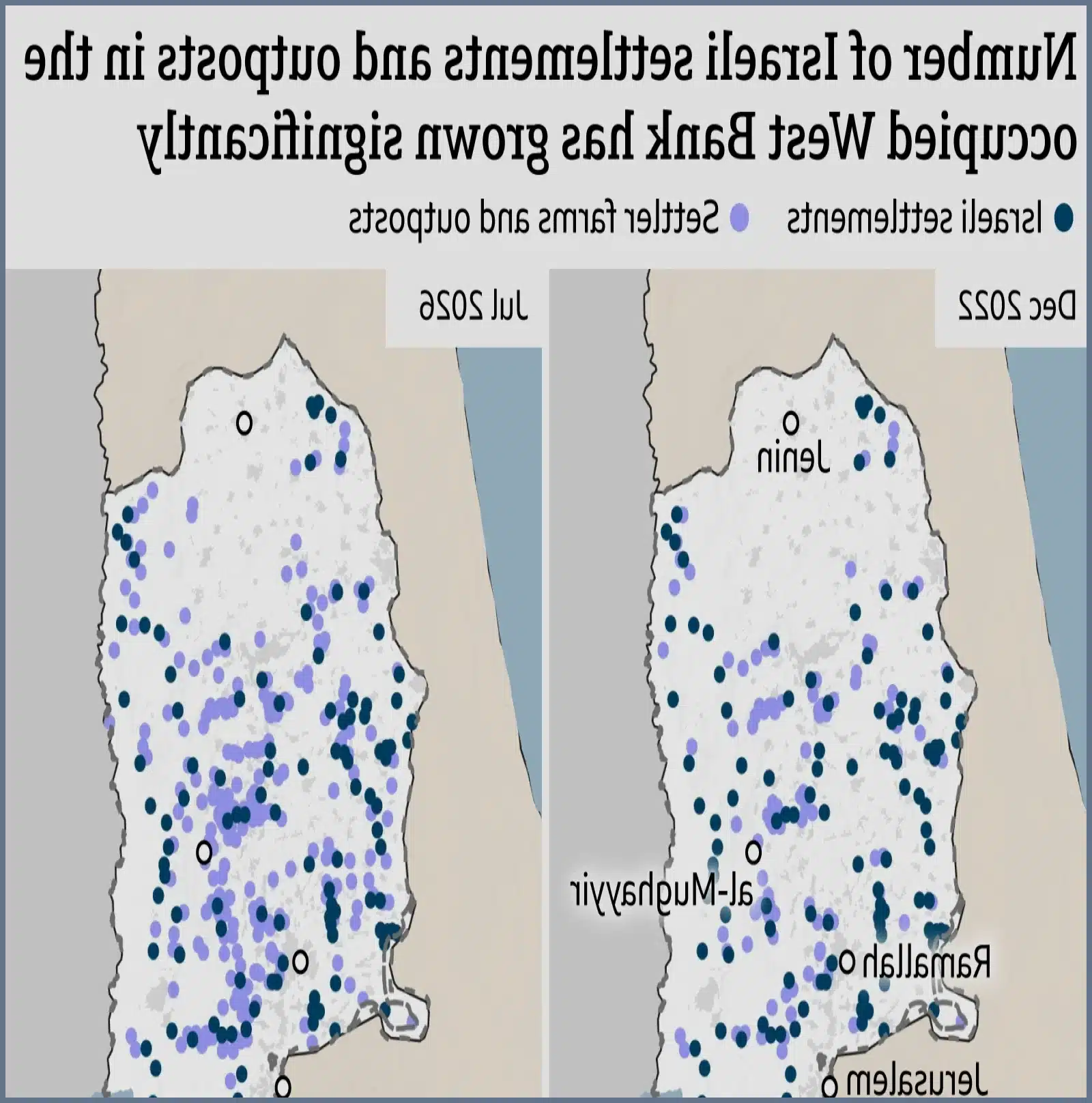
A new generation of Israeli settlers has returned to the settlement of Kadim in the occupied West Bank, marking the complete reversal of a closure enacted by a previous Israeli administration two decades ago. On Thursday, thirty "pioneer families" arrived at the site from Tel Aviv, according to the regional settlers' council, riding a wave of Jewish nationalism actively encouraged by Israel's current right-wing government.
The settlers arrived in small groups, with some traveling under military escort. Blue and white Israeli flags fluttered from their vehicles as they passed Palestinian agricultural lands and villages. Some of the incoming families dragged trailers loaded with furniture, bedding, and various building materials to establish their new homes.
This return follows the current Israeli government's decision to overturn a 20-year ban on Jewish settlements in the area surrounding the Palestinian city of Jenin. While all Israeli settlements and outposts are considered illegal under international law, and outposts are also illegal under domestic Israeli law, they frequently receive funding and services from the state.
A national ceremony was held to mark the reopening, attended by senior Israeli political figures. Among them was Israel's far-right Finance Minister Bezalel Smotrich, who celebrated the move. "21 years after the crime of expulsion from northern Samaria, we have completed the correction […] and have returned to the settlement of Kadim," Smotrich declared, utilizing the Biblical term for the northern West Bank. Other high-profile attendees included Israel's Justice Minister, the Speaker of the Knesset, Amir Ohana, and Yossi Dagan, the head of the regional settlers' council. During the event, Dagan vowed that Israeli settlers would eventually return to the Gaza Strip as well.
Located on a small hillside just outside Jenin, Kadim was originally evacuated in 2005 by the Israeli government as part of a unilateral Disengagement Plan. That initiative saw all Jewish soldiers and settlers pulled out of the Gaza Strip, alongside the dismantling of four settlements in the northern West Bank. At the time, officials deemed these four settlements too isolated, strategically insignificant, and excessively costly to protect. In recent weeks, however, white trailer homes were moved back onto the hilltop to prepare for the return of the families. Requests to interview attendees at the opening ceremony were declined, and media representatives were barred from entering the settlement on the day of the event.
For local Palestinians, the rapid return of settlers has brought profound anxiety. A 53-year-old Palestinian vegetable farmer, who lives in the house where he was born, recalled watching Kadim being built during his childhood, and later watching the government force the settlers out twenty years later. He noted that during the original settlement period, relations were different. "Back then, the settlers were living alongside us, and we coexisted peacefully. They lived their lives and we lived ours," he said. Now, he watches their return with dread. "I'm afraid of the events spreading around us, and the bypass road [where] they demolished shops and businesses," he explained. "They drove my nephews away from their vegetables and citrus trees, telling them 'you have no place here, don't come back'." Having fled Haifa with his family during the 1948 Arab-Israeli War, the farmer added, "There's no more displacement left in me. We're living with a sense of resignation. It's a life of fear."
Following the 2005 evacuation, Israelis were legally barred from settling in the area. However, the current coalition government overturned that restriction. Kadim is the final settlement of the four evacuated in 2005 to be formally reopened, following Ganim, Sanur, and Homesh, where families have already relocated. These developments are part of a massive expansion project. Since taking power in late 2022, the current government has approved more than 100 new settlements across the West Bank, including 19 in the northern sector.
According to Hagit Ofran, director of the Settlement Watch programme at Peace Now, this rapid construction around Jenin is part of a broader effort by the Israeli government to expand its footprint in the West Bank before the national elections scheduled for October. One such newly established settlement is Emek Dotan, located west of Jenin, which officially opened last Sunday and is now home to nearly two dozen Jewish families.
Samer Jaber, a schoolteacher living in a small cluster of Palestinian houses adjacent to Emek Dotan, has watched the settlement's rapid development, from the arrival of bulldozers to the installation of caravans. Jaber, who is partially blind and has a leg injury that restricts his mobility, stated that problems began even before the families fully moved in. "Groups come and stand opposite our houses, filming us," Jaber said. "Yesterday they came and stood here, filming me and my children. Every time my wife stepped outside, they filmed her too. They try to enter our homes. And they go house by house, shining powerful floodlights directly through all the windows at two or three in the morning." He expressed deep vulnerability, adding, "Fear dominates everything. We are completely defenceless. All of them have weapons. I'm bringing concrete blocks to close off this side of the house because I'm afraid for my children."
Reflecting on the lack of international intervention as settlements and settler attacks expand, Jaber expressed bitter disillusionment with global politics. "Europe has no time for us, America is preoccupied with Iran, China has no interest," Jaber remarked. "Russia is busy with Ukraine, the United Nations is finished, and the Arab countries have their own internal problems. Democratic systems are over, they're finished. Civilisation, progress and modernity are lies."
Alongside the civilian settlements, Israel is rapidly constructing military infrastructure around Jenin. Two new military bases are being built behind high concrete walls topped with watchtowers and barbed wire. Additionally, a military outpost is being constructed on seized Palestinian land next to the Jenin Refugee Camp in Jabriyat. This represents the first Israeli military base built on land under full Palestinian Authority control since the signing of the Oslo Accords in 1993. The Israel Defence Forces confirmed the construction of the Jabriyat outpost, stating it was ordered "in accordance with operational needs." Previously, the Israeli military evacuated thousands of residents from the Jenin Refugee Camp before occupying it in 2025.
Kamal Abu al-Rub, the Palestinian Authority Governor for Jenin, expressed grave concern that the land seizures around the refugee camp indicate a plan to permanently house settlers there, effectively dividing Jenin in a manner similar to Hebron or Jerusalem. He described the past twenty years without local settlements as "bliss." "Now, we live in the hell orchestrated by them and their assaults," the governor said. "It limits our movement. They cut off roads, bulldoze lands and cut down trees."
The physical landscape is changing rapidly. A café that stood along the road running from Kadim through the northern West Bank to Israel—alongside dozens of other Palestinian shops and businesses—was recently reduced to rubble by the Israeli army. Local residents observe that the countdown to the October elections is being measured in the number of demolished Palestinian buildings and the rising count of new settler caravans.
Related Articles

Meet Md. Rubel Rana
As a core contributor to Worlddincidents.com, Rubel Rana brings a unique perspective to the world of journalism. Whether it’s deep-diving into historical trivia or covering the latest global headlines, Rubel Rana is committed to delivering high-quality, high-impact articles. Their writing blends meticulous research with a compelling voice, helping readers stay informed and curious about the world around them.