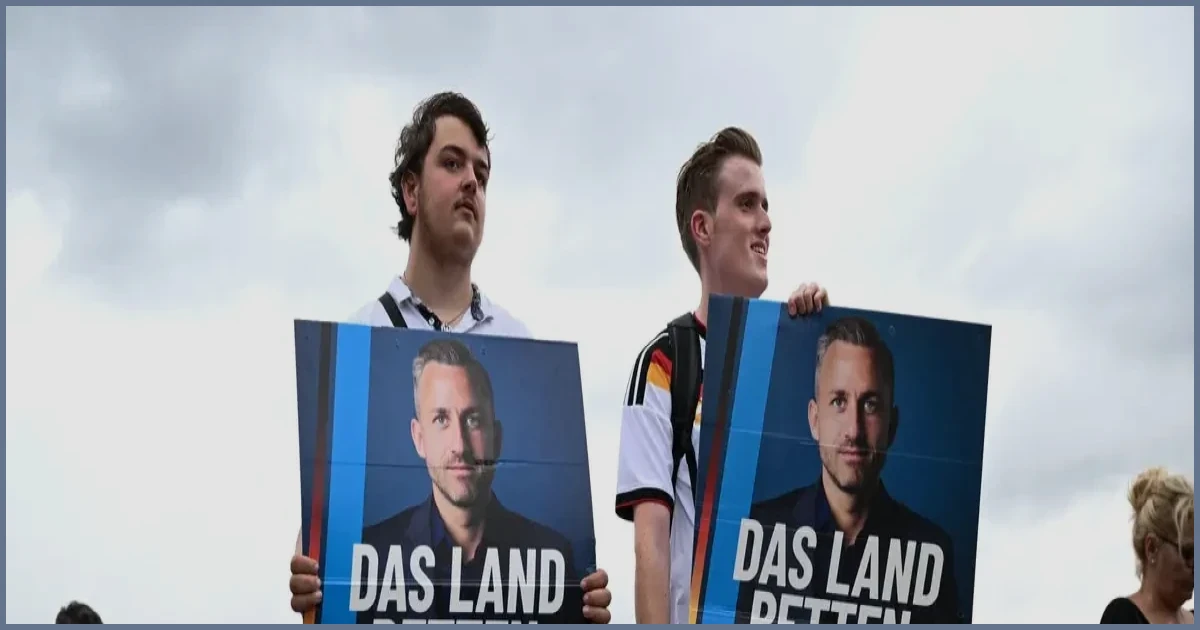
Early exit polls in Germany on Sunday indicated that the Alternative for Germany (AfD) party has secured a commanding lead in a crucial regional election. Despite this strong performance, it remains highly uncertain whether the party will be able to overcome political barriers to form the country's first far-right state government since World War II. The election took place in Saxony-Anhalt, an East German state of 2.1 million people located west of Berlin, with its capital in Magdeburg, a city of approximately 244,000 residents where the AfD has focused its hopes of rising to executive power.
Heading into Sunday's vote, the AfD sought to secure an absolute majority in the state legislature. Achieving this threshold would allow the party to govern entirely on its own, effectively bypassing the so-called "firewall" established by Germany's mainstream political parties, which have consistently refused to enter into any governing coalitions or work with the far-right group. Projections released by public television broadcasters ARD and ZDF placed the AfD at approximately 44% of the vote, representing more than double the support the party received in the region five years ago.
This projected outcome placed the AfD far ahead of its closest rival, the center-right Christian Democratic Union (CDU). The CDU, which is led nationally by Chancellor Friedrich Merz and currently heads the state government in Saxony-Anhalt, was seen polling at just 18.5%. The Left Party was projected to finish in third place with about 9% of the vote. Meanwhile, the center-left Social Democrats and the Greens were both on track to retain representation in the state legislature, with each party polling around 8% to 9%. It remained unclear from the early figures whether the newly formed BSW party would secure the 5% of the vote required to win seats in the parliament. Crucially, the exit polls indicated that the AfD's support might fall at least marginally short of the absolute majority needed to govern alone.
Ulrich Siegmund, the charismatic 35-year-old AfD candidate for state governor, expressed triumph in an interview with ARD, declaring that "we have written history." Siegmund asserted that voters had sent a powerful signal to the political establishment that "things cannot carry on like this." If the AfD does manage to secure power, it would represent an extraordinary breakthrough for an organization that was founded in 2013 primarily as a protest movement against the European Union, but has since undergone a dramatic shift to the far right.
The political rise of the AfD in Saxony-Anhalt has occurred alongside intense scrutiny from state authorities. Since 2023, the state Office for the Protection of the Constitution—the regional branch of Germany's national domestic intelligence agency—has officially classified the AfD Saxony-Anhalt as a "confirmed far-right extremist" organization. According to the intelligence agency, the core political positions of the state party chapter violate the fundamental principles of Germany's constitution and are "substantially permeated by the racist ideology of ethnopluralism."
In its official assessment, the agency stated that "numerous anti-Muslim, racist and antisemitic statements by officials and elected representatives of the state association demonstrate that the AfD in Saxony-Anhalt seeks precisely such an ethnoculturally homogeneous national population and calls for the exclusion of people on the basis of their origin or religion." Siegmund, the party's lead candidate, has strongly rejected this classification. In an interview conducted in August, he accused the domestic intelligence agency of being politically weaponized to target his party, stating that "it monitors the opposition" and "is being used as a political instrument." Siegmund added that if the AfD wins power, the administration would consider either completely abolishing the state intelligence agency or restructuring it entirely.
Siegmund has cultivated a public image as a composed, approachable, and charismatic figure. However, his radical platform has drawn national alarm, culminating in a cover story by the widely read magazine Der Spiegel in August that branded him "Germany's most dangerous man," highlighting his combination of a winning personal demeanor, a realistic path to state power, and an extremist agenda. The publication noted that Siegmund's close political associates include former officials from the "Heimattreuen Deutschen Jugend," a neo-Nazi youth organization that was banned by German authorities in 2009.
Furthermore, Siegmund was a participant in the controversial 2023 "Potsdam meeting," a private gathering of German and international far-right figures. At this meeting, Austrian anti-immigration extremist Martin Sellner presented a "master plan" for "remigration." This concept outlines a strategy to expel asylum seekers, non-Germans living legally within the country, and even German citizens with immigrant backgrounds who are deemed to have failed to "assimilate," suggesting they be sent to an unspecified nation in Africa. A version of this plan has since become a central pillar of the AfD Saxony-Anhalt platform.
The state party's official platform calls for a "deportation and remigration offensive," which includes the construction of more detention centers to handle individuals designated for deportation, alongside tight new limits on the number of people permitted to migrate to Germany. While Germany currently has no annual cap on immigration, the state AfD has dismissed proposed national caps of around 200,000 as being far too high. While the rhetoric may draw comparisons for some to the controversies surrounding ICE detentions and the aggressive deportation policies of the Trump administration in the United States, the concept of "remigration" goes significantly further by advocating for the expulsion of individuals who hold legal residency or even national passports.
The AfD Saxony-Anhalt has also faced severe criticism for its rhetoric regarding Germany's Nazi past. Hans-Thomas Tillschneider, a prominent state politician within the party, has spoken disparagingly of "memorial site stuff" and criticized what he described as a "guilt-laden" approach to German history. These statements have caused deep offense and controversy in a country where the memory of the repression, orchestrated mass violence, and systemic horrors of Nazism and the Holocaust have fundamentally shaped public and political discourse for at least three generations.
Simply winning the largest share of the vote in Sunday's election will not guarantee the AfD a path to power. The only certain route for the party to govern on its own and appoint the state's premier—the equivalent of a U.S. governor—is to win an absolute majority of the seats in the state parliament. Polling leading up to the election made such an outcome appear unlikely. If the AfD wins a plurality of seats but falls short of an absolute majority, it would be forced to find a coalition partner among the other parties that clear the 5% threshold. This represents a major obstacle, as all of Germany's mainstream political parties have long ruled out any form of cooperation with the AfD. Siegmund himself has stated that he would only lead a full AfD government, explicitly ruling out a coalition partnership.
This dynamic raises the possibility that the AfD could win the election by a wide margin but still be entirely excluded from power, a scenario for which there is recent precedent. In the neighboring state of Thuringia's regional election in 2024, the AfD won more seats than any other single party but fell short of a decisive majority. Other political parties with lower vote shares agreed to cooperate, forming a coalition government that excluded the AfD entirely, leaving the far-right party with the largest number of individual lawmakers but no role in the state administration.
The debate over migration heavily dominated the election campaign on the streets of Magdeburg, exacerbated by a tragic attack on the city's Christmas market in 2024. In that incident, a doctor originally from Saudi Arabia drove his vehicle into a crowd of holiday revelers, killing five people. Investigations revealed that the perpetrator was not an Islamic extremist; he identified as a former Muslim, was highly critical of Islam, and had expressed sympathy for the far-right and the AfD. Despite these facts, and the reality that the driver had resided legally in Germany for decades, the tragedy heightened local anxieties. One female resident of Magdeburg, who spoke on the condition of anonymity, noted that "I feel that the situation is particularly tense following the attack," adding, "I think that has given the AfD a particular boost."
Local voters remain deeply divided over the party's rise. Justin, a 27-year-old resident, expressed his support for the AfD, stating he believes the party will take decisive action against "uncontrolled migration." He singled out Syrian refugees, approximately 300,000 of whom were welcomed into Germany a decade ago during the Syrian civil war, claiming they had failed to adapt to German society. Justin remarked that "the AfD is good for Germany because they see Germany's problems," before claiming that Syrians in Magdeburg "behave like animals." He complained that "they sit on these plastic chairs with their children outside in the middle of the night and they are never quiet," though he acknowledged that "there were Germans misbehaving" in the city as well. He concluded that "now it's really bad. I think the AfD sees that and they will help Germans to also get more pension." This characterization of Syrian refugees is countered by the successful integration of tens of thousands of Syrians across the country, including one refugee who arrived in 2015 and has served as the elected mayor of a village in southwestern Germany for several years.
Other local residents expressed deep concern over the AfD's platform. A voter named Birgit stated that she was "quite afraid of the AfD," describing the party as "far too extreme." A local couple in their 40s, who described themselves as left-wing former punk rockers, voiced strong opposition to the AfD and expressed consternation over its anti-migrant policies. They argued that foreign workers remain absolutely indispensable to the health and social services sectors, particularly given Saxony-Anhalt's rapidly aging population. Another resident, who had relocated to Magdeburg from western Germany, stated that he could not imagine remaining in the city if the AfD took control of the state government. As the father of a young daughter, he expressed particular concern that an AfD administration would alter how Germany's history, specifically the legacy of Nazi rule and the Holocaust, is taught in local schools.
Related Articles

Md. Kazi Bijoy is a dedicated tech enthusiast and content creator with a passion for digital innovation. With years of experience in the tech industry, he specializes in breaking down complex topics into easy-to-understand guides. When he isn’t writing, he explores the latest gadgets and researches emerging trends in the digital world.