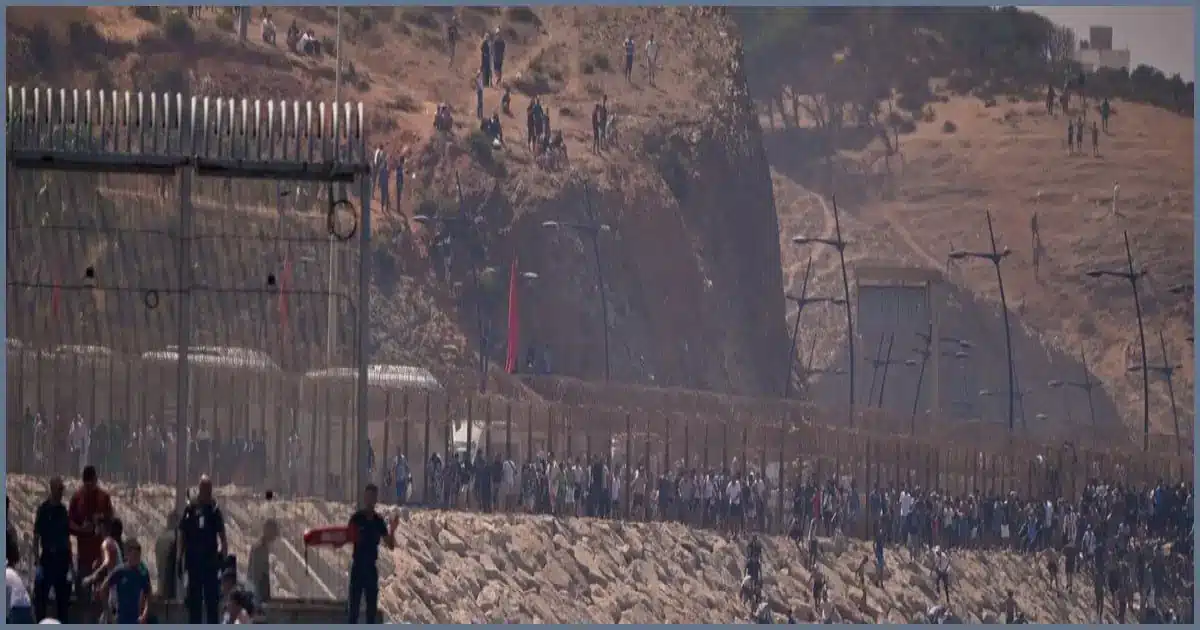
Spain's central government has ordered the deployment of its military to the North African exclave of Ceuta to restore order along the border with Morocco. The decision follows a massive surge of thousands of migrants breaching the frontier on Thursday, which resulted in the deaths of at least nine individuals.
The deployment was announced on Thursday evening by Spain's government after local officials in Ceuta requested emergency reinforcements to manage a rapidly deteriorating border crisis. The Armed Forces will assist the Civil Guard in maintaining security in the city. Additionally, Spanish Prime Minister Pedro Sánchez and Interior Minister Fernando Grande-Marlaska are scheduled to visit Ceuta on Friday to assess the situation firsthand.
Describing the situation as "absolute chaos," Rachid Sbihi, the head of the association representing Spain's Civil Guard officers policing the Ceuta border, stated that the border had "totally collapsed." While Sbihi noted it was impossible to provide precise figures, he confirmed that thousands of migrants had successfully crossed. Achraf Maimouni, a member of the Moroccan Association for Human Rights in northern Morocco, also described the events as "exceptional," stating that the Tarajal border had been opened under unusual circumstances on Thursday morning.
Video footage from the scene showed crowds of people, predominantly Moroccan young men, as well as families with women and young children, navigating the breakwaters at Tarajal beach to reach local Spanish roads. Some of the migrants shouted "Viva España!" to a photographer. However, the crossing proved deadly. Spain's government delegation in Ceuta confirmed that at least nine people lost their lives during the chaotic Thursday crossings. While specific details about the circumstances of the deaths were not immediately provided, bodies were observed floating in the water. Local authorities noted that dozens of people have already died this year attempting to reach the Spanish territory.
This sudden escalation follows a prior surge on Wednesday, when numerous migrants attempted to reach the exclave by swimming. To reach Ceuta, which sits on a historic isthmus on the northern African coast and has been a Spanish possession since 1580, migrants often swim from the nearby Moroccan town of Fnideq, a distance of about 3.1 miles, or from Belyounech, where the distance is shorter.
Ceuta's regional government head, Juan Jesús Vivas, had warned on Wednesday that local reception centers were already overwhelmed, forcing hundreds of migrants to sleep on the streets after more than 1,500 people arrived over the preceding week. Vivas urged the national government in Madrid to declare a national emergency on security grounds and deploy the military. However, Spain's Interior Ministry explained that under current legislation, migration flows do not qualify as a threat to national security, preventing a formal declaration of a national emergency. Instead, the ministry emphasized that government agencies are coordinating a rapid and effective response.
Local authorities in Ceuta previously connected the sudden spike in arrivals to a Spanish Supreme Court ruling issued earlier this month. The court decided that migrants arriving by sea cannot be immediately pushed back across the border without due process, a legal protection that does not apply to those who cross by land, such as by climbing the border fence. However, human rights activists in Morocco expressed skepticism regarding this explanation, pointing out that the vast majority of migrants are likely unaware of such complex legal developments.
Despite the crisis, Spain's Interior Ministry stated that the Moroccan government is "closely cooperating" to manage the situation. Moroccan police are reportedly stopping numerous individuals attempting to make the crossing, and both nations have agreed to work together to facilitate the prompt return of all individuals who entered Ceuta illegally. Moroccan authorities have not released a public statement regarding the crossings, and the country's Interior Ministry did not respond to requests for comment.
The current scenes of mass crossings are reminiscent of the May 2021 border crisis, during which over 8,000 migrants entered Ceuta in two days. That incident occurred amid a diplomatic dispute, after Spain allowed Brahim Ghali, leader of the pro-independence Polisario Front—which claims representation of the Western Sahara region disputed by Morocco—to receive medical treatment in a Spanish hospital.
Spain remains a major gateway into Europe for migrants seeking safety from violence or looking for better economic opportunities. While the Interior Ministry declined to confirm the exact number of recent arrivals ahead of its next official migration report scheduled for publication on August 3, existing figures show that nearly 3,000 migrants had already entered Ceuta by land or sea this year as of July 15.
Related Articles

Md. Kazi Bijoy is a dedicated tech enthusiast and content creator with a passion for digital innovation. With years of experience in the tech industry, he specializes in breaking down complex topics into easy-to-understand guides. When he isn’t writing, he explores the latest gadgets and researches emerging trends in the digital world.
1 thought on “Spain Deploys Military to Ceuta Border After Nine Migrants Die”