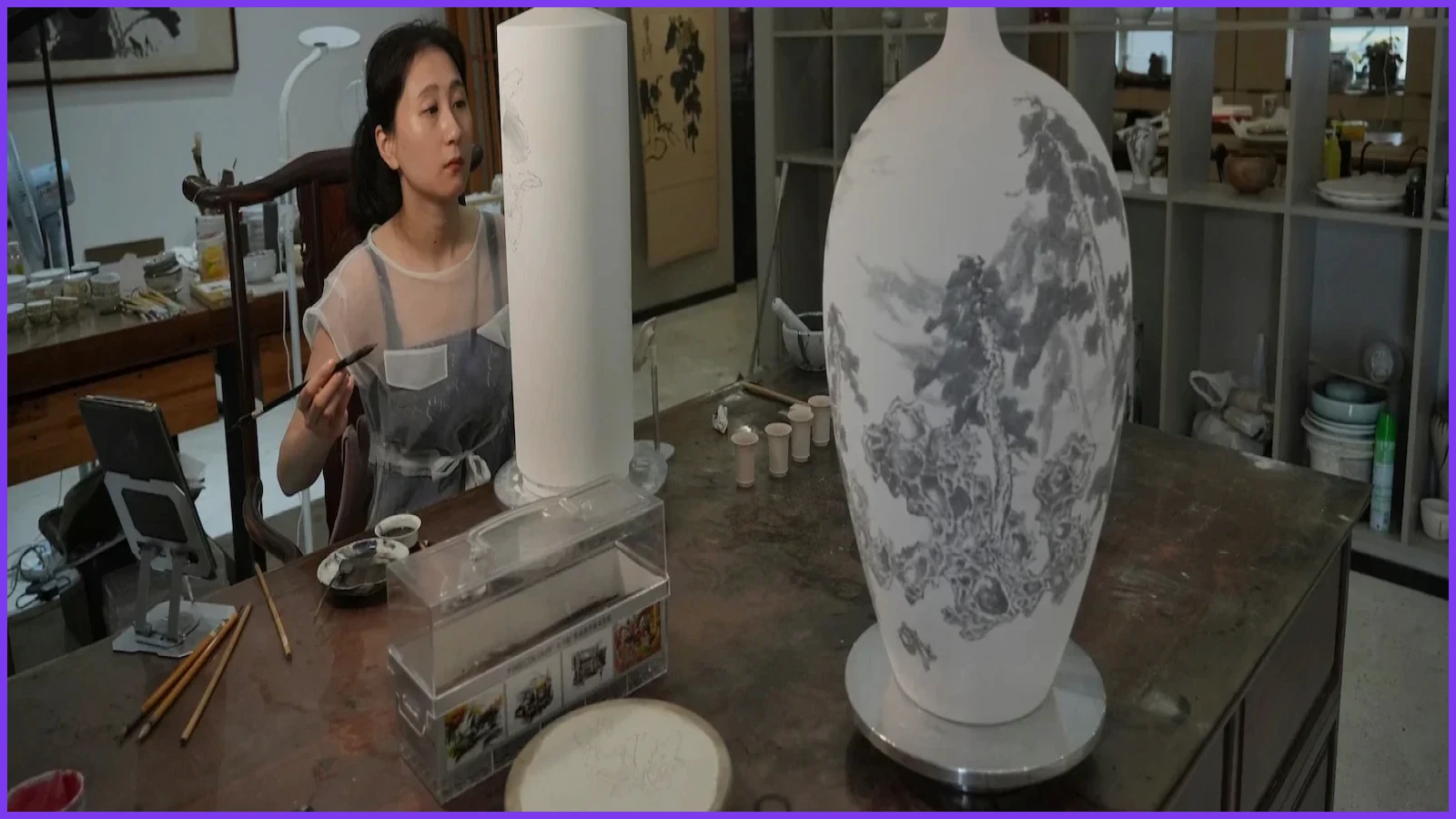
In the Chinese city of Jingdezhen, known globally as the "Porcelain Capital," the preservation of a 2,000-year-old craft relies on a delicate balance of oral family secrets, spiritual devotion, and cutting-edge digital science. Located in Jiangxi province, approximately 1,180 kilometers (735 miles) southeast of Beijing, Jingdezhen has been a center of pottery-making since the Han Dynasty. Its historic porcelain sites received global recognition with their inscription on UNESCO's World Heritage List in 2026. Today, a new generation of local and international artists is working alongside researchers to ensure the ancient imperial techniques survive far into the future.
For porcelain artist Chen Qing, the continuity of this heritage is deeply personal. Her family has practiced the craft in Jingdezhen since around 1860, adapting imperial court traditions after the fall of the Qing Dynasty in 1912. Chen vividly recalls her grandfather writing down the formula for their family's unique red pigment only once. He had her mother memorize the recipe before burning the paper minutes later, ensuring the secret would only be passed down orally. "My mother did not reveal the formula to me until I was over 30," Chen said. She notes that such closely guarded practices are common, explaining, "The craft is very difficult for an outsider to master. A family might spend nearly a century developing a single technique."
Two tables in her studio are covered with brushes, unfinished pieces and pigments. Working in absolute silence under the focused light of a lamp, Chen's process is painstakingly precise; her fingers never touch the porcelain's surface. She steadies her hand against its outer edge, holding the brush firmly as she paints delicate, precise strokes. Painting a porcelain teacup can take days to complete, and a single speck of dust or a drop of sweat can ruin the work, forcing her to start over. Landscapes present the greatest challenge due to their lack of clear boundaries, requiring seamless transitions from emerald green mountain peaks to warmer browns further down the slopes. "Mastering a craft is a lifelong process," Chen remarked, adding that few people are willing to spend more than a decade learning such demanding work.
While individual artisans preserve these physical techniques, institutions are turning to modern technology to reconstruct the past. The Imperial Kiln Institute in Jingdezhen researches and restores ceramic fragments excavated from a nearby imperial complex where kilns once produced porcelain exclusively for emperors. Under the leadership of president Weng Yanjun, the institute is building a "ceramic gene bank" and utilizing artificial intelligence to match and piece together ancient fragments. "We hope that we can retrieve ancient technology with modern science," Weng said, noting that the data also reveals the diverse cultural and religious influences that shaped historic designs. According to Weng, decorations on the porcelain harmoniously blended elements of Islam, Buddhism, Taoism, and later, European Catholic Christianity.
This cultural synthesis is evident in historical structures like the Bao'en Pagoda in Nanjing. Once part of a Buddhist temple complex destroyed during a 19th-century rebellion, the pagoda's exterior was covered in porcelain tiles crafted in Jingdezhen's imperial kilns, each depicting an image of the Buddha. The history of the kilns is also bound to local spiritual beliefs. Within the imperial kiln complex, a shrine still honors Tong Bin, the "Immortal Master of Wind and Fire" or "Kiln God." Local tradition holds that Tong sacrificed himself during the Qing dynasty to protest the mistreatment of kiln workers. "In ancient times, the technology was not as advanced as it is today, so, in many cases, people had to rely on their beliefs — their gods — to help bring good luck and better results," Weng explained.
Today, the spiritual connection to the craft varies among Jingdezhen's artisans. While some claim no specific beliefs and others place figures of Budai, the laughing Buddha, in their shops for good luck, others maintain a quiet reverence. Master Sun Lixin, a fourth-generation artisan who began learning from his father at age 13, keeps his own ritual. Before firing a kiln, he instinctively bows to the Kiln God to pray for a successful outcome. Sun remains deeply mindful of the hundreds of millions of years of geological history behind the white clay he shapes. "Some traditional rituals have faded considerably," Sun said. "Yet in the hearts of craftspeople, that reverence remains. If we do not care for it, paint it with devotion and treasure it, how could we possibly do it justice?"
Beyond traditional family lineages, Jingdezhen is attracting fresh talent from across China and the world through academic programs and artist residencies. Institutions like Jingdezhen Ceramic University and local residency initiatives are drawing new creators. Paola Masi, an Italian ceramic artist participating in a residency program through October, noted that her early training was heavily shaped by Song dynasty porcelain, making her journey to Jingdezhen feel like returning to her artistic roots. Similarly, Chinese artist Huang Qi, who graduated from Jingdezhen Ceramic University in 2015, returned to the city after working elsewhere. "Jingdezhen is where my dream began," Huang said, expressing optimism about the city's future following its UNESCO inscription. "More and more people are coming and the city is attracting growing attention. It gives us confidence. Things will continue to get better."
Related Articles

Mr. Udoy is a professional Web Developer and Blogger with 7+ years of experience in the tech world. He specializes in web architecture and digital storytelling. As the driving force behind worldincidents.com, he focuses on delivering high-quality, well-researched content to a global audience.