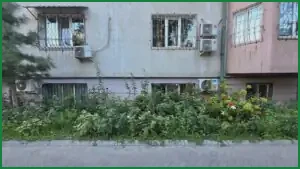
In the absence of robust government regulations and funding, the responsibility of adapting to the rapid onset of climate change in Central Asia has increasingly fallen on individual gardeners and local cooperatives. In Bishkek, the capital of Kyrgyzstan, residential condominiums frequently deplete scarce potable water supplies to sustain non-native plant species, such as roses, which require heavy irrigation. A city-wide abundance of rose gardens contribute to an inefficient use of land, as roses remain one of the most water-demanding options available. (Photograph by Walt Ohnesorge) This practice highlights a broader challenge across the region: whether a coordinated network of miniature "sponge cities" can be established at the grassroots level to mitigate the severe environmental shifts threatening Central Asia. While aesthetic preferences and institutional barriers continue to hinder urban climate adaptation, localized individual actions and community efforts are emerging as vital pathways for change.
The environmental stakes for Kyrgyzstan and the wider Central Asian region are exceptionally high, particularly regarding groundwater reserves. Regional temperature increases are driving Central Asia's glaciers to melt at a rate four times faster than the global average—significantly outstripping previous scientific projections. Because these glaciers feed the region's rivers and streams throughout the year, their rapid depletion presents a grim future. Experts warn of a scenario where rivers run completely dry, forcing entire cities to rely solely on rainwater harvested during a few brief months of the year. In such a future, the capacity to retain water where it falls will determine whether these urban centers can survive or will cease to exist. The growing frequency of severe storms, floods, prolonged droughts, lethal heatwaves, and climate-induced mass migration is placing immense pressure on regional policymakers to modernize failing infrastructure.
To address these challenges, urban planners are looking to the concept of "sponge cities," a term coined in 2003 during a public lecture by architect Kongjian Yu. The concept outlines a comprehensive set of urban planning principles designed to absorb, store, and manage water in flood-prone regions of China. Since its introduction, the Chinese Communist Party has integrated the sponge city framework into national public policy, mandating climate-resilient urban development. In contrast, Bishkek has experienced a massive loss of green space since the Soviet era, driven by rapid, unregulated development that dwarfs efforts to preserve or retrofit existing urban areas. Adopting a state-funded regulatory approach to green spaces could not only build climate resilience in Kyrgyzstan but also generate jobs and, where fruit-bearing plants are used, reduce food insecurity and poverty. Bishkek’s own Green Cities Action Plan acknowledges these needs, yet implementation remains limited.
Research into community-led gardening initiatives in Kyrgyzstan reveals a stark lack of grassroots sustainable agriculture collectives within Bishkek, especially when compared to cities like New York, which host numerous community-driven projects. Identifying the systemic challenges in Bishkek is far easier than finding active solutions. Consequently, environmental advocates are examining what it would look like if individual residents took the initiative to implement localized water preservation systems. Currently, some residents improvise with homemade drip irrigation systems to maintain small plots near condominium buildings during the dry summer months, but wider adoption is blocked by a lack of awareness.
Interviews with local residents reveal that aesthetic desires often override ecological concerns. Asel, a local dacha owner, admitted that climate change never crossed her mind when planning her garden; she simply planted species recommended by her landscape designer, who prioritized visual beauty over water management. Similarly, Bakyt, a groundskeeper at a Bishkek condominium, explained that his team routinely plants roses and uses municipal drinking water to keep them alive. However, there is a latent appetite for change. Zarina, another dacha owner, noted that she had never seen a list of recommended plants suited to the local climate but expressed strong interest in utilizing one. This suggests that a coordinated educational campaign could easily motivate individuals to adopt more sustainable gardening habits.
Walt Ohnesorge, an artist and designer, observed that many condominium buildings in Bishkek could easily adapt by attaching rainwater catchment systems to their gutters. By pairing these systems with perennial, food-bearing plants, residents could conserve drinking water, lower their grocery bills, and establish a far more efficient water-use cycle. Nuraiym Syrgak, a Kyrgyzstani social researcher, ecologist, and former executive director of the El-Too Public Foundation, agreed that actions at all levels can help the land adapt. Syrgak, who also serves as a board member of the Green Alliance of Kyrgyzstan, pointed out that current water allocation patterns in rural villages exacerbate the problem. Irrigation water is primarily directed to large agricultural plots, leaving residential gardens and village green zones with very little water. To address this, her initiatives have focused on turning these neglected small plots into centers of ecological attention.
Syrgak emphasized that women have proven to be the most effective agents of change in these agricultural projects. While men often display skepticism toward new ecological methods initially, women are highly receptive to trying new techniques. By working closely with women first, El-Too was able to gradually bring men on board, creating a highly successful, family-based approach to sustainable agriculture. This philosophy of cooperation also extends to urban parks, which Syrgak believes can be transformed into miniature sponges. She criticized the common practice of planting non-native decorative trees in public parks, noting that while they are beautiful, they provide little shade, are poorly adapted to the local climate, and require intensive maintenance. In contrast, permaculture advocates for cooperating with nature to minimize human labor.
While there is currently no official government list of priority species to combat climate change, Syrgak suggests that centering native species is the most logical starting point. “If you look at our deserts or abandoned zones, there are always these elms, which is a local type of tree and does not require watering,” Syrgak pointed out. “Then there are a lot of species like local shrubs, which could be useful for changes. We often discussed [these plants] with biologists.” This year, members of El-Too attempted to intervene with construction companies building guesthouses in the scenic Issyk-kul region. Syrgak explained that developers typically clear all native vegetation from construction sites, which is highly dangerous. Native shrubs have deep root systems extending up to 10 meters that hold the soil in place. Removing them destroys the natural environment, causing the soil to crumble and dramatically increasing the risk of devastating mudflows and floods across the region.
Syrgak advises that developers and gardeners must analyze their specific land conditions before planting. Sun-loving plants should be positioned on the sunny side of properties, while moisture-demanding plants should be placed in shaded areas. “We have plenty of examples – even, I think, these construction companies, wherever you go, they plant very pretty arborvitae, spruces; some of these decorative plants,” Syrgak noted. “Well, if maintenance isn’t good, they die off after a year. I think it would be better for construction companies to introduce some deciduous trees so they can provide shade.”
In the absence of centralized government guidelines, a collaborative network of individuals, urban planners, designers, and local authorities could implement highly effective climate-resilient initiatives. These efforts could include targeted planting of native species, community tool-sharing programs, grant funding for water cisterns and catchment systems, and widespread educational campaigns. Local municipalities could also facilitate remediation by allocating free, otherwise unusable public lands to willing local gardeners. The Central Asia Climate Campaign 2026, which supports these educational efforts, is currently being implemented by the MediaNet International Centre for Journalism and n-ost, with funding from the Federal Ministry for Economic Cooperation and Development of Germany as part of the "Communicating Climate in Central Asia" project.
Related Articles

Meet Md. Rubel Rana
As a core contributor to Worlddincidents.com, Rubel Rana brings a unique perspective to the world of journalism. Whether it’s deep-diving into historical trivia or covering the latest global headlines, Rubel Rana is committed to delivering high-quality, high-impact articles. Their writing blends meticulous research with a compelling voice, helping readers stay informed and curious about the world around them.